Thank you for taking time to read my book review of Sunlit Arches: How William Manly King Shaped South Florida. This book is written by Janet Naughton and published by Palmango Press.
I was provided a complimentary copy of this book. I have also received a very generous line in the book’s acknowledgements. These fact nots have impacted my impressions of the book or the review below.
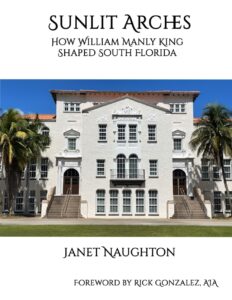
Naughton, Janet. Sunlit Arches: How William Manly King Shaped South Florida. West Palm Beach: Palmango Press. 2025. ISBN 9798999109033. B/W illustrations, index, selected bibliography. 225 pages, 185 pages of text. $24.99.
From the opening paragraph of the introduction, readers know they hold in their hands an important work. Author Janet Naughton, a faculty librarian, professor, and award winning author, hits us with a needed dose of reality from the start. Living in Florida I am well too aware of what she describes, but the slap in the face is a reminder call to what is going on throughout the state.
When a building is lost, a story disappears with it. Architecture doesn’t just provide shelter; it tells the story of a place It reflects values, ambitions, and circumstances of the people who built and used it. In Florida, where rapid growth often demands demolition,, those voices can vanish before they’re heard. (page 1)
It is important to understand that this book is not a biography of William Manly King in the traditional sense. As the author states,
This book is not a comprehensive biography or a technical architectural survey. It is a blend of history, memory, and research, an attempt to place King’s building in context and to tell the stories of the communities they shaped…focus on select examples of his designs, from landmark institutions to neighborhood fixtures, revealing what they meant in their time and what they still mean today. (page 2)
William Manly King was born in Mississippi in 1886 to parents William, Sr. and Katherine. William, Sr. worked in the construction industry and was active in the King family’s small community. The family soon moved to Alabama where his father’s traits no doubt left an impression on the young William, Jr. The boy had a rigorous education and ultimately pursued training at the Georgia School of Technology (now Georgia Tech).
The young architect began his career as a draftsman in Birmingham, Alabama. Here he produced the technical drawings needed for building ideas to become reality. This early work, done for several firms, allowed King to gain the experience needed in order to start his own partnership, King & Davis, in 1910. In 1919 he passed the Alabama exam to become a licensed architect and his career never looked back.
King’s wife had family living in the West Palm Beach, FL area, and with King’s success, he and his family were able to visit the growing area regularly. In 1922, they made the big move to Florida, allowing the young architect to participate in the growing Florida land and construction boom. His skill quickly became in demand.
As the author states, this work is not a comprehensive biography of the architect so we do not learn a tremendous amount regarding the new family interactions and what exactly led the King family to Florida. Here however we do learn about King’s commissions and the sweeping growth that was taking place in the pre-Great Depression days of south Florida. King became known for his Mediterranean Revival style that was often evident in the grand hotels and resorts he was was often designing.
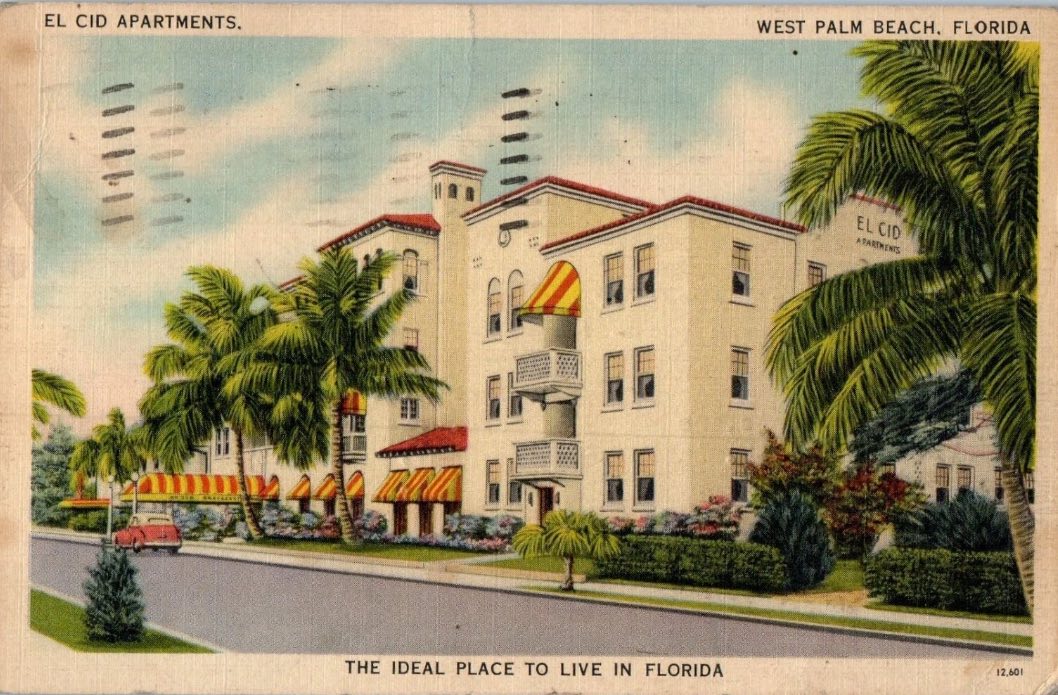 The large influx of new residents to Florida required housing and King was there to assist, with many apartment complexes and single family homes to his credit. While some of these majestic buildings, such as the El Cid, have been remodeled or repurposed and stand today, others, such as the Hibiscus Apartments, have fallen to the wrecking ball, often in the name of progress.
William Manly King and his firms were given many contracts for the design of public schools. Unfortunately, many of these facilities outlived their usefulness and now either sit vacant or have been demolished, while we are fortunate and some have been repurposed, allowing us to study the design work of the architect.
The Florida land bust, the Okeechobee Hurricane of 1928, and the Great Depression caused havoc for architects like William Manly King. The election of Franklin Delano Roosevelt and the instituting of the various alphabet projects during the New Deal brought south Florida back to life. These projects provided local governments with money which allowed infrastructure projects and smaller community building efforts to gain traction, helping put people to work and restarting local economies. Already known as a reputable architect, King was primed for opportunities such as a local National Guard Armory, the Florida State Prison Farm, in Belle Glade, and others. It was during this period when King’s style most evolved, focusing on the Art Moderne style that was most popular.
Find the best flights at the best prices using Aviasales on Travelpayouts. Enter your preferred departure and arrival airports, your preferred flight dates, and the number of passengers. The search engine will do the rest for you. All you have to do is book the flight.
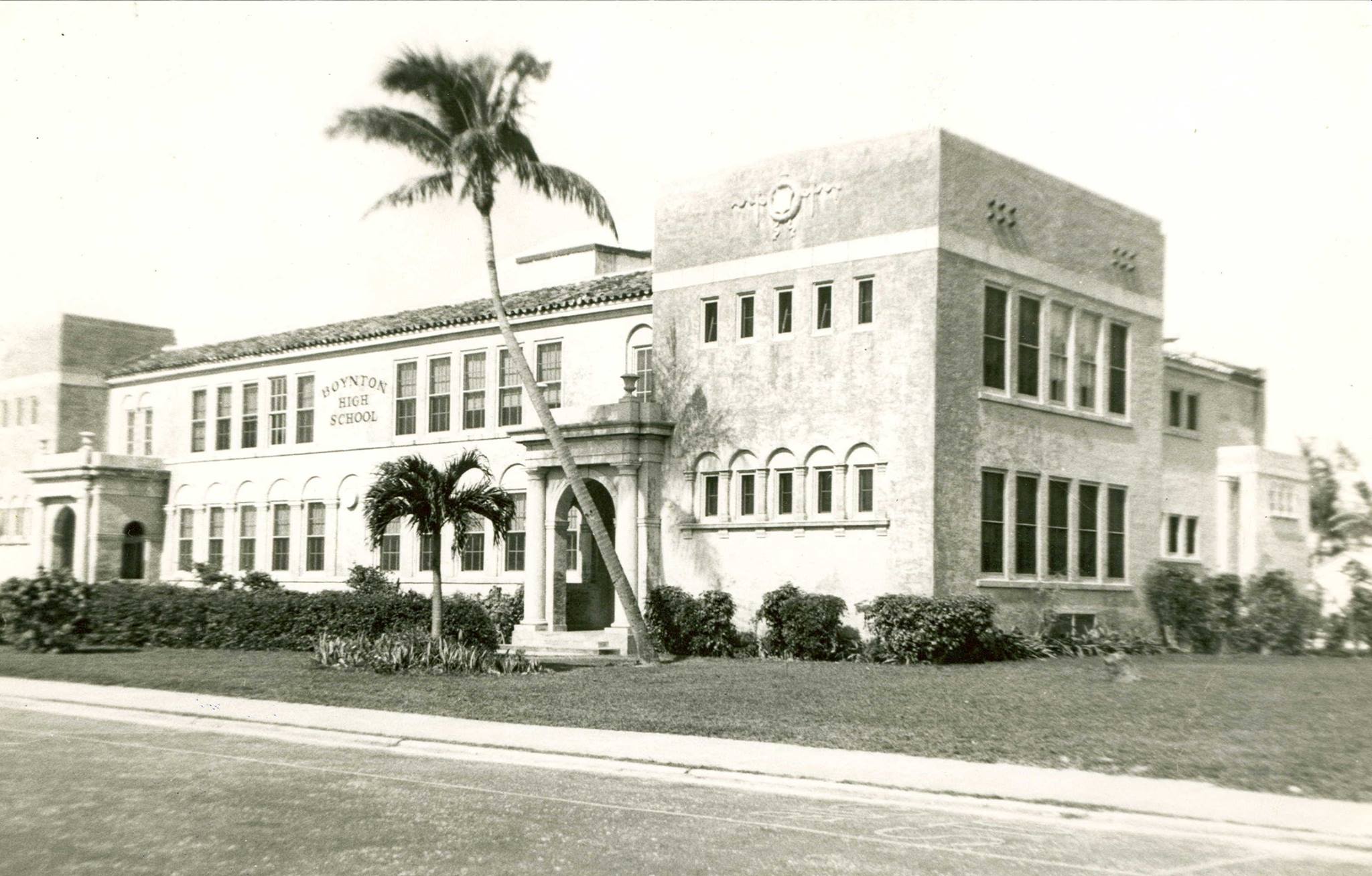
King spent much of his energies focused on community based projects such as schools, hospitals, and even college dormitories. His father’s influence shined through as he spent several years on his local planning and zoning commission. He was active in the Kiwanis organization. In the pre-integration days, King was known to work with African American groups to make sure they had access to educational and religious facilities.
As Ms. Naughton reminds us, much of King’s work as been lost to time. Either demolished or going unrecognized today. There is no master listing of his works. It is believed there are buildings still standing that are of from his hand waiting to be identified.
While comparatively little is known about the man, William Manly King, the work he has left, and the work given us by Janet Naughton, remind us of the value historic architecture plays in understanding our past and the developments of local communities. The final resting spot of King and many of his family remain purposely unmarked. We, however, have the buildings he designed that still stand as his legacy.
Author Janet Naughton is a faculty librarian, history professor, and author who concentrates on the Palm Beach county area. She has written numerous books and articles on Florida history. Despite her academic credentials, this book is not academic, and rather, is accessible to all readers. The text is brought to life through many b/w illustrations including postcards, photos, and memorabilia. The book includes an index and bibliography. A listing of known King properties is included. Many are private and not open to the public. An additional incomplete list of King designs is included. For me, an interesting appendix is the list of additional architects working locally while King was active. There are no notes included, which for me would have proven useful, but does not detract from the book.
For readers on Facebook, I recommend that you join the group Architect William Manly King, Jr. Fans. Photos in this post are courtesy of this group.
Architectural history is important to the study and knowledge of local history. A book like this is tremendously important for what it provides us. While not a biography of William Manly King, that is not the priority. Is a biography of King needed? Absolutely. Is there a possibility there just isn’t enough material to write such? Absolutely. Rather, we have an excellent volume highlighting the importance of the architecture from a key period in Florida history focused on a particular, lesser known until now, architect. This book should find a home on the shelves of everyone interested in historic preservation, architecture, and Florida history. Highly recommended.