Thank you for your interest in my book review of Florida’s New Deal Parks and Post Office Murals.
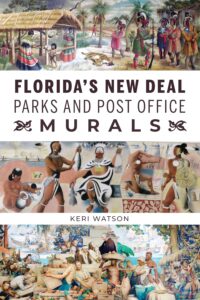 Watson, Keri. Florida’s New Deal Parks and Post Office Murals. Charleston: History Press/Arcadia Publishing. 2024. 123 pages, 114 pages of text. B/W images, color images, bibliography. ISBN 9781467156967, $24.99.
You may order a copy of this book from Amazon using the link above or by clicking the image. You may also order direct from the publisher by using THIS LINK. If you order from the publisher, use my discount code REDD24 and receive 15% off your entire order. Get free economy shipping on all orders of $50 or more.
FULL DISCLOSURE–Arcadia Publishing has published several of my books. I purchased the book and it was not provided in exchange for a review.
I grew up in a small Florida community, well, it’s not quite so small any longer with all the northern migration south. All those years ago, there was a small post office located on one of the two major roads going through town. On the wall were several large paintings. Even as a child, my eye was drawn to the size, color, and subject, particularly while waiting for my mother to finish her business.
It turns out these artworks were not part of the Franklin D. Roosevelt New Deal “alphabet” programs, but there were certainly some similarities and no doubt, the thought behind these local murals came from the work originally commissioned through the Treasury Section of Painting and Sculpture, often referred to simply as The Section. Today, that small post office has been closed to the public, but the murals were moved to a new home in a courthouse building, which is now home to County offices. The murals are readily accessible for anyone wanting to see them.
Keri Watson, professor of art history at the University of Central Florida, has written a concise look at how various New Deal programs impacted the state of Florida through the creation of state parks, post offices, and art created for these post offices.
Dr. Watson earned her M.A. and Ph.D. in Art History at Florida State University. She holds an undergraduate degree from the University of West Florida.
Dr. Watson’s work has been recognized and supported by a Fulbright Fellowship and grants from the National Endowment for the Arts, among others.
While her book focuses on the period of 1931 through 1946, Watson reminds readers that hard economic times hit Florida well ahead of the stock market crash of October 1929. The state had endured two major hurricanes, an embargo on citrus exports, and a collapsing real estate market. Florida was in desperate need of federal assistance and Franklin Delano Roosevelt, and his New Deal, delivered.
This book concentrates on the efforts of the Civilian Conservation Corps, Public Works Administration, Civil Works Administration, Works Progress Administration, and the prior mentioned Treasury Section. These programs helped create parks, buildings, and art, that are still vital to our state almost 100 years later. At the time, these programs created jobs, and held provide a social safety net as the country rebounded.
New Deal programs employed nearly 50,000 workers in Florida. Workers created ten state parks. Programs helped build sixteen post offices. Artists contributed works showcasing daily life, history, industry, and landscapes.
State Parks, including Ravine Gardens, Fort Clinch, Myakka River, and others built through the New Deal are still economic drivers for their communities. These parks were created through the labor and sweat of CCC workers, who took advantage of the natural beauty of areas, but at times, also worked the land to create even better vistas. Cabins, buildings, trails, and more were built, leaving the state with a tourism foundation that is strong today.
Post offices and the art to adorn them were built throughout the state. A goal was improved mail service and to provide communities needed and modern infrastructure. While some of these facilities have been repurposed during the ensuing century, many are still in service today.
Art that adorned post offices was created through an invitational process with selected artists collaborating with local authorities to fine tune submissions before being granted approval. These artworks include “murals” and relief sculptures. It is not technically accurate to call these paintings murals. Murals are painted directly on a wall. These works were usually large oil paintings that were attached to the wall, often over the postmaster’s office door. This provided several advantages. The art is portable and can be moved as needed. It also eliminated the artist needing to work onsite, possibly for long periods of time. There would be no scaffolding and drop clothes throughout the beautiful new buildings. Not all artists were local, or even Florida residents, so this method also reduced travel expenses.
These artists and their works were a part of their time and as such, some have caused controversy in more modern times. Postal employees covered sixteen works with black plastic sheeting in 2020. Most of these depict antebellum scenes with some directly depicting slavery. Officials covered the Madison, FL post office mural. George Snow Hill is the artist, the work titled Long Staple Cotton, and dates to 1940. Watson provides several pages of useful analysis of this national controversy.
Three geographic areas are featured; North, Central, and South Florida. Each park or post office has its own small chapter. Most chapters are less than five pages in length. The book is quite short, with only 114 pages of text, including many b/w photos. There is a section of color photos on unnumbered pages. The images, while small due to the constraints of the book, are an incredible resource.
Dr. Watson has written a book accessible to all readers. Despite being a university professor, Watson and the publisher avoid academic trappings. There are no foot or end notes, which I would have found helpful. There is a strong bibliography consisting of books, magazines, and journal articles. Many of these sources will be readily available for download, purchase, or library check out/inter-library loan. Librarians will be able to assist with more difficult titles.
Recommended as a good starting point for the subject. Use the bibliography to find other sources. This book can also be used as an excellent travel guide.