Posted on Leave a comment

Ormond Indian Burial Mound Historic Marker
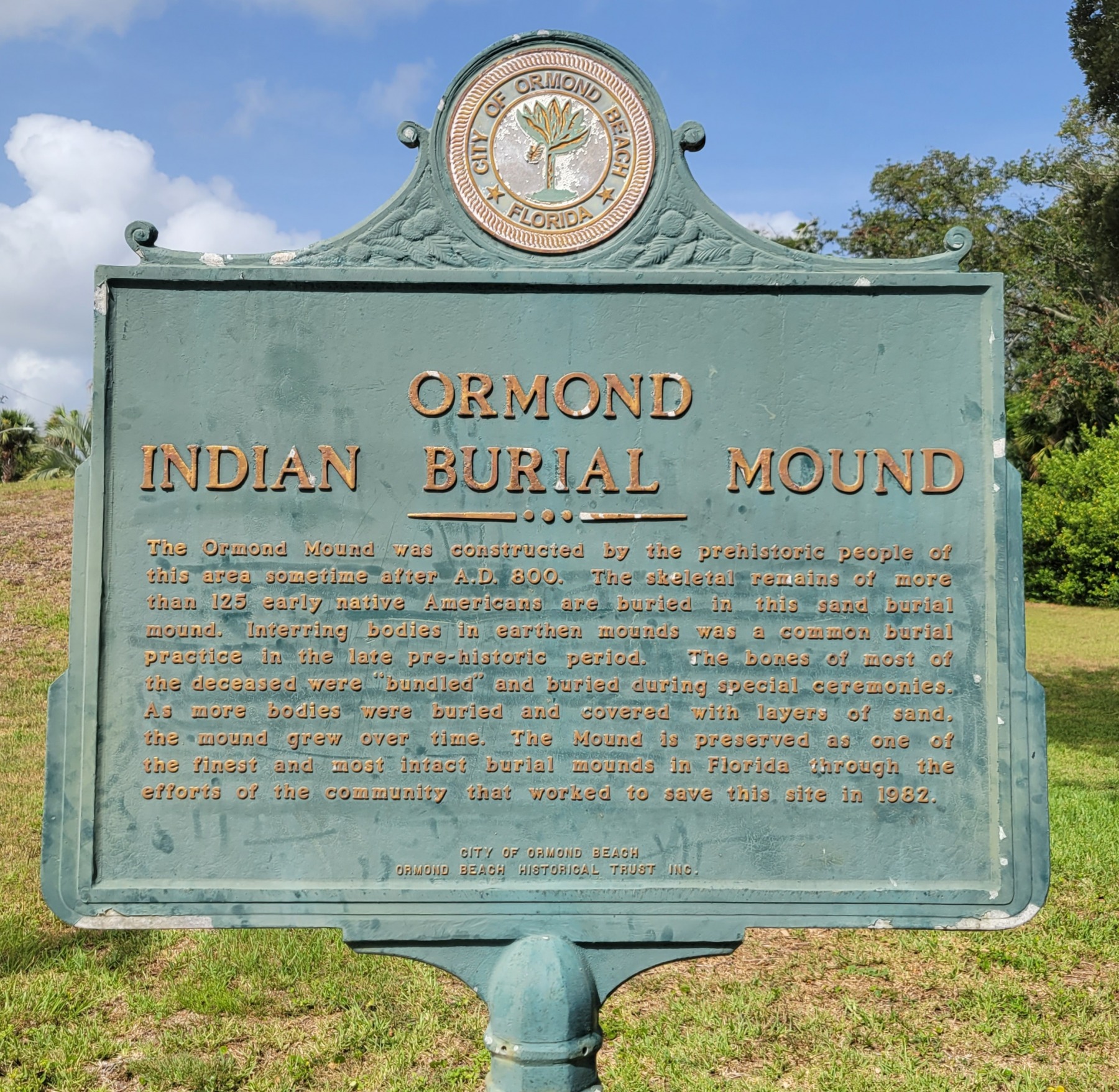
Historic Marker placed by City of Ormond Beach

Ormond Indian Burial Mound

In May 1982, when Dixon H. Reeves, and his wife Harriett, paid contractors to break ground on a house site at the corner of south Beach Street and Mound Avenue in Ormond Beach, they did not fully comprehend the damage they were going to do to an irreplaceable cultural artifact. In fact, once the city manager issued a stop work order, the Reeves sued the city for damages. The property ownership reverted to Mr. and Mrs. Melvin Barron, who the Reeves purchased the property from, and the Reeves eventually received a $4,000 settlement from the city.
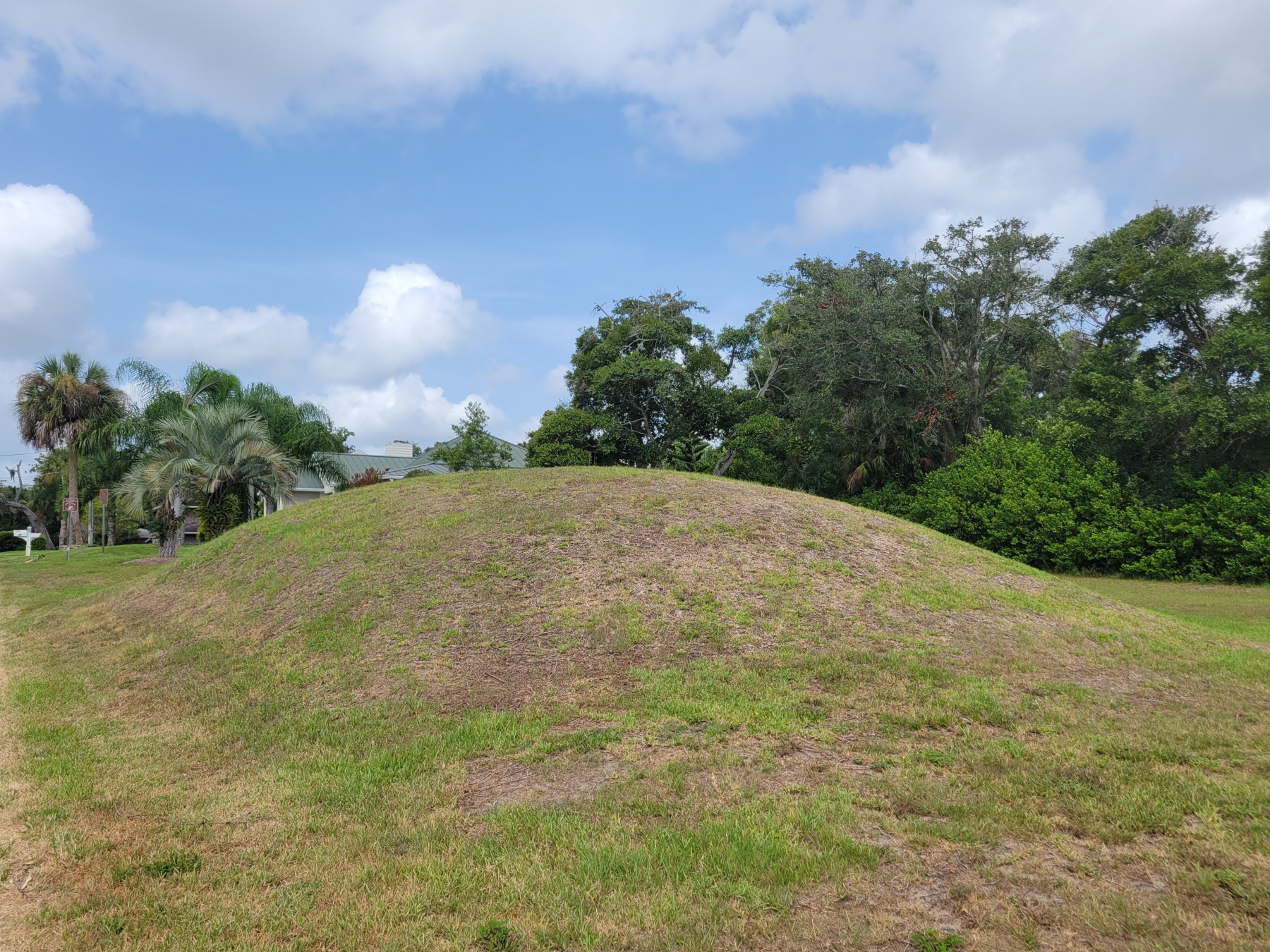
Ormond Indian Burial Mound

Where the Reeves wish to build their home was the site of a Timucuan Burial Mound. Timucuan society did not bury the dead. Instead the Timucuans placed bodies on top of the ground and piled dirt on top. In some instances, the flesh was allowed to decay, and the bones were bundled and placed at the mound site. Items owned by the deceased were broken and included in the interment.

Despite the mound having received considerable damage through the years, including digging by “pot hunters” and construction of adjacent roadways, archaeologists believe as many as 125 Timucuans had been buried on the site. For anybody caught digging on this, or similar sites, you will more likely than not be charged with a third-degree felony. See this link for additional information.

With a lack of consensus among city leaders, a fund was started to help purchase and preserve this sacred site. The Barron’s agreed to sell the property to the city for $55,000. Despite confirmation on the importance of the site from professional anthropologists and archaeologists, it took an anonymous donation of $30,000, along with the fundraising drive, to help secure the sale as shortsighted elected city officials balked at the price and potential ongoing costs.

Today, the City of Ormond Beach owns this site and is a park in a residential area. Visitors can see the mound from all sides, surrounded by roads and houses. Parking is available across the street at Ames Park so please do not park on park lands or in the yards or drives of nearby property owners. Please do not climb on the mound as it is a fragile archaeological site.


Nomatic - Life on the Move - Shop Now

Sign Text


Historic Marker placed by City of Ormond BeachOrmond Indian Burial Mound
Ormond Indian Burial Mound Historic Marker placed by the City of Ormond Beach and the Ormond Beach Historical Trust

Prehistoric people of this area constructed the Ormond Burial Mound sometime after A.D. 800. The skeletal remains of more than 125 early native (sic) Americans are buried in this sand burial mound. Interring bodies in earthen mounds was a common burial practice in the late pre-historic period. The bones of most of the deceased were “bundled” and buried during special ceremonies. As more bodies were buried and covered with layers of sand, the mound grew over time. The Mound is preserved as one of the finest and most intact burial mounds in Florida through the efforts of the community that worked to save this site in 1982.

City of Ormond Beach

Ormond Beach Historical Trust


The City of Ormond Beach placed this marker and is not a part of the Florida Department of State marker program.



The Timucua link to Amazon Ormond Indian Burial MoundIf you wish to learn more about Timucuan culture there is an excellent book I can recommend.

Perhaps the definitive book on the subject is written by Dr. Jerald Milanich, The Timucua.  

This is the story of the Timucua, an American Indian people who thrived for centuries in the southeast portion of what is now the United States of America.

Timucua groups lived in Northern Florida and Southern Georgia, a region occupied by native people for thirteen millennia. They were among the first of the American Indians to come in contact with Europeans, when the Spaniard Juan Ponce de Leon landed on the Florida coast in 1513. Thousands of archaeological sites, village middens and sand and shell mounds still dot the landscape, offering mute testimony to the former presence of the Timucua and their ancestors.

Two hundred and fifty years after Ponce de Leon’s voyage the Timucua had disappeared, extinguished by the ravages of colonialism. Who were the Timucua? Where did they come from? How did they live? What caused their extinction? These are questions this book attempts to answer, using information gathered from archaeological excavations and from the interpretation of historical documents left behind by the European powers, mainly Spain and France, who sought to colonize Florida and to place the Timucua under their sway.

I also recommend taking a look at this page from the National Park Service. 
 

MagazineValues.com


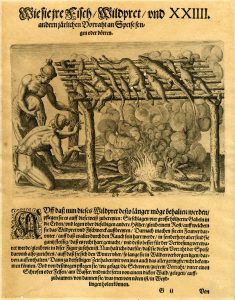
Timucua Mode of Drying Fish, Wild Animals, and other Provisions Courtesy Florida Memory
Bry, Theodor de, 1528-1598. XXIV. Mode of Drying Fish, Wild Animals, and other Provisions. 1591. State Archives of Florida, Florida Memory. Accessed 22 October 2022.

The State Library and Archives of Florida (Florida Memory), has an excellent page of Theodor de Bry’s Engravings of the Timucua. These incredible works of art date from before the year 1600. The 42 pieces are all available for viewing and low resolution copies are available for download. A sample de Bry image is seen at the left.

 Sources:

Daytona Beach News Journal

Florida Master Site File VO00240

Ormond Beach Historical Trust, Inc. “The Story of the Timucua Indian Burial Mound in Ormond Beach, Florida.” Pamphlet published April 2000.

Buy Me A Coffee donation link
Click the image to support this site through Buy Me A Coffee. Your support pays for web services, research trips, photocopies, and photo usage fees.


This post may contain affiliate links. If you click these links and make a purchase, I may receive a small commission. This commission does not affect any price that you pay. Affiliate programs or sponsors providing products do not influence the views and opinions shared on this website. 


nbsp;


Posted on Leave a comment

Civil War Monument and Memorial Resources

Confederate Monument Monticello, FL

Memory can be a funny thing. It changes over time. People change, times change, interpretations change, what we consider important changes. With this listing, you will be able to find Civil War Monument and Memorial Resources to help you better understand the who, where, and why of these often times controversial reminders. 

Nowhere is this more evident than in the field of Civil War memory and monuments. In the years immediately after the war, monuments and memorials were constructed for several different reasons. In some instances, it was to remember and honor those who served and maybe did not return from battle. In the south, these monuments were often meant to recall what those of the time considered a better time. Words carved into granite were chosen with great care as to meaning.

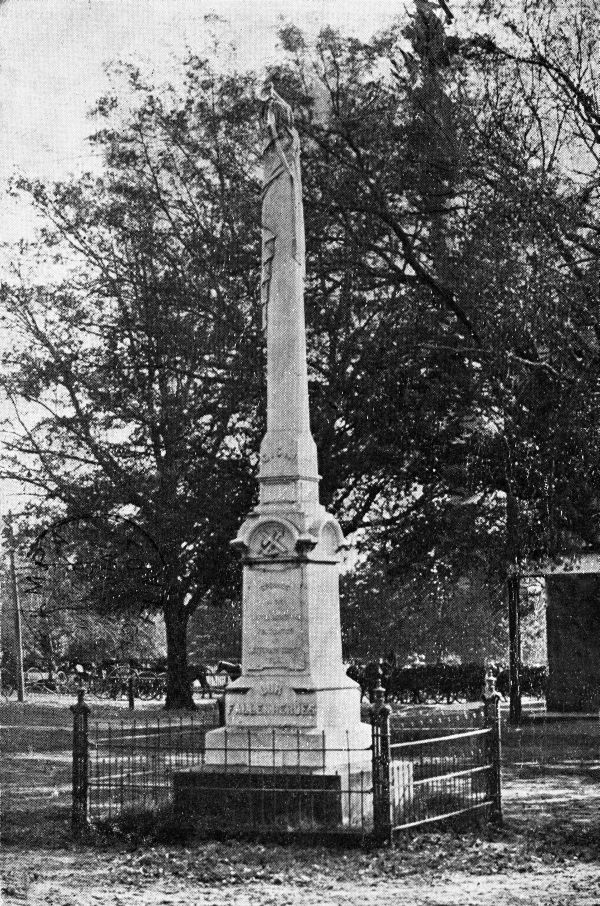
Confederate Monument Monticello, FLCivil War Monument and Memorial Resources
Confederate Monument in Monticello, FL erected by the Ladies Memorial Association of Jefferson County. Image courtesy State Archives of Florida.

Ladies Memorial Associations and similar groups were often at the head of constructing these memorials; raising funds and dealing with stonemasons to make sure these reminders of the past were exactly what they wanted. Most scholars consider these memorials a key component of Lost Cause mythology.

In the years after the passing of Civil War veterans and their direct descendants, memorial creation has passed to new generations. These newer monuments often have a different, and many times politically charged rhetoric. As memorials, particularly those honoring the Confederate cause, are removed from publicly owned lands; new monuments are usually placed on privately held lands. Historians have often questioned the need or motives for placing new memorials.

The fate of memorials removed from public lands is a thorny one that does not have a clear and easy answer. Many people are against removal of any type of monument, often claiming it is erasing history. On the other side are those who would not just remove what they deem offensive memorials, but they would destroy them, often in a public scene in order to gain attention to their cause.

An often-cited answer is to put them in a museum. It is not as easy as that. Museums have collection policies and goals that Boards of Directors must abide by. Housing a large Civil War monument in usually not in those goals. Space is often a concern. How many museums have room to house a twenty-five foot tall memorial? Are museum facilities structurally able to hold the weight of what might be a several ton piece of granite or a large bronze piece? Finally, who will pay for the moving and exhibit upkeep? Even if a museum can address these concerns, community input is important. Do museum patrons feel owning a Civil War monument is in the best interest of the organization? Finally, again we come  to the thorny question, who and how would these pieces be interpreted. 

A final concern with any type of public memorial is interpretation and context. Interpretation and context are areas that some of the public do not appreciate. They feel they should be left as is with no attempt to explain what a viewer is witnessing. Also, should monuments to the Confederate cause be placed at government buildings no matter the interpretation.

Some memorials are blatantly obvious what they are trying to achieve. Others are more nuanced with carefully chosen language and symbolism. While maybe not obvious to everyone today, to contemporaries, these monuments were understood in their day. 


As stated above, interpretations change. No matter where a monument may be located, it is important today that some level of interpretive work be included to let visitors know the who, what, and why of a monument or memorial. It is then up to the viewer to make a determination what they think. This might be memorials to lost soldiers and family members. Memorial builders could be lamenting having lost a prior way of life. Some monuments meant to hurt and intimidate others. Many are a reminder of a way of life we should not allow to be forgotten. Can these become a teaching tool or are they strictly now a work of art like any other sculpture? 

African American Civil War MemorialCivil War Monument and Memorial Resources
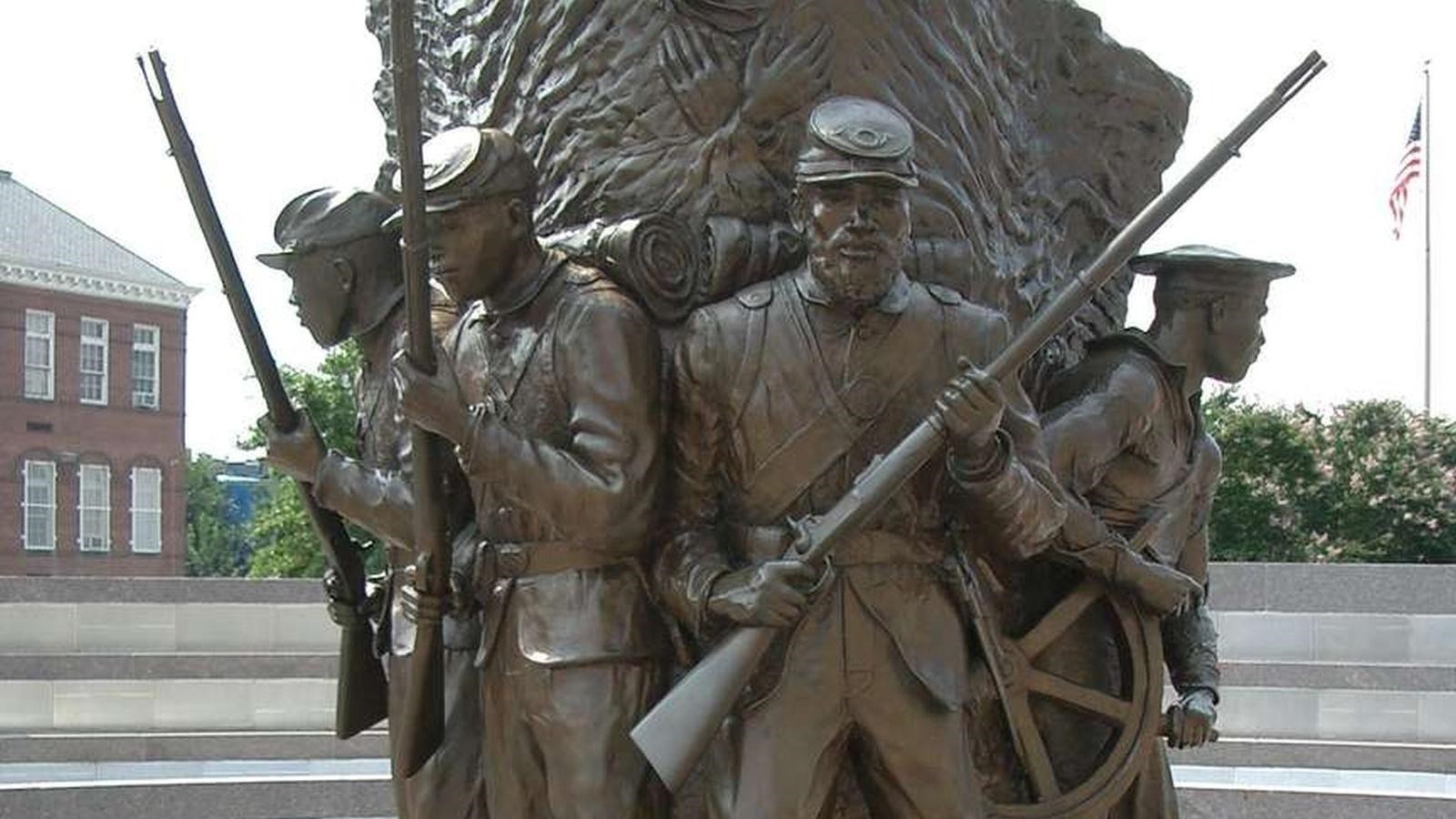
The African American Civil War Memorial located on the National Mall in Washington D.C. Photo courtesy National Park Service

Today, there is increasingly an effort to memorialize those who have been forgotten in the past. This includes memorials to women, those on the home front, and the telling of stories of slavery and African American soldiers.  No longer are cities, states, and organizations scared of telling the true horrors of war and what it was like for those outside the sphere of battle. While this movement has not proven universally popular, it is one that will continue, particularly as further scholarship develops these previously unknown stories.

What I have gathered below is a listing of materials related to Civil War monuments, memorials, and memory. These works are often from academic presses and may have a scholarly bent. Some of these titles tackle head on the controversy of Civil War memorials while others are concerned with cataloging memorials by state or battlefield.

While I do own quite a few of these titles, I have not reviewed all of them. If I have included them I feel they are appropriate to the subject and worthy of your consideration.

Please note, the intent of this bibliography is not to take sides or promote an ideology, but rather it is to provide you, the reader, with resources allowing you to better understand the topic. Titles that appear to be intentionally inflammatory are excluded. 

I have not yet mined academic journals and other periodicals regarding the subject, but I hope to do so in the not too distant future. A new section will be created in this post for these materials.

Please feel free to reach out to me or leave a comment regarding books I have not listed. Materials dealing with Civil War memorials, groups who erected these memorials, artists and those who created monuments, and related topics are encouraged.  If you have read any of these titles, please feel free to leave a comment about the book. An open and respectful dialogue is encouraged.

I will periodically be updating this list based upon reader input and especially as publishers release new titles.

To keep up with all things Civil War including modern interpretation, I strongly recommend a subscription to Civil War Monitor. With writing by top notch scholars you will look forward to receiving each issue.


bookshop.org affiliate button
Support small businesses. Click this link to purchase from bookshop.org and help support my blogging efforts. Your support is truly appreciated.


BOOKS

Allison, David B. Controversial Monuments and Memorials: A Guide for Community Leaders. Lanham: Rowman and Littlefield, 2018.

Andres, Matthew Cenon. Stone Soldiers: Photographing the Civil War Monuments in Illinois. Self Published. 2019.

Brown, Thomas J. Civil War Monuments and the Militarization of America. Chapel Hill: University of North Carolina Press, 2019.

Brown, Thomas J. The Public Art of Civil War Commemoration: A Brief History with Documents. New York: Macmillan Publishers, 2004.

Butler, Douglas J. North Carolina Civil War Monuments: An Illustrated History. Jefferson: McFarland & Co., 2013.

Chevalier, R.N. and Donna Chevalier. Rhode Island Civil War Monuments: A Pictorial Guide. Pawtucket: Stillwater River Publications, 2017.

Cox, Karen L. Dixie’s Daughters: The United Daughters of the Confederacy and the Preservation of Confederate Culture. Gainesville: University Press of Florida, 2019.

Cox, Karen L. No Common Ground: Confederate Monuments and the Ongoing Fight for Racial Justice. Chapel Hill: University of North Carolina Press, 2021.

Domby, Adam. The False Cause: Fraud, Fabrication, and White Supremacy in Confederate Memory. Charlottesville: University of Virginia Press, 2022.

Foster, Gaines M. Ghosts of the Confederacy: Defeat, the Lost Cause, and the Emergence of the New South, 1865-1913. New York: Oxford University Press, 1987. 

Gallagher, Gary W. and Alan T. Nolan. The Myth of the Lost Cause and Civil War History. Bloomington: University of Indiana Press, 2010.

Gill, James. Tearing Down the Lost Cause: The Removal of New Orleans’s Confederate Statues. Jackson: University Press of Mississippi, 2021.

Goldfield, David R. Still Fighting the Civil War: The American South and Southern History. Baton Rouge: Louisiana State University Press, 2002.

Hagler, Jr., Gould B. Georgia’s Confederate Monuments: In Honor of a Fallen Nation. Macon: Mercer University Press, 2014.

Hartley, Roger C. Monumental Harm: Reckoning with Jim Crow Era Confederate Monuments. Columbia: University of South Carolina Press, 2021.

Harvey, Eleanor Jones. The Civil War and American Art. New Haven: Yale University Press, 2012.

Huntington, Tom. Guide to Gettysburg Battlefield Monuments: Find Every Monument and Tablet in the Park. Mechanicsburg: Stackpole Books, 2013.

Ingall, David and Karin Risko. Michigan Civil War Landmarks. Charleston: Arcadia Publishing, 2015.

 Isbell, Timothy T. Gettysburg: Sentinels of Stone. Jackson: University of Mississippi Press, 2006.

Isbell, Timothy T. Shiloh and Corinth: Sentinels of Stone. Jackson: University of Mississippi Press, 2007.

Isbell, Timothy T. Vicksburg: Sentinels of Stone. Jackson: University of Mississippi Press, 2006.


Jacob, Kathryn Allamong and Edwin H. Remsberg. Testament to Union: Civil War Monuments in Washington D.C. Baltimore: Johns Hopkins University Press, 1998.

Janney, Caroline E. Burying the Dead but Not the Past: Ladies Memorial Associations and the Lost Cause. Chapel Hill: University of North Carolina Press, 2012.

Johnson, Kristina Dunn. No Holier Spot of Ground: Confederate Monument & Cemeteries of South Carolina. Charleston: Arcadia Publishing, 2009.

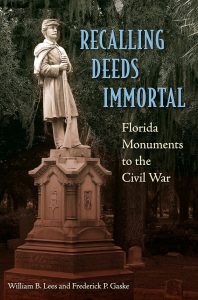
Lees, William B. and Frederick P. Gaske. Recalling Deeds Immortal: Florida Monuments to the Civil War. Gainesville: University Press of Florida, 2014.

McMichael, Kelly. Sacred Memories: The Civil War Monument Movement in Texas. Denton: Texas State Historical Association, 2009.

Mills, Charles. Civil War Graves of Northern Virginia. Charleston: Arcadia Publishing, 2017.

Mills, Cynthia and Pamela H. Simpson. Monuments to the Lost Cause: Women, Arts, and the Landscapes of Southern Memory. Knoxville: University of Tennessee Press, 2003.

Newsome, Ryan Andrew. Cut in Stone: Confederate Monuments and Theological Disruption. Waco: Baylor University Press, 2020.

Pelland, Dave. Civil War Monuments of Connecticut. Monument Publishing, 2013.

Reaves, Stacy W. A History & Guide to the Monuments of Chickamauga National Military Park. Charleston: Arcadia Publishing, 2013.

Reaves, Stacy W. A History & Guide to the Monuments of Shiloh National Park. Charleston: Arcadia Publishing, 2012.

Reaves, Stacy W. A History of Andersonville Prison Monuments. Charleston: Arcadia Publishing, 2015.


Savage, Kirk. The Civil War in Art and Memory. Washington D.C.: National Gallery of Art, 2016.

Savage, Kirk. Monument Wars: Washington D.C., the National Mall, and the Transformation of the Memorial Landscape. Berkeley:University of California Press, 2011.

Savage, Kirk. Standing Soldiers, Kneeling Slaves: Race, War, and Monument in Nineteenth-Century America. Princeton: Princeton University Press, 2018.

Sedore, Timothy S. An Illustrated Guide to Virginia’s Confederate Monuments. Carbondale: Southern Illinois University Press, 2018.

Sedore, Timothy S. Mississippi Civil War Monuments: An Illustrated Field Guide. Beverly: Quarry Books, Inc., 2020.

Sedore, Timothy S. Tennessee Civil War Monuments: An Illustrated Field Guide.Beverly: Quarry Books, 2020.

Seger, Marla and Joanna Davis-McElligatt. Reading Confederate Monuments.Jackson: University Press of Mississippi, 2022.

Seidule, Ty. Robert E. Lee and Me: A Southerner’s Reckoning with the Myth of the Lost Cause.New York: St. Martins Press, 2022.

Tracey, John and Chris Mackowski. Civil War Monuments and Memory: Favorite Stories and Fresh Perspectives from theHistorians at Emerging Civil War.El Dorado Hills, SavasBeatie, 2022.

Wiggins, David N. Georgia’s Confederate Monuments and Cemeteries. Charleston: Arcadia Publishing, 2006.


Thank you for taking time to review my listing of Civil War Monument and Memorial Resources. Do you know of other resources that should be included here? Please drop me a line so that I can update this list.


Buy Me A Coffee donation link
Click the image above to support this site through Buy Me A Coffee. Your helps pay for website fees and maintenance, research fees for blog and book writing, photo usage and rights fees, and other associated costs. And maybe, it will go to buying a bag of coffee to help keep me focused on the research topic at hand.


This post may contain affiliate links. If you click these links and make a purchase, I may receive a small commission. This commission does not affect any price that you pay. Affiliate programs or sponsors providing products do not impact the views and opinions shared in this blog. 

Recalling Deeds Immortal
Recalling Deeds Immortal is a book that should be in every personal library of Florida Civil War students.
Posted on Leave a comment

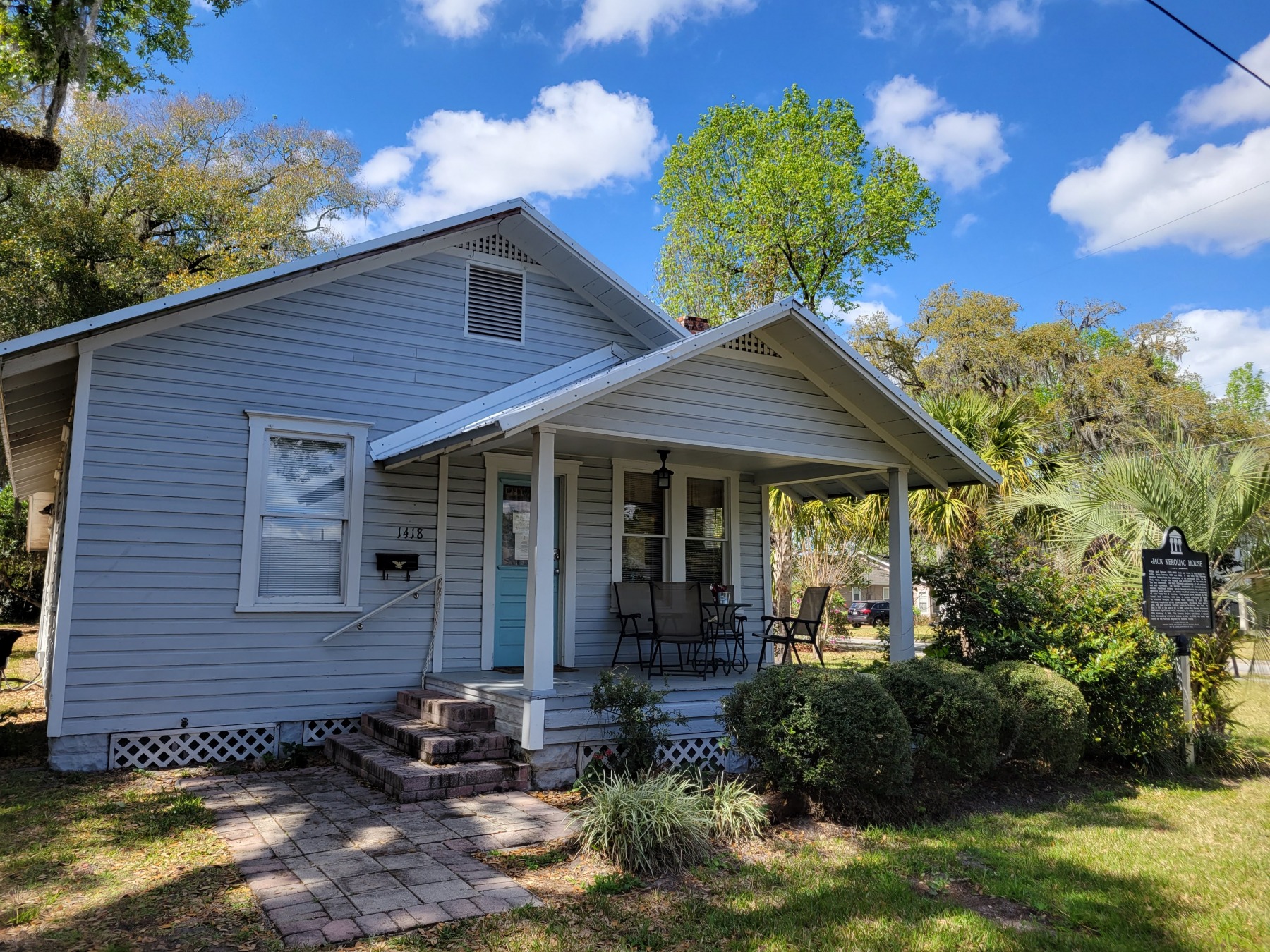
Jack Kerouac House in Orlando, Florida: A Must See if You are “On the Road”

Jack Kerouac House
1418 Clouser Avenue
Orlando, FL 32804

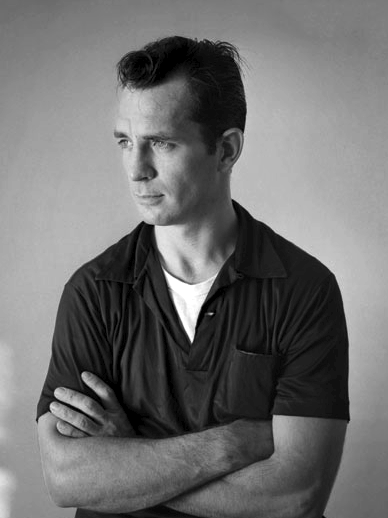
By Kerouac_by_Palumbo.jpg: Tom Palumbo from New York, NY, USA derivative work: Sir
Richardson at en.wikipedia – This file was derived from: Kerouac by Palumbo.jpg:, CC BY-SA
2.0, https://commons.wikimedia.org/w/index.php?curid=85963062

When most people think of the Beat Generation, certain visuals often come to mind.
Unemployed young adults, sitting around a coffee house in San Francisco, smoking away, rambling on self-importantly about books most of main stream America has never read seems to often fit the description. These descriptors are really about beatniks and not a literary movement. For those a bit more acquainted with the Beat Generation, certain names will come immediately to mind; Kerouac, Burroughs, Kesey, Ginsberg, and maybe even Ferlinghetti. Literature titles such as Howl, Naked Lunch, and On the Road  are probably the most famous. Despite the passage of nearly seventy years, these books and others of the movement are still in print and widely read today.

In July of 1957, only months before the groundbreaking On the Road would receive tremendous praise in the New York Times, the then 32-year-old Kerouac rented a small apartment for him and his mother. The home did not have air conditioning and the Florida heat was almost too much for Kerouac, who took to writing at night. Today, visitors to the city of Orlando have the opportunity to see the home where Jack Kerouac and his mother lived during 1957, the year that catapulted him to fame.

On the Road by Jack Kerouac                                                                The praise was not to be long, nor universal. The beatnik movement seemed to take over. Musician David Amram believes that the beatnik movement was a manufactured one, arguing Beat writers such as Kerouac were not the goateed, beret wearing, pretentious types. Rather, he described themselves as hicks, not wanting to draw attention to themselves. Author Bob Kealing, a noted Kerouac expert, has put forth that Kerouac himself claimed that those of the Beat Generation “were searching for spiritual truth and meaning beyond the confines of post-World War II life.” This search is what confounded and worried critics.
Meanwhile, in his small Orlando apartment, Kerouac continued typing away on his follow-up, to
be titled Dharma Bums. In a rapid fire twelve days of output, Kerouac finished the novel on
December 7, 1957, Pearl Harbor Day. Kealing reminds us that to Kerouac, the term “dharma”
meant truth.

Orlando Walking Ghost Tour – $54.67

Every year since its inception, the Orlando Ghost Tour has grown exponentially, with more and more people coming to enjoy their spooky stories and all-around demonic fun.


In April 1958, Jack and his mother packed into a station wagon owned by Robert Frank and
made off for Long Island, New York. Dharma Bums was published in October of that year.
Fame was not something Kerouac was ever comfortable with, nor does it seem that he sought it
out. Kerouac was to become too familiar with the bottom of a bottle, and on October 21, 1969, at
age 47, he died a painful death from cirrhosis of the liver. His remains were transported to
Lowell, Massachusetts, where he was buried at Edson Cemetery.

Jack Kerouac House, Orlando, FL

Listed today on the National Register of Historic Places, the future of the Orlando, Florida Kerouac House was not always assured. Once it was determined that this location was the residence of Kerouac during a critical time in the author’s life, efforts began in order to purchase and rehabilitate the house. Led by Kealing, former bookstore owners Marty and Jan Cummins, and others, they founded the not-for-profit Kerouac Project of Orlando. With the generous financial support of Jeffrey Cole and Cole National, they were able to purchase and rehabilitate the house. Today, the Project provides several writer in residence opportunities each year, allowing the visiting author to live and work in the home made famous by Jack Kerouac.

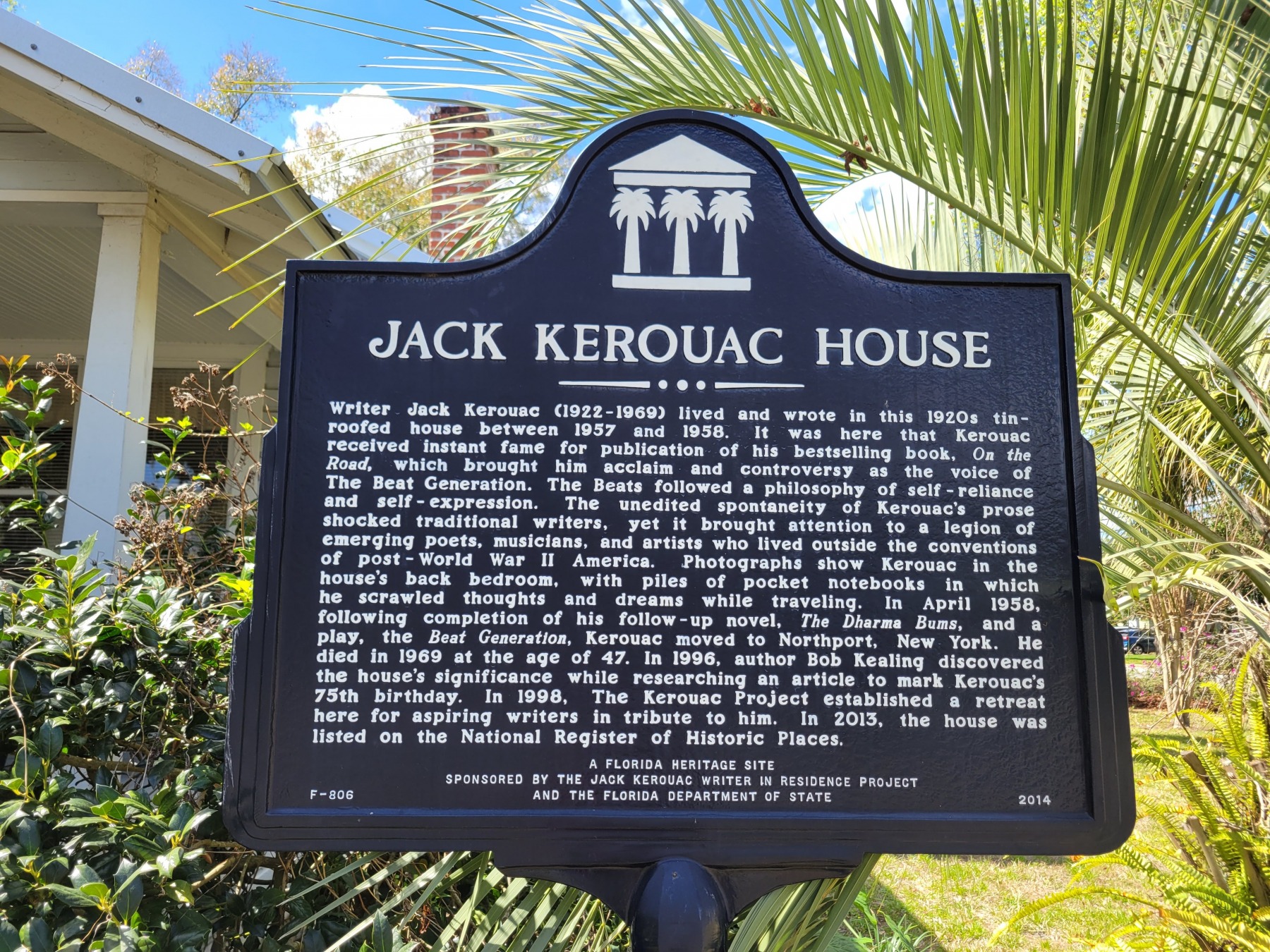
The home is not open to the public. Those wishing to see the house may drive by and briefly stop to take it in. There is not public parking available and this is a residential area so please be mindful of those who live in the area and if you are taking photos be on the watch for traffic. A state of Florida historical marker is on-site. The text reads

State of Florida Historic Marker–Jack Kerouac House Orlando, FL

Writer Jack Kerouac (1922-1969) lived and wrote in this 1920s tin-roofed house between 1957 and 1958. It was here that Kerouac received instant fame for publication of his bestselling book, On the Road, which brought him acclaim and controversy as the voice of The Beat Generation. The Beats followed a philosophy of self-reliance and self-expression. The unedited spontaneity of Kerouac’s prose shocked traditional writers, yet it brought attention to a legion of emerging poets, musicians, and artists who lived outside the conventions of post-World War II America. Photographs show Kerouac in the house’s back bedroom, with piles of pocket notebooks in which he scrawled thoughts and dreams while traveling. In April 1958, following completion of his follow-up novel, The Dharma Bums, and a play, the Beat Generation, Kerouac moved to Northport, New York. He died in 1969 at the age of 47. In 1996, author Bob Kealing discovered the house’s significance while researching an article to mark Kerouac’s 75th birthday. In 1998, The Kerouac Project established a retreat here for aspiring writers in tribute to him. In 2013, the house was listed on the National Register of Historic Places.

To learn more about Jack Kerouac and his time in Florida, readers should find a copy of Bob Kealing’s excellent book, Kerouac in Florida.

Readers wishing to learn more about the Beat Generation, I recommend Desolate Angel: Jack Kerouac, the Beat Generation, and America, or perhaps Women of the Beat Generation: the Writers, Artists, and Muses at the Heart of a Generation. 

Sources:
Florida Master Site File, OR8407

Kealing, Bob. Kerouac in Florida: Where the Road Ends. Arbiter Press, 2004.

Kealing, Bob. “The Road to Kerouac: He Came to Orlando in 1957.” Orlrlando Sentinel. March 9,
1997.

National Park Service. National Register of Historic Places Registration Form: Jack Kerouac
House. 2013.

This post may contain affiliate links. If you click these links and make a purchase, I may receive a small commission. This commission does not affect any price that you pay. All views and opinions provided are my own and are never influenced by affiliate programs or sponsors providing products.


Desolate Angel

Women of the Beat Generation

The Dharma Bums by Jack Kerouac

Allen Ginsberg, Howl
Naked Lunch by William S. Burroughs


Posted on Leave a comment

Historic Lake Monroe Bridge in Sanford, Florida

Marker with the bridge in background
Lake Monroe Historic Marker
The front side of the Lake Monroe Bridge in Sanford, Florida Historic Marker
Lake Monroe Bridge marker
The backside of the Lake Monroe historic marker
Marker with the bridge in background
The old Lake Monroe Bridge with the historic marker showing in front.


Marker Text

The Lake Monroe Bridge was the first electronically operated swing bridge in Florida. In 1932-1933, the
state used Federal assistance to build the bridge, which replaced a wooden toll bridge that was manually
operated. The construction of the bridge provided economic relief for an area hurt by the economic
collapse of the Depression era. The bridge was fabricated by Ingalls Iron Works of Birmingham, Alabama;
the swing machinery manufactured by Earl’s Gears and Machine Co., Philadelphia, Pennsylvania; and it
was erected by W. W. White Steel Construction of St. Petersburg, Florida. Kreis Contracting Company of
Knoxville, Tennessee was the general contractor for the Florida Department of Transportation. The
Florida Department of Transportation and Seminole County cooperated in preserving the swing span as
a fishing pier when the new Benedict Bridge was completed in 1994.

The Lake Monroe Bridge had historic impact on the communities of the area, but also is of historical
value as an example of a branch of bridge engineering.

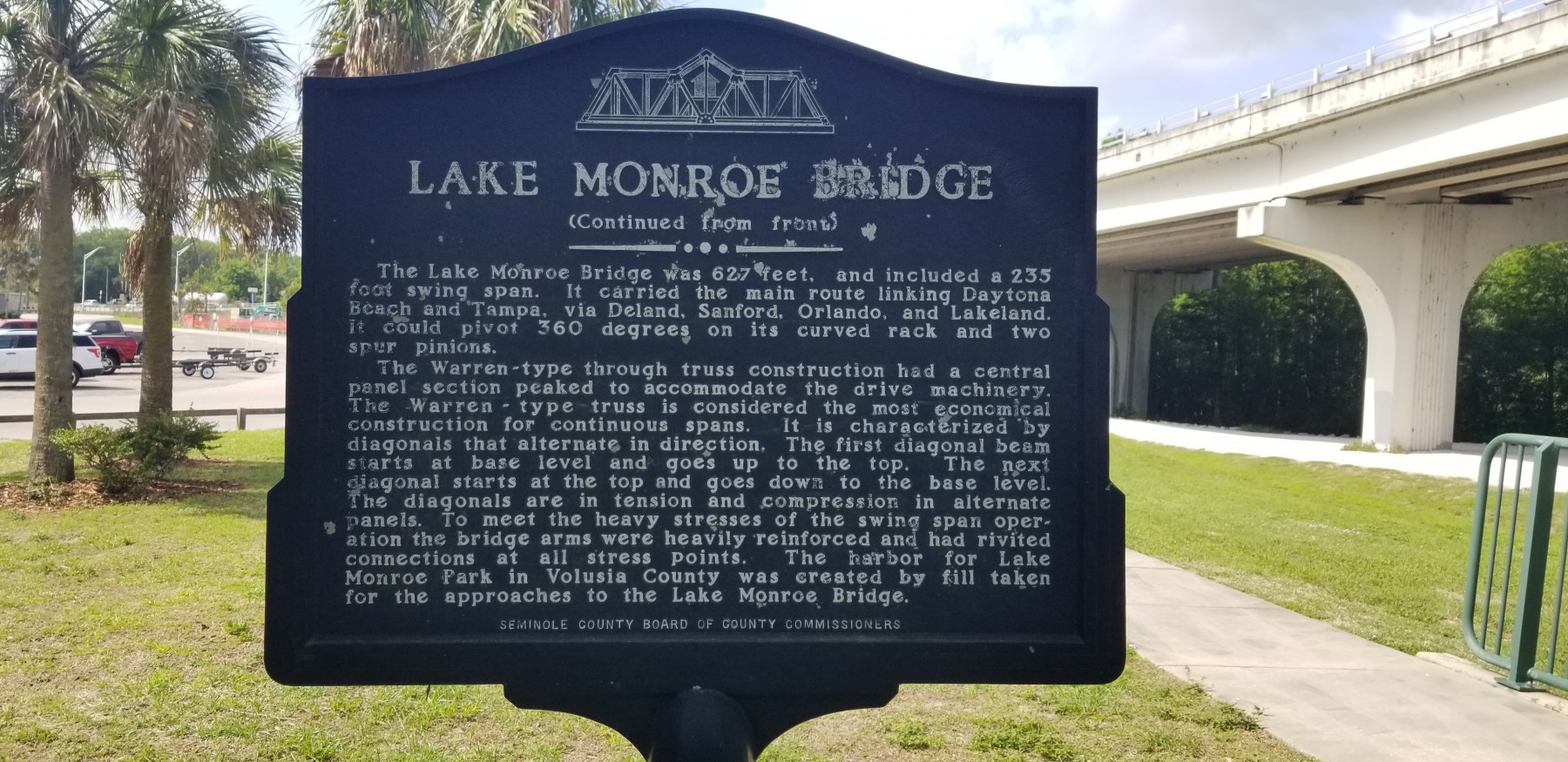
The Lake Monroe Bridge was 627 feet, and included a 235 foot swing span. It carried the main route
linking Daytona Beach and Tampa, via DeLand, Sanford, Orlando, and Lakeland. It could pivot 360
degrees on its curved rack and two spur pinions.

The Warren-type through truss construction had a central panel section peaked to accommodate the
drive machinery. The Warren-type truss is considered the most economical type of construction for
continuous spans. It is characterized by diagonals that alternate in direction. The first diagonal beam
starts at base level and goes up to the top. The next level diagonal starts at the top and goes down to
the base level. The diagonals are in tension and compression in alternate panels. To meet the heavy
stresses of the swing span operation the bridge arms were heavily reinforced and had riveted
connections at all stress points. The harbor for Lake Monroe Park in Volusia County was created by fill
taken from the approaches to the Lake Monroe Bridge.

Seminole County Board of County Commissioners

This marker is not part of the State of Florida historic marker program.

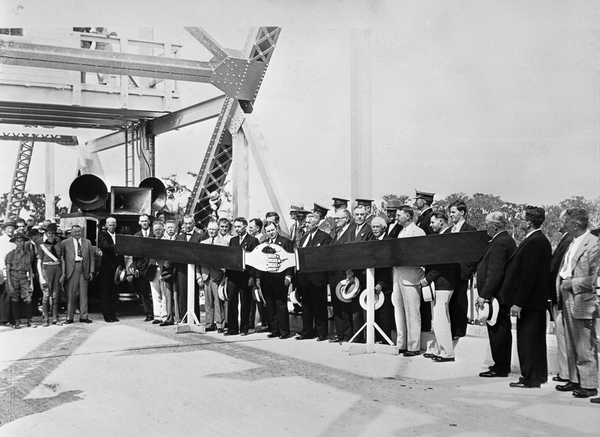
Lake Monroe Bridge dedication April 6, 1934
The April 6, 1934 Lake Monroe Bridge dedication. Image courtesy Florida Memory n028431


Local newspaper reports state that dedication of the $75,000 Bridge took place at a 3 p.m. ceremony on
April 6, 1934. Participants included Florida Governor David Sholtz and the Stetson University band. An image of the dedication is shown above.

Lake Monroe Bridge Sanford, FLSee some beautiful early images of Sanford, FL in this title from the Images of America Series. From its days as a leading river town, to being the Celery Capital, to being the home to many incredible mid-century modern homes, Sanford has an incredible history.

Also recommended is African Americans of Sanford, which recognizes and applauds those who have helped to preserve Sanford’s history as well as those who have participated in making it.


This post may contain affiliate links. If you click these links and make a purchase, I may receive a small commission. This commission does not affect any price that you pay. Affiliate programs or sponsors  providing products do not influence the views and opinions shared in this blog.