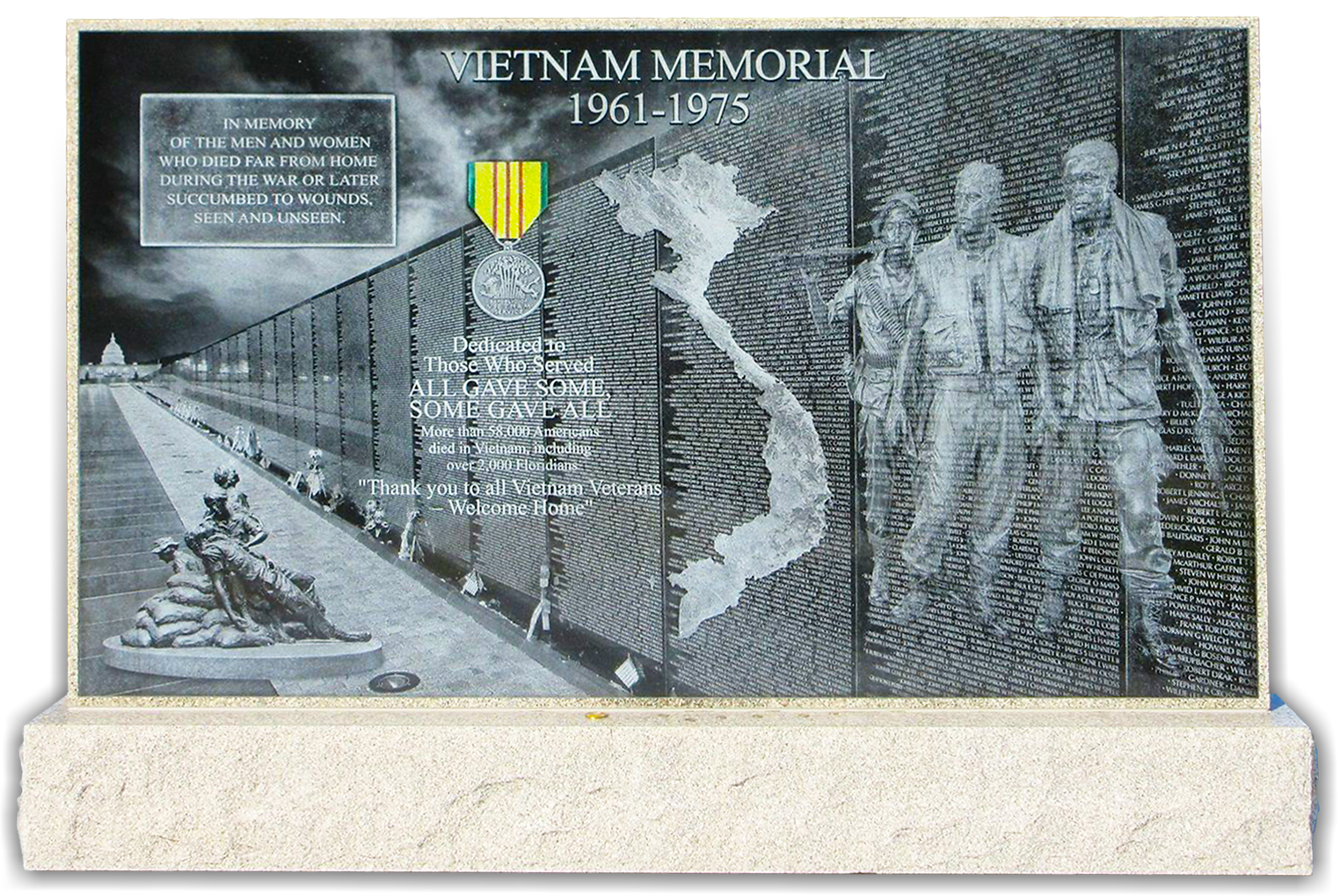
VOLUSIA COUNTY, FLORIDA – To honor local Vietnam veterans and preserve their legacy for generations to come, Volusia County will unveil a Vietnam Memorial Wall at 10 a.m. Friday, March 27, at Veterans Memorial Plaza, 125 W. Orange Ave., Daytona Beach.
The gray granite monument, which is 5 feet high and 8.5 feet wide, will stand on the north side of the plaza against a backdrop of the Halifax River. A black granite panel, etched with scenes from the Vietnam Memorial Wall and Vietnam Women’s Memorial in Washington, D.C., will document the war, those who served, those lost, and those who came home.
Inscribed on the panel are the words, “To All the Vietnam Veterans/Thank You and Welcome Home,” a call to residents to thank a Vietnam veteran, shake their hand, and welcome them home – honors many of them did not receive when they returned from the war.
Volusia County Veterans Services Director Scott Olson noted that the monument will also serve as an educational tool. It will help capture the duty, honor and sacrifice of Vietnam veterans and their families.
U.S. Army veteran Robert “Bob” Adkins, a sergeant during the Vietnam War, led the effort to bring the monument to Volusia County. As past president of Volusia Vietnam Veterans of America (VVA) Chapter 1048, Adkins spearheaded the chapter’s $35,000 donation.
“The Vietnam Veterans of America Chapter 1048 is proud to have partnered with Volusia County to make this monument a reality,” Adkins said. “This wall will mean a great deal to the veterans who served and to the community that supports them, and we hope it stands as a lasting reminder of the sacrifices made by so many.”
Speakers include retired Gen. James Hartsell, executive director of the Florida Department of Veterans Affairs; State Sen. Tom Wright; State Rep. Chase Tramont; Volusia County Council At-large Member Jake Johansson; and Bob Adkins. VVA Chapter 1048 will serve as the Honor Guard. Coastal Florida Police & Fire Pipes & Drums will provide traditional music to mark the solemnity of the occasion.
Read the story of Staff Sergeant William Lee Owen Brown, a DeLand born man who lost his life when a plane he was flying aboard came under fire while approaching the Khe Sanh Airfield in 1968.
Click the image above to support this site through Buy Me A Coffee. Your helps pay for website fees and maintenance, research fees for blog and book writing, photo usage and rights fees, and other associated costs. And maybe it will go to buying a bag of coffee to help keep me focused on the research topic at hand.
This post may contain affiliate links. If you click these links and make a purchase, I may receive a small commission. This commission does not affect any price that you pay. Affiliate programs or sponsors providing products do not influence my views and opinions.
Men’s, Women’s, or Children’s. Shirts, hats, golf attire, beach attire, and more. Shop their exclusive line of USA 250 gear and celebrate the country’s 250th birthday! Shop Flagshirtfor all your patriotic needs.
On the night of January 23, 1931, Daytona Beach, FL police officer Banny Praither Stricklin was shot and killed during a shootout with burglary suspect Joe “Nassau Red” Ward.
Banny Praither Stricklin
Banny Praither Stricklin was born in January 1896 to parents James Golden and Sophronia Belle (Brewer) Stricklin, of Wayne County, Tennessee. According to the 1900 United States Census report, father James was a student, at age 26, and Sophronia did not work outside the home. The young Stricklin family lived with James’s parents, Samuel H. and Sarah. By 1910, the younger Stricklin family were living on their own, James working as a surveyor in the Wayne County area. (U.S. Census Reports 1900, 1910)
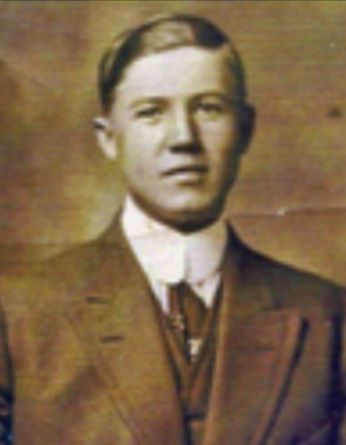
An undated image of a young Banny Praither Stricklin. Image courtesy Findagrave.
Soon, young Banny was to meet Mary Lois Busby and the two were married on October 4, 1914. Banny was only 18 with Lois being around 16/17. The Nashville Banner ran notice of the wedding stating the young couple were wed at the home of Judge and Mrs. E. E. McNely and that “the wedding was a surprise to the many friends of the young couple.” (Nashville Banner 10/10/14)
The young newlyweds quickly started a family with daughter Lera being born in 1916.
With World War I raging and the United States on the verge of full participation, Banny was required to register for the draft in 1917. The Stricklins were living in Collinwood, TN. Banny described himself on his registration card as being of medium build with brown eyes and black hair. He was self-employed, operating a grist mill. The young man requested an exemption from military service, having served two years in the Tennessee State Guard, in the 1st TN Regiment. Further, he was needed at home to care for his wife, daughter, and mother. I cannot see that Stricklin served during the Great War. (World War I Draft Registration Card)
By 1920, the still quite young family were living with Lois’s family in Lawrenceburg, TN. Little Lera and the family had welcomed a second daughter, Anita, to the family in 1919. Banny was employed as a construction worker, working with his father in law.
Some time during the late 1920s, the Stricklin family broke from their family ties and moved to Daytona Beach, FL. Here, they rented a home, hoping to start a new life. Banny owned Strickland Service Station, while Lois worked out of the home and was the primary caregiver to the children. Perhaps seeking to provide a stable living for his family, Banny accepted employment with the Daytona Beach Police Department in December 1930.
Named for the figures and landmarks that have helped make Milwaukee what it is today, our boots are a hand-crafted nod to our city’s wealth of industry and work ethic. They’re made for those who crave real craftsmanship. Those who work hard and are fearless when it comes to failure. For those who hold on to true grit, determination, and will be damned if their boots don’t follow suit. Click the link or image and learn more about Milwaukee Boot Company and to place an order.
Crimes That Evening
The early morning hours of January 23, 1931 were eventful ones for Daytona Beach Police Officers. The area south of what was then Halifax Boulevard, now International Speedway Boulevard, was the scene of several home intrusions. Ultimately, one police officer was shot, dying several hours later from his wounds.
M.C. Jones, of First Street, reported the loss of five dollars from his room. A.J. Burch, who lived on S. Beach Street reported chasing a “negro” intruder from his home around 1:30 a.m., firing off two shots in the process. Whether these minor crimes could have been pinned on the same individual who later killed Officer Banny P. Stricklin, is unknown.
According to reports, around 3:00 a.m., Howard Elting of S. Ridgewood Avenue, was awakened to find an intruder in his room who demanded money. Elting’s shouts awakened his wife and maid who were asleep upstairs in the home. When Elting told the intruder he had no cash, the man made off with a pair of pants and an overcoat.
Mrs. Elting screamed awakening the neighbors. Mr. Elting pushed the assailant out a door, though neither he nor his wife managed a good look at the intruder. The burglar left quickly into the night, carrying a flashlight and his pilfered clothing.
The Killing of Officer Stricklin
Officers were quickly on the scene. Sergeant Roy Tillis, Banny Stricklin, and “two negro patrolmen,” R.C. Clark (I believe this memorial to be for the correct person) and Clarence Roberts gave chase. They tracked the unknown robber to the neighborhood of South and First streets. Sergeant Tillis placed his men at “strategic points,” and ran in search of additional help.
The three officers patrolled their assigned territory, seeking to prevent a getaway. Clark and Roberts reported gunfire; two sharp discharges preceding a much heavier sounding shot. The officers heard Stricklin yell that he had been shot. Rushing to the intersection of South and First, the two officers found Stricklin lying in a pool of blood, where he soon lost consciousness.
Stricklin, gravely wounded, was rushed to Halifax district hospital. Surgeons Joseph H. Rutter and James Ralston Wells quickly found Officer Stricklin had been shot in the right shoulder, a major artery being severed, accounting for the considerable loss of blood. Patrolman Stricklin, on the force less than one year, passed at 10:10 a.m. from severe loss of blood. He is claimed to have said to a fellow officer, “He got me. I’m going to die. Oh, my poor wife and babies.” (Shooting details: Daytona Beach News Journal 1/23/1931)
The immediate investigation determined that Stricklin’s gun had two empty chambers, matching the sounds reported by Officers Clark and Roberts. Local residents however disagreed with the two officers sequence of events, stating the loud, heavier shot was first, followed what would be Stricklin’s two rounds. Residents aroused by the commotion claimed to have seen a seen the assailant, describing him as a “negro wearing a brown overcoat.” (DBNJ 1/23/1931)
The DeLand Sun News provided a racially charged description of the murder suspect stating “that the negro was a light brown or ginger bread color, tall, slim, and stoop shouldered. He was apparently from 35 to 38 years of age and weighed about 165 pounds. The negro is said to have worn a light cap, an overcoat which had been stolen and which was of a light brown or tan color. In this overcoat was a leather cigarette case, a whistle, and some keys. The coat had a New York label in it. ” (DeLand Sun News 1/23/1931)
At Gate Operators Direct, we are committed to providing high-quality, durable, and reliable gate automation solutions for residential, commercial, and industrial properties. As a trusted supplier in the industry, we offer a wide range of gate openers, accessories, and security solutions, ensuring homeowners and businesses have the best products to secure their properties with ease.
Immediate Reaction
As happens when a law enforcement officer is killed, action was swift in trying to name and apprehend the accused. A $100 reward was quickly put forward by the City of Daytona Beach. The city was littered with handbills and posters seeking information and residents were quick to respond. Unfortunately, the tips led nowhere quickly.
A jury of inquest into the shooting was held which proved inconclusive. Both officers Clark and Roberts were unable to identify the gunmen and could not state with certainty the man’s race. Howard Elting testified about the intruder at his residence but as with the officers, could not state conclusively if the man was White or Black.
Muddying the waters was the testimony of Dr. Joseph Rutter, who stated the wound suffered by Stricklin would have caused him to bleed to death almost immediately. Rutter stated the right hand firing Stricklin almost certainly would have had to have fired first, because the wound would have paralyzed his arm. The men of the jury discounted the possibility of Stricklin firing with his left hand due to the rapid discharge sounds reported.
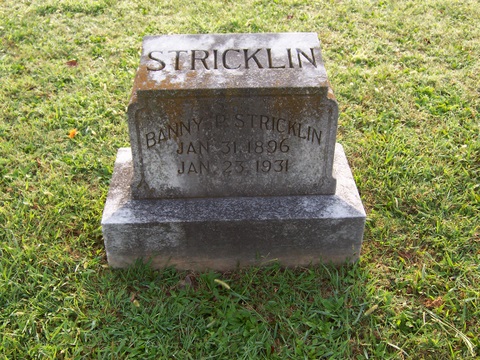
The headstone for Banny Praither Stricklin. Image courtesy Findagrave.
The body of Banny P. Stricklin was handled by the local funeral home, Baggett-Wetherby, and was loaded on a train, which departed for Waynesboro, TN, the day after the murder. The Stricklin family was onboard as well, with it being reported they would be leaving Daytona Beach to live with family in Tennessee. Young officer Praither was laid to rest in McGlamery Cemetery, in Collinwood, TN. (DBNJ 1/25/1931)
During the inquest, Officers Clark and Roberts testified they had seen the robbery suspect race into a wooded area prior to their fellow officer being mortally wounded. Roberts encouraged Clark to go with him into the dark area in an attempt to apprehend them. Clark testified that he was afraid to follow and refused. For his lack of action, Officer R. C. Clark was relieved of duty. In announcing the termination, Daytona Beach Police chief Charles J. Luke stated, “We cannot have men on the force who are afraid to face the music. It’s unpleasant, but that’s what we are for.” (DBNJ 1/26/1931)
In the wake of R.C. Clark being relieved of duty for failing to act, a new officer was needed and Chief Luke wasted little time in filling the opening. As reported in the News Journal, “Jessie Mitchell, negro, will carry out the police duties formerly executed by Patrolman R.C. Clark…” (DBNJ 1/29/1931)
GARVEE is a leading brand that specializes in equipment and tools, developed and managed by Garvee lnnovation lnc.GARVEE offers a wide array of commercial equipment to fulfill a variety of business needs, ranging from DIY tools to maintenance, repair, and operations (MRO) products across multiple applications. Our inventory spans business & industrial tools, agricultural supplies, furniture, plumbing solutions, gardening essentials, outdoor gear, home necessities, as well as automotive parts & repair tools, and robust commercial kitchen equipment. Click the link or image to discover the wide range of tools and equipment offered by GARVEE, all at great prices.
An Arrest
For more than two weeks, there was seemingly little to report and it certainly had to feel as if the trail had grown cold. Two days after Valentine’s Day, on February 16, 1931, news broke that “a negro” by the name of Joe Ward, using the nickname “Nassau Red,” approximately 35 years old, was being held in a Miami jail awaiting Constable George L. Haney to arrive and whisk him back to Volusia County where murder charges awaited him.
Police chief Charles Luke, using informant information from one of five known Ward compatriots, tracked the shooter to Miami where Nassau Red was located, already behind bars, suspected in the robbery of a Miami Beach home. Miami police willing gave up the murder suspect and he was immediately brought back to Daytona Beach, arriving at 3 a.m. in the morning of the 17th. (DBNJ 2/16/1931)
It didn’t take long for the accused to confess to being the shooter. By early afternoon on February 17, Ward had confessed and waived his preliminary hearing. He was to be transported to the county jail facility in DeLand and held for trial. It went unreported whether Ward had received legal counsel at this time. (DBNJ 2/17/1931)
Ward would not be alone in jail for long however. Only days later, Constable Haney made the long drive to Miami a second time, returning with Clyde Morrison, a 25-year old “negro,” who was held for being an accessory before the fact according to the warrant. Morrison appeared before justice Charles L. Beers for a first hearing on February 23 with Joe Ward testifying as a witness.
Ward testified that it was Morrison who acted as his driver and had supplied the weapon used in the shooting of officer Stricklin. Arresting officer Haney testified that Morrison admitted selling the weapon to James Gaskin and that he, Haney, had recovered the weapon from Gaskin.
The accused was represented by attorney Paul W. Harvey. Harvey attempted to provide Morrison with an alibi, placing Jannette Falson, Morrison’s “sweetheart” on the stand. She stated the accused as with her from 8:30p until 2:30a. Morrison’s mother testified that he arrived home at 3:00a.
As would have been expected, Morrison was ordered held for trial and placed in the county jail in DeLand. (DBNJ 2/22/31, 2/23/31)
In early April, Morrison, with the assistance of a new attorney, Elmer Jones, was granted a habeas corpus action with Judge Marion G. Rowe presiding. Bond for the accused was set at $5,000, but there appeared to be no immediate action with Morrison remaining in custody. (DBNJ 4/3/31)
Trial
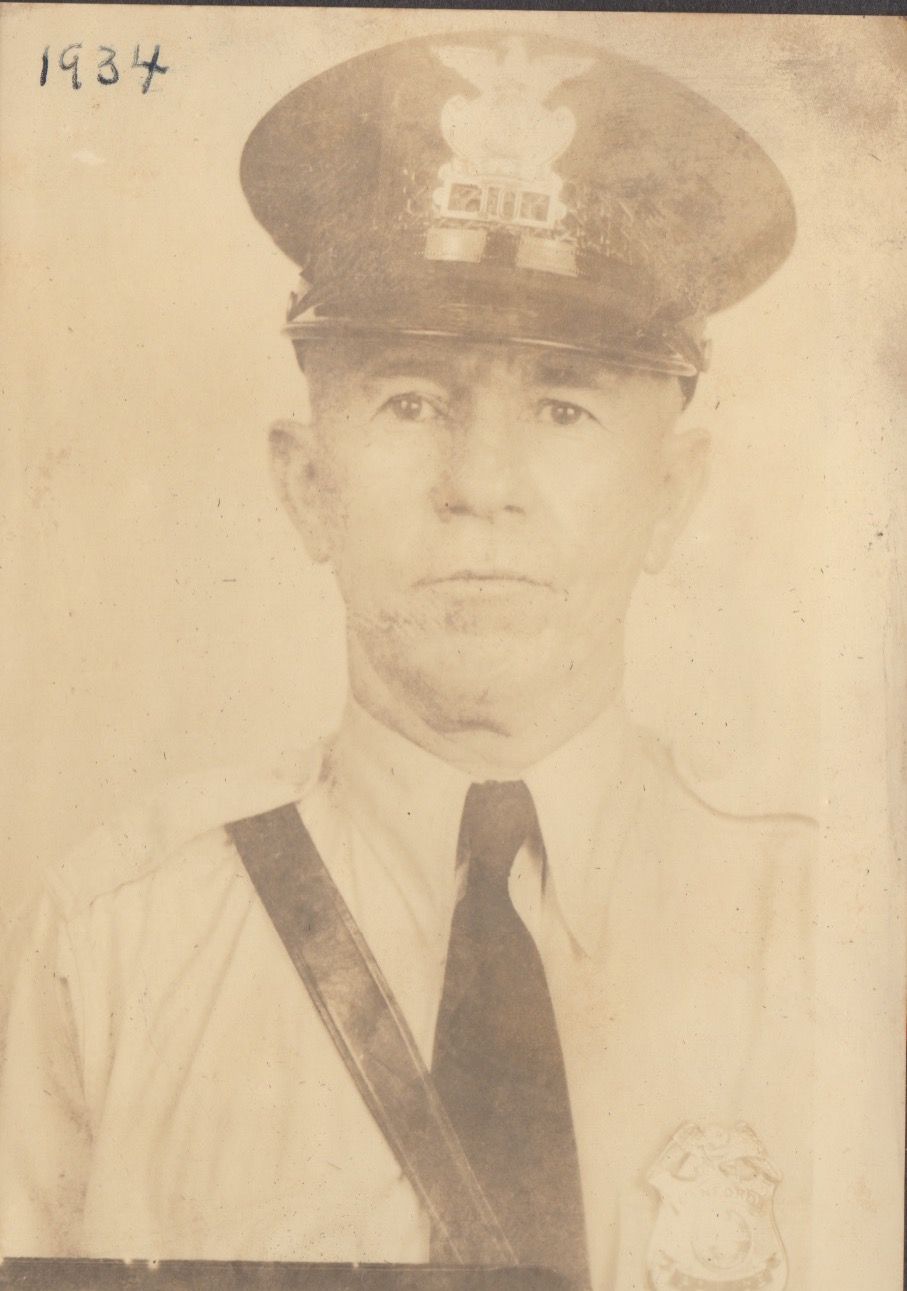
Leroy “Roy” Tillis. Image courtesy Findagrave.
Court actions began in earnest during the second week of July. A grand jury was convened on July 9 with ten witnesses summoned to provide testimony. Called before the grand jury were police chief Charles J. Luke, officers Roy Tillis and J. M. Durden, constable George L. Haney, E. V. Dickman, Clyde Morrison, Lilly M. Lloyd, Nora Adams, James Gaskin, and the accused, Joe Ward.
The grand jury returned with a charge of first degree murder with a trial date set for July 20, 1931. Ward entered a plea of not guilty to the crime charged, which carried with it a death penalty. The court appointed Joseph A. Scarlettto serve as defense counsel. The same grand jury returned a no true bill against Ward conspirator Clyde Morrison. A no true bill meant that they were unable to determine if there was enough evidence against Morrison in order to prosecute at that time. It did not mean they believed him innocent. Morrison was held as a material witness on a $1,000 bail. (DBNJ 7/8/31, 7/13/31)
Court proceedings moved quickly. The same week as a the grand jury indictment, judge Daniel Simmons drew a venire (pool of jurors) of 18 regular and 36 special to potentially serve as jurors for the trial. These same jurors were also called for two additional first degree murder cases. State attorney Murray Sams, known as an aggressive prosecutor, stated that “We are ready for trial Monday…” (DBNJ 7/16/31, 7/19/31)
The trial of Joe Ward took place at the Volusia County Courthouse, in downtown DeLand, to much fanfare as would be expected in such a significant case. A jury was quickly selected in the morning. The defense excused four jurors using peremptory challenges; C.L. Stone, Eric Causey, Arthur B. Wilkinson, and Fulton F. Smith. Two jurors were excused for “conscientious scruples;” F.J. Nordman and John “Pat” Sheedy.
The final empaneled jury included G.R. Brownlee, E.H. Washburn, G.W. Horn, J.G. Cade, J.M. Hughes, Herbert C. Russell, R.O. Kirchoff, Harry Eastman, G.B. Thomas, N.H. Harper, George W. Tanner, and D.L. Waters.
Murray Sams called the first witness, Dr. Joseph H. Rutter, who dramatically testified how officer Stricklin had bled to death from a bullet severed artery. Police Chief Charles J. Luke then identified the bullet which had been introduced as evidence to the jury.
A further parade of witnesses were called by Sams, describing the events of the evening, including robbery and the shooting. Sergeant Roy Tillis described the search for a robbery suspect, leading them to a wooded area. Tillis recounted gathering officers Clarence Roberts and Jessie Clark (earlier reported as R.C. Clark), along with Stricklin and posting them at the woods while he attempted to find additional officers. After hearing of the shooting, Tillis testified, “With officer James McHale, I rushed to the scene. We found Stricklin weltering in blood and unable to walk. I left several officers on the scene in ambush and rushed Stricklin to the hospital where he died a few hours afterwards.”
Next on the stand was officer Clarence Roberts. Roberts stated, “Clark and I were quite a little distance from Stricklin. Suddenly we heard three rapid shots and a call for help from the officer. I rushed to his aid and Clark followed later. I sent him [Clark] to telephone headquarters. Stricklin gave a description of the negro who shot him and told which way he went. Soon the other officers arrived.”
Clyde Morrison, Ward’s accomplice, was called and proved a key witness for the prosecution. Morrison testified that on the day after the shooting, Ward visited him and left the murder weapon in his [Morrison’s] possession. Morrison testified he later agreed to drive Ward to Cocoa for ownership of the gun and ten gallons of gas. Morrison claimed he agreed to this arrangement out of fear.
From here, the ownership of the weapon becomes a bit muddled as Morrison claims he sold the weapon to James Gasque, a Black man from Daytona Beach. Gasque took the stand and stated he turned the weapon over to Constable Haney, who himself took the stand to identify the weapon.
Defense attorney Scarlett attempted to downplay the testimony of Morrison by showing he had been in jail on charges related to this crime. Judge Simmons however reminded jurors that this was done at court order due to his status as a witness.
While on the stand Constable George Haney brought forth perhaps the most stunning testimony and evidence of the trial. Haney brought forth the signed confession from Ward, stating he had seen a copy of this. The typewritten confession in question was given in the presence of attorney Louis Ossinsky and stenographer Lily (Nellie according to the DeLand Sun News) M. Lloyd. Lloyd testified that while Ossinsky was questioning Ward, Ward stated he wished to confess. Attempts by defense counsel to put Ward on the stand to refute the testimony from Ms. Lloyd proved unsuccessful. The confession was read into evidence by attorney Murray Sams.
Witnesses who closed out the day’s testimony included William O’Shea who identified Ward as having purchase twelve bullets from him the day prior to the murder, and W.C. Jones, a man whose home had been robbed the night of the murder.
With his role of witnesses complete, state attorney Murray Sams rested his case at 3 o’clock.
Defense attorney Joseph A. Scarlett faced the unenviable, and near impossible, task of defending a man accused of killing a law enforcement officer when a signed confession was allowed into evidence. Faced with few options, Scarlett put the accused on the stand to attempt to defend himself. Ward claimed he was coerced into making a confession and that he testified against Clyde Morrison out of fear of the police. Ward testified that chief Luke told him he would never reach the county jail if he didn’t sign the confession. “I confessed what he told me to confess. I wasn’t scared of Chief Luke, but of what they might do to me.”
As would have been expected, Sams easily dealt with Ward, with Luke, Ossinsky, and Lloyd all denying Ward’s claims, while enticing him to admit he was a sailor who made frequent trips to and from Bimini and the Bahamas, returning to the Florida with loads of illegal whiskey as prohibition was still the law of the land. (DBNJ 7/20/31, 7/21/31; DSN 7/21/31)
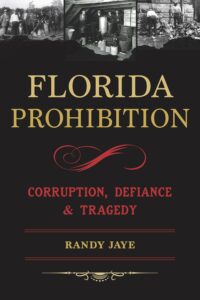
To learn more about Prohibition in Florida, I invite you to read Florida Prohibition: Corruption, Defiance, & Tragedy, written by Randy Jaye. You may also order this excellent title directly from the publisher, Arcadia Publishing. If you order any books directly from Arcadia, use my discount code REDD24 and save 15%.
Whether you want to watch your favorite streaming services or play online games with no lagging, at the highest visual quality, the Valerion StreamMaster Plus 2 Laser Projector is for you. This system integrates seamlessly with your Smart Home system. CLICK HERE, or the image, to learn all the details and to place your order.
Verdict
The jury needed only 19 minutes to find Joe “Nassau Red” Ward guilty of first degree murder, a charge which carried the death penalty. His attorney, Joseph A. Scarlett began making plans for his appeal. (DBNJ 7/21/31; DSN 7/21/31)
The following morning, Scarlett filed his motion for appeal with circuit court clerk Samuel D. Jordan, citing multiple reasons for requesting the verdict be set aside and a new trial called. As reported Scarlett’s reasons were: the verdict was contrary to law; the verdict is contrary to evidence; the verdict is contrary to law and evidence; the verdict is contrary to the charge of the court; no evidence was admitted upon which to hinge a premeditated design; the jury was influenced by something other than testimony. Judge Simmons made no immediate ruling on the request. (DBNJ 7/22/31)
On the morning of July 23, judge Simmons ruled in favor of Scarlett’s request with the reasoning that “the verdict is not in keeping with the evidence and would not be sustained by the supreme court.” Having gained this victory, Ward’s attorney, Joseph A. Scarlett entered a guilty plea to second degree murder. While spared the death penalty, Ward was sentenced to life in prison. The following week he was transported to Florida State Prison in Raiford. (DBNJ 7/23/31; 7/28/31)
The Killer
Little is currently known about Joe “Nassau Red” Ward. As he confessed to in the trial, he worked as a sailor, importing illegal liquor into the United States during the prohibition years. Through his movements after the crime, he can be traced to the Miami area. Whether that was a permanent home or just out of convenience is still unknown.
Unfortunately, with a common name like Joe Ward and little else to go on, tracking his life is exceptionally difficult. Newspaper accounts show that in November 1938, he requested a pardon, which was denied.
One helpful bit of information was that he served time at the Florida State Prison Farm & Hospital in Union County, FL. Through that small lead, I was able to find Ward in the 1940 US Census. Through the Census record, we learn that Ward was born in approximately 1896, which made him 34 or 35 years old at the time of his crime. Unfortunately, the report lists his birthplace as Florida, providing no further clues to locating earlier records. Ward was uneducated, having completed only the third grade.
Ward’s time in prison is currently a mystery. A records request for Ward’s prisoner file came back with no record found. That was certainly frustrating but I suppose not unexpected in a nearly 100 year old case.
Ward is not listed in the 1950 US Census for the Florida State Prison. Through Ancestry I was able to locate the Florida State Prison Register, 1875-1959 and luckily did find a record for Joe Ward. Here we find that Ward was granted parole on August 26, 1947. Unfortunately, as often happens, the local press had apparently lost interest in the story and no mention has been found covering this event.
So the big question becomes, what happened to Joe Ward after his release in August 1947. Where did he go? Did he keep clean or return to a life of crime? When did he die and where is he buried? For now, these questions shall remain unanswered.
Memorials
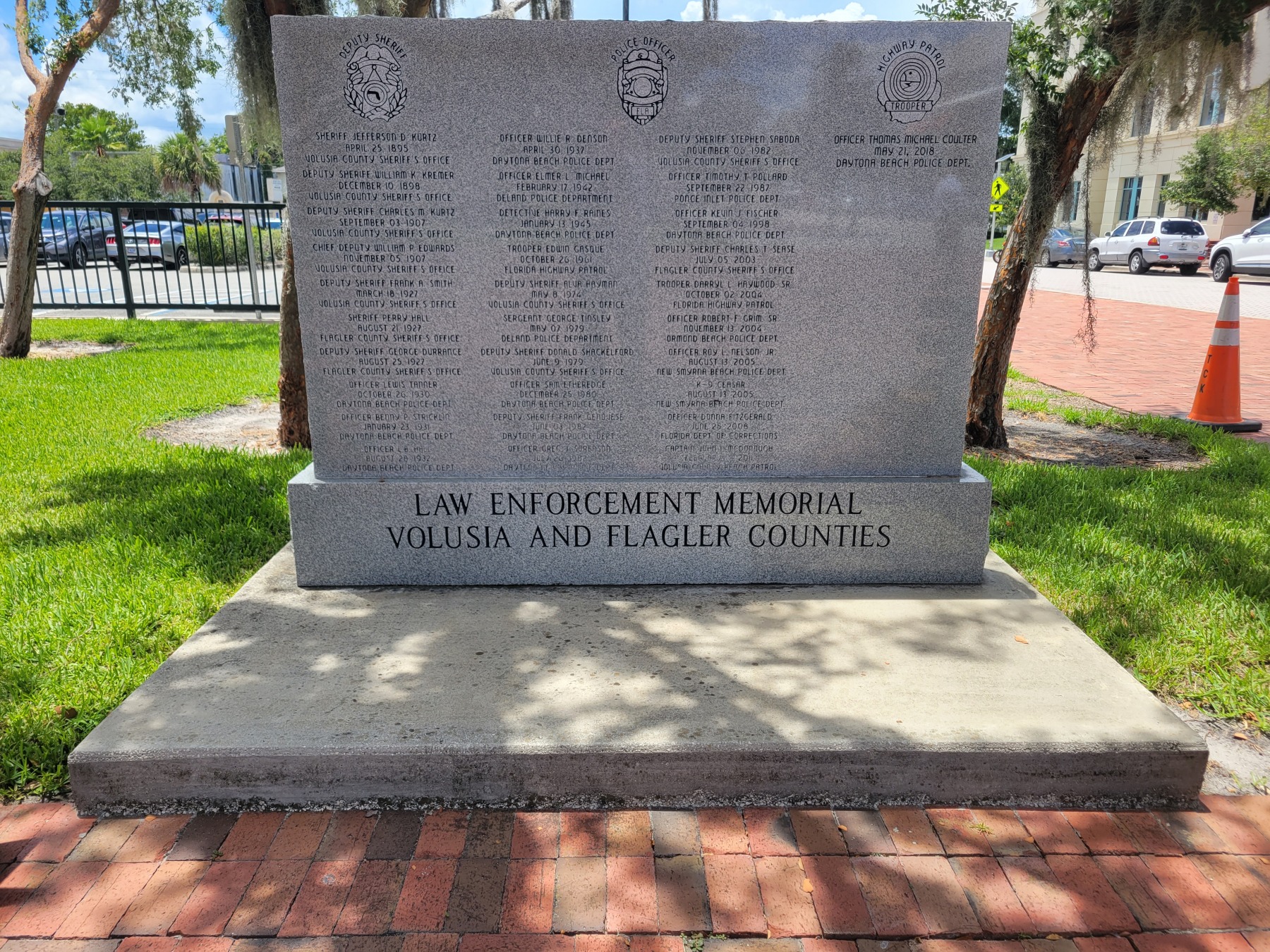
For those in the Volusia County area, there are two memorials which can be visited that pay tribute in part to Banny Praither Stricklin.
Volusia and Flalger Counties Law Enforcement Memorial located outside the Historic Volusia County Courthouse in DeLand
Readers are encouraged to view my post dedicated to the Volusia Flagler Law Enforcement memoriallocated in DeLand, FL. This post will provide you with information and links to other posts about local officers who gave their lives in the line of duty.
Daytona Beach Police Department “Fallen Heroes” memorial
In a peculiar twist of fate, the Stricklin family had suffered tragedy before the killing of Banny in 1931. Stricklin’s father, James G. Stricklin, commonly known as J. G., was a local land agent and trader in Collinwood, TN, who according to the Knoxville Sentinel, “had many enemies in the community, mainly on account of recent activities in connection with some revenue officers.” The Nashville Banner reported that Stricklin “had incurred the enmity of a number of people in the county.” The reason for the apparent dislike is not recorded in any detail. (Knoxville Sentinel 3/1/17, Nashville Banner 2/28/17)
On the evening of February 27, 1917, the elder Stricklin was visiting a friend, J. H. Cole, in Waynesboro. Leaving at the end of the night, Stricklin walked along College Street, unaware danger was lurking near a blacksmith’s shop. Parked on the street near the shop was a log wagon, left overnight for repairs to be made in the coming days.
From behind the wagon, a hidden gunman opened fire at around 10:30 p.m., striking the defenseless Stricklin with nine pieces of buckshot below and to the left of the heart. Local residents, including Katherine Cole, the daughter of Stricklin’s host that evening, raced to the scene and brought the dying man back to the Cole home. The wounded Stricklin would not live long, dying within an hour. Before passing, newspaper reports claim that Stricklin is said to have named who he believed the shooter to have been. That name does not appear to have been released through the press.
A coroner’s jury was quickly impaneled to determine the facts of the murder and who was behind the seemingly unprovoked attack on the otherwise peaceful neighborhood. Working throughout the day after the murder, and despite the possible assailant’s name, the jury returned a verdict that the deceased had met his death at the hands of unknown parties. In a newspaper report more than two week after the murder, it was stated that no arrest had been made.
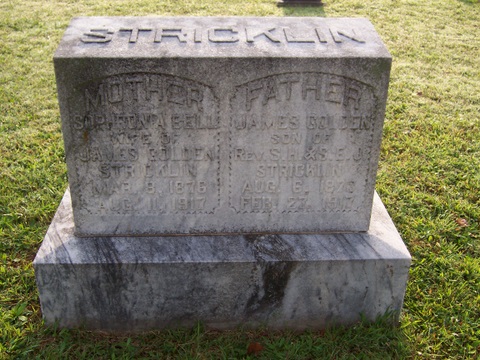
Headstone for James & Sophronia Stricklin. Image courtesy Findagrave
The Nashville Banner reported that in addition to his wife, James “is also survived by a son, aged about 21, Denny[sic] Stricklin.” (Nashville Banner 2/28/17)
James Stricklin was laid to rest in McGlamery Cemetery, in Collinwood, TN. On online memorial may be found HERE. According to Findagrave, Banny’s mother, Sophronia, also passed away later in 1917, but I have been unable to determine the circumstances.
Sources
Daytona Beach News Journal
DeLand Sun News
Findagrave
Florida State Prison Register, 1875-1959 (Records available on Ancestry)
Knoxville Sentinel
Nashville Banner
Tennessee Marriage Records 1780-2022 (Records available on Ancestry)
United States Census 1900, 1910, 1920, 1930, 1940
World War I Draft Registration Card (Records available on Ancestry)
Click the image above to support this site through Buy Me A Coffee. Your helps pay for website fees and maintenance, research fees for blog and book writing, photo usage and rights fees, and other associated costs. And maybe, it will go to buying a bag of coffee to help keep me focused on the research topic at hand.
This post may contain affiliate links. If you click these links and make a purchase, I may receive a small commission. This commission does not affect any price that you pay. Affiliate programs or sponsors providing products do not influence my views and opinions.
Never stop learning. Stream over 18,000 lectures in topics such as history, religion, travel, literature, foreign languages, and more. Click the link below or the image to get started. Welcome to New Home of the Great Courses – Save 20% Off!
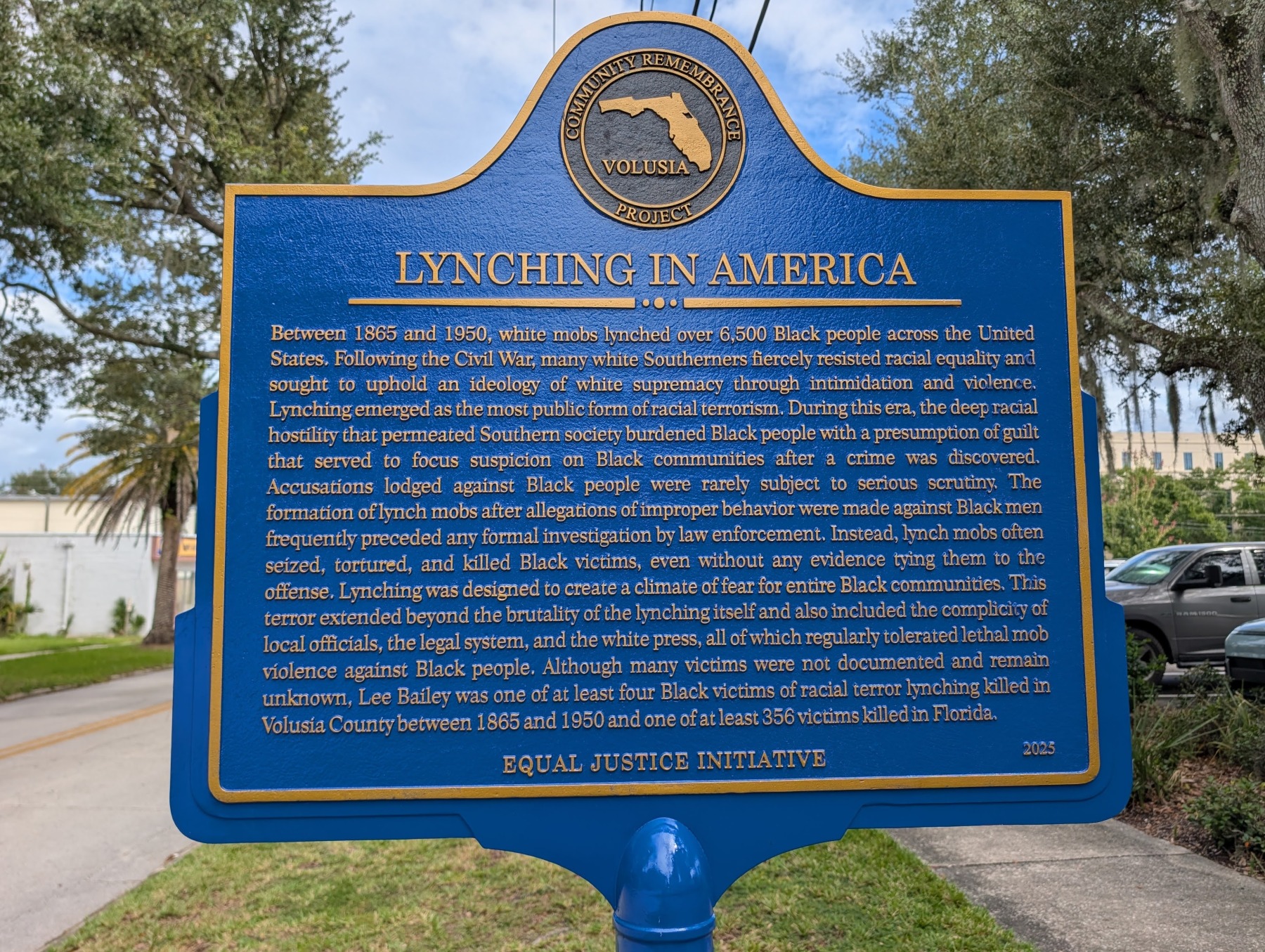
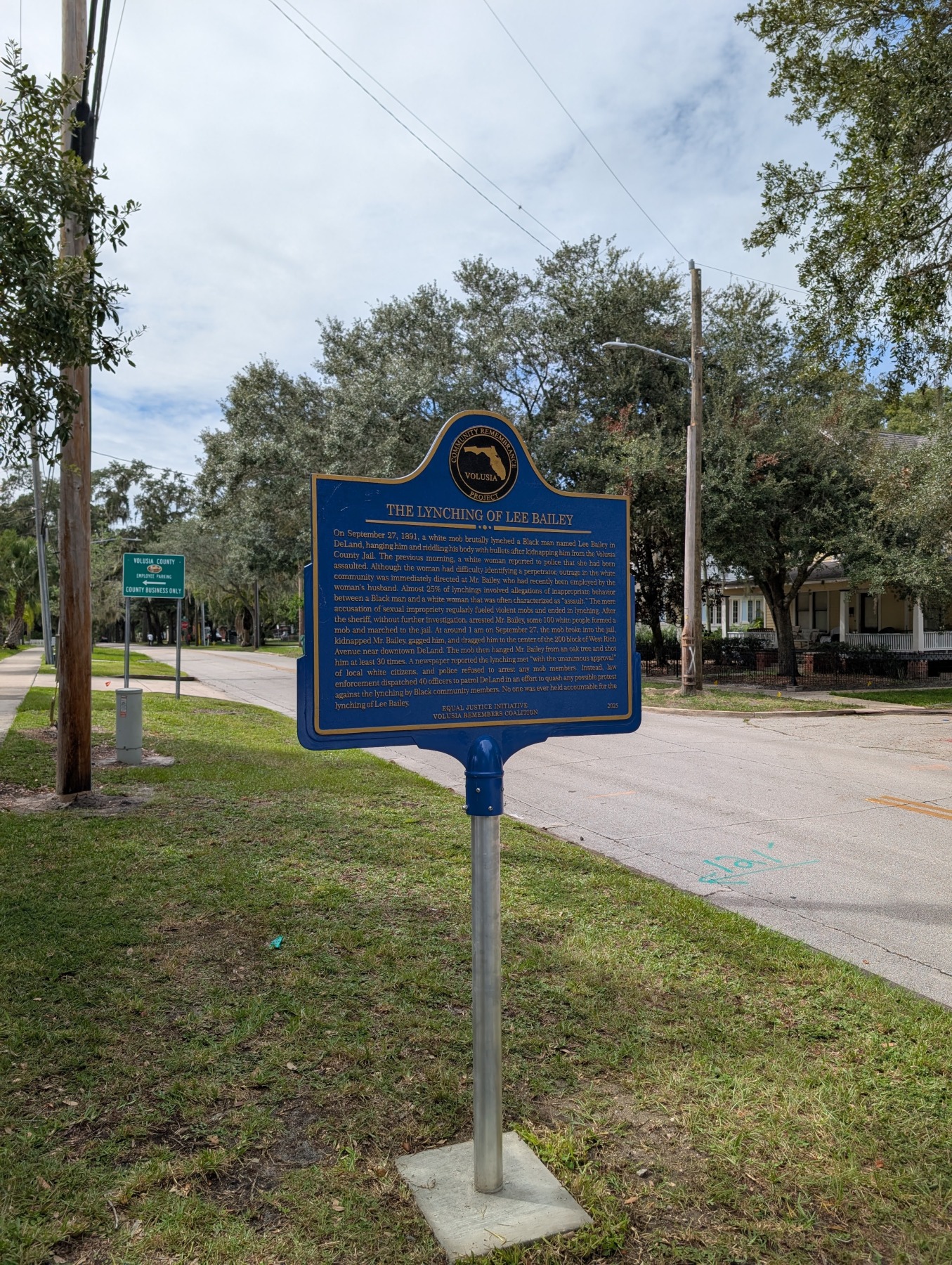
In 1891, Lee Bailey was the victim of a lynching in DeLand, FL. His story is now remembered with a historic marker in DeLand, Florida. The marker is located in the 200 block of west Rich Avenue, near the county owned parking lot. An easy way to find this marker, is to find Tom’s Auto Repair. The marker is across the street.
Bailey is one of five identified lynchings in Volusia County. More than 350 lynchings occurred in Florida between the end of the Civil War and 1950.
The marker was placed with the approval of the City of DeLand by the Volusia Remembers Coalition and the Equal Justice Initiative. A public unveiling of the marker was held on Saturday, September 27. The goal of the marker and Volusia Remembers Coalition is to honor, educate, and reconcile.
Buy it by the bag or subscribe and get delicious Intelligentsia Coffee delivered right to your door regularly. You choose: whole bean, ground, single origin, blends, espresso, light, medium, or dark roast. All freshly roasted and shipped straight to you. Click the image above to place your first order and you’ll be drinking Intelligentsia Coffee in no time.
The Marker Side One
The Lynching of Lee Bailey
On September 27, 1891, a White mob brutally lynched a Black man named Lee Bailey, in DeLand, hanging him and riddling his body with bullets after kidnapping him from the Volusia County Jail. The previous morning, a White woman reported to police that she had been assaulted. Although the woman had difficulty identifying a perpetrator, outrage in the White community was immediately directed at Mr. Bailey, who had recently been employed by the woman’s husband. Almost 25% of lynchings involved allegations of inappropriate behavior between a Black man and a White woman that was often characterized as “assault.” The mere accusation of sexual impropriety regularly fueled violent mobs and ended in lynching. After the sheriff, without further investigation, arrested Mr. Bailey, some 100 White people formed a mob and marched to the jail. At around 1 a.m. on September 27, the mob broke into the jail, kidnapped Mr. Bailey, gagged him, and dragged him to the center of the 200 block of West Rich Avenue near downtown DeLand. The mob then hanged Mr. Bailey from an oak tree and then shot him at least 30 times. A newspaper reported the lynching “met with the unanimous approval” of local White citizens and police refused to arrest any mob members. Instead, law enforcement dispatched 40 officers to patrol DeLand in an effort to quash any possible protest against the lynching by Black community members. No one was ever held accountable for the lynching of Lee Bailey.
2025
Equal Justice Initiative Volusia Remembers Coalition
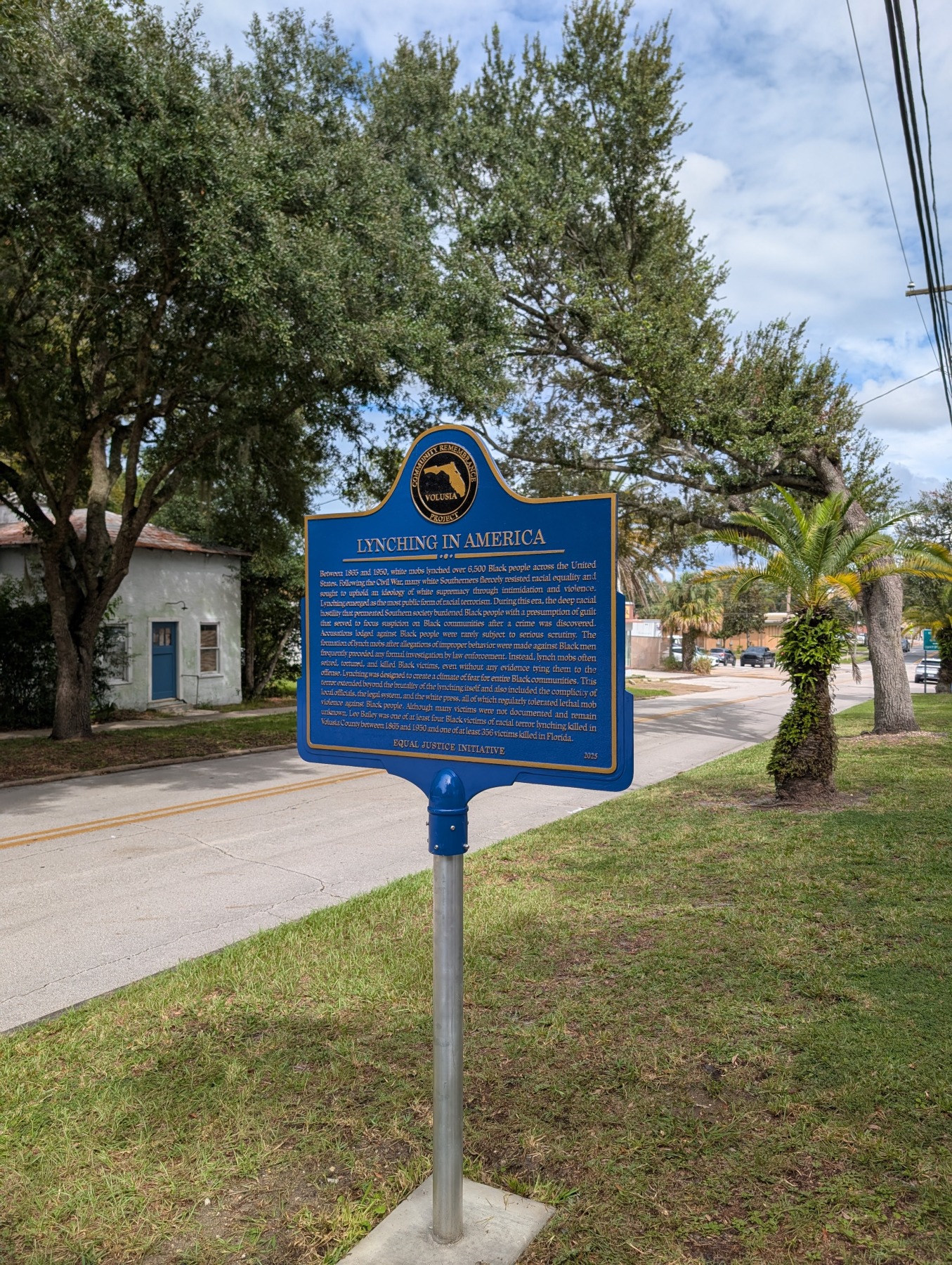
The Marker Side Two
Lynching in America
Between 1865 and 1950, White mobs lynched over 6,500 Black people across the United States. Following the Civil War, many White Southerners fiercely resisted racial equality and sought to uphold an ideology of White supremacy through intimidation and violence. Lynching emerged as the most public form of racial terrorism. During this era, the deep racial hostility that permeated Southern society burdened Black people with a presumption of guilt that served to focus suspicion on Black communities after a crime was discovered. Accusations against Black people were rarely subject to serious scrutiny. The formation of lynch mobs after allegations of improper behavior were made against Black men frequently preceded any formal investigation by law enforcement. Instead, lynch mobs often seized, tortured, and killed Black victims, even without any evidence tying them to the offense. Lynching was designed to create a climate of fear for entire Black communities. This terror extended beyond the brutality of the lynching itself and also included the complicity of local officials, the legal system, and the White press, all of which regularly tolerated lethal mob violence against Black people. Although many victims were not documented and remain unknown, Lee Bailey was one of at least four Black victims of racial terror lynching killed in Volusia County between 1865 and 1950 and one of at least 356 victims killed in Florida.
2025
Equal Justice Initiative
Brief Analysis
As often occurs, I have a couple of minor quips with this Marker. The first being a grammatical correction I have made in my text. We either capitalize or use lower case for skin color. This choice should be used consistently. I capitalize, so I have done that throughout my transcription of the marker text. My second comment is that I find the text a bit long on both sides of the marker. Both sides seemed to lose a little bit of focus.
NOW, that being said, this is a vitally important marker. Lynchings were (and still are to read about them) terrible events that never should have occurred in a civilized society. We need to not forget these monstrous events happened. The Volusia Remembers Coalition and Equal Justice Initiative deserve credit for researching this story and bringing it to the attention of the world.
Volusia County has been known to have a poor record of race relations. To learn more, I invite you to read my blog post about Roy L. Cook.
Click the image above to support this site through Buy Me A Coffee. Your help pays for website fees and maintenance, research fees for blog and book writing, photo usage and rights fees, and other associated costs. It might go to buying a bag of coffee, keeping me focused on the research topic at hand.
This post may contain affiliate links. If you click these links and make a purchase, I may receive a small commission. This commission does not affect any price that you pay. Affiliate programs or sponsors providing products do not influence my views and opinions.
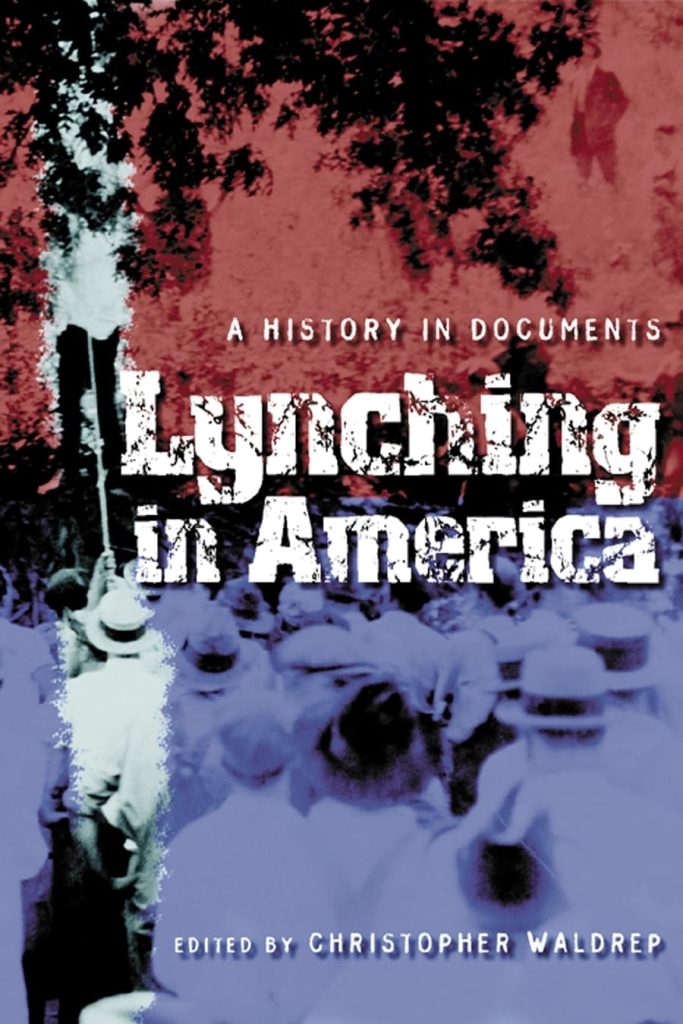
Since its founding, lynching has permeated American social, political, and cultural life, and no other book documents American lynching with historical texts offering firsthand accounts of lynchings, explanations, excuses, and criticism. CLICK HERE or the image to learn more and purchase your own copy.
The Sands Fish & Oyster Company two-sided Florida Historic Marker can be found in Port Orange, FL and is accessed through Riverwalk Park, located on the east side of US1 (Ridgewood Avenue).
Florida Marker Program
The Florida Historical Marker Program is one of the Division of Historical Resources’ most popular and visible public history programs. It is designed to raise public awareness of Florida’s rich cultural history and to enhance the enjoyment of our historic sites by citizens and tourists. These markers allow us to tell the stories of the places and people who created the Florida that we all enjoy today, by identifying the churches, schools, archaeological sites, battlefields and homes that represent our past.
If you wish to learn more about this state program, including qualifications, how to apply, the application, costs, and more, please use THIS LINK.
Image courtesy Volusia County History Facebook group
Side One
The Sands Fish & Oyster Company supplied oysters to markets and restaurants up and down the Atlantic Seaboard from 1916 until 1955. Founded by William Sands, Sr., the company earned Port Orange, Florida, the title of “Oyster Capital of the World” by harvesting fresh, delicious oysters known far and wide. In addition to oysters, the company supplied clams, fish, and shrimp. Sands managed oyster leases along the Halifax River as far south as New Smyrna Beach and as far north as St. Augustine. Before starting his company he had worked as a bookkeeper for Daniel DuPont’s Port Orange Oyster Company. Originally located just north of Herbert Street along Halifax Drive, the Sands oyster house moved one block north to the corner of Ocean Avenue and Halifax Drive in the 1930s. In exchange for use of City of Port Orange property, the company provided the city with oyster shells for local roads. As the business grew, the oyster house expanded eastward over the river on pilings. Harvesting an average of 500 gallons of oysters per week, the company reached a high mark of 905 gallons during one week in 1943. Packed in gallon siz metal cans, the oysters were shipped out by truck.
This definitive oyster bible and cookbook from expert food writer Nils Bernstein delivers an array of tips, trivia, and history, plus approachable recipes that celebrate the delicious bivalve.
Side Two
A mainstay of the Port Orange business community, the Sands Fish & Oyster Company provided numerous jobs. Workers traveled from New York and Georgia to work the eight-month oyster season. During the off season, workers replenished the oyster beds and fished the river. For each gallon of oysters shucked, workers received a token known as a “Sands Dollar” that could be turned in for pay or used in local stores. In 1947, William Sands, Sr., passed away and his wife Mabel Sands and her son William Sands, Jr., took over the company. Success of the oyster business continued, but the water quality of the river declined after the construction of the second Dunlawton Bridge in early 1951. The bridge’s earthen causeway design, known locally as the “Port Orange Dam,” restricted the water’s tidal flow. Contaminants from septic tanks coupled with restricted flow raised bacterial levels in the river enough to end oyster harvesting. Sands Fish & Oyster remained in business selling fish, smoked mullet, clams, shrimp, and oysters that were supplied from other parts of the state. Mabel Sands sold the company to Fred and Martha Downing in 1956. The Downings continued the fish and shrimp market until 1961.
A Florida Heritage Site
Erected by the Port Orange, The City of Port Orange, and the Florida Department of State
As is often the case unfortunately, these markers do contain errors and the information should be confirmed independently. The text is often not written by historians, or many times even folks with any level of historical knowledge. At the state level, the details are not reviewed, rather, they are trusting that the writers and sponsors have done their research properly. There are some requirements during the submission phase. The review committee will only catch glaring errors of fact or omission. They are more used for stylistic edits and program consistency. They are not experts in every facet of local history.
Please note the unusual language in the “erected” notation at the bottom of the marker. There is definitely something missing. Whether this was submitted in this manner and missed during editing or was a manufacturing error I am unsure.
Sands Fish & Oyster Company founder, William Edward Sands, Sr. passed away on February 4, 1958 at the young age of 59. The historic marker incorrectly lists his death year as 1957. An online memorial for Sands, Sr. can be found HERE. In addition to confirming his death date on the memorial site, I have confirmed the 1958 date through newspaper obituaries and government death records.
William Edward Sands, Jr., who took over and ran the market for several years passed away in 2014 at age 93. An online memorial for Sands, Jr. can be found HERE.
I was able to verify that the Downings received a transfer of the property lease from Ms. Sands in July 1956. I have been unable to verify when the Downing family closed the business.
If you have additional information on the Sands Fish & Oyster Company, or if you have images to share, please reach out. I will be glad to post an update and provide the appropriate credit.
Click the image above to support this site through Buy Me A Coffee. Your helps pay for website fees and maintenance, research fees for blog and book writing, photo usage and rights fees, and other associated costs. It might go to buying a bag of coffee, keeping me focused on the research topic at hand.
This post may contain affiliate links. If you click these links and make a purchase, I may receive a small commission. This commission does not affect any price that you pay. Affiliate programs or sponsors providing products do not influence my views and opinions.
For many visitors, a trip to Manchester, UK, is about one thing: football. Soccer as it is more commonly called in the United States. Fans of Manchester United and Manchester City follow their teams with a devotion American fans can’t fully understand. To be a European football fan means something different than being a sports fan in the states. There are many other delightful things to take in during a visit to Manchester. One I can recommend is a visit to Chetham’s Library in Manchester, and while there, don’t miss the small but impactful World Wars commemoration, honoring students who fell during one of the two World Wars.
Reserve Your Tour Date and Time
A visit to Chetham’s Library starts with reserving your tour. No, library tours are not free, but your tour fees go to a good cause. It is recommended you begin on the Visitor Information page. Here you will find the crucial information needed ahead of your planned visit. How far in advance can you reserve your tour? How long are tours? Do visitors have to go through security? Are photos allowed? How accessible is the library? These questions and many more can be answered by a short visit to their website, linked prior in the paragraph.
Once you know you want to visit, and this really is a must see attraction, head over to the tours reservation page and start the process. Tours cost £13.50 for adults, with discounts for seniors, students, and children under age 10. Tour space is limited and reservations must be made in advance. There appear to be several tours on most days so with a bit of planning, you should be able to get in on your preferred day.
Researchers
If you are a researcher and you think Chetham’s might have material of use to you, please consult their online catalog and finding aids. If there are materials in their collection that can assist you, please make an appointment in order to review said materials. You can find information on that process through the link provided earlier in the paragraph.
Researchers and the general public may also view many of the library’s holdings using their Digital Resources collection. Check back regularly as items are always being added.
As you can see in the photo on the left, the library is filled with thousands of rare and antique volumes. During a visit to Chetham’s Library in Manchester, you are able to see these amazing shelves but are not able to access or handle the fragile volumes.
Never stop learning. Stream over 18,000 lectures in topics such as history, religion, travel, literature, foreign languages, and more. Click the link below or the image to get started. Welcome to New Home of the Great Courses – Save 20% Off!
About Chetham’s Library
Chetham’s Library and the Chetham’s School of Musicwere originally established through a bequest in the will of Humphry Chetham, a wealthy English textile merchant.
Chetham’s Library is housed in medieval building that dates to 1421. The library was originally founded in 1653 and began accumulating materials in 1655, making it the oldest public library in the English speaking world. In addition to early printed books, the library collection includes ephemera, manuscript diaries, letters and deeds, prints, paintings and glass lantern slides.
The Library is known for being the place where Marx and Engels met to discuss their revolutionary ideas, and visitors will be able to see this area. It’s also where Dr. John Dee supposedly summoned the Devil! Learn more about this story HERE or HERE.
During your tour, your guide will point out unique features of the building, such as several doors which contain smaller, “cat doors” located at floor level. Look closely at the image on the left to see the small cut out area.
Remembering Those Lost in World War I and II
During a guided tour, visitors will pass two separate memorials to students who gave their lives in service of their country during World War I and World War II. The first is the small marker shown in the image above.
The second, and more impressive memorial is a large triptychwith a large crucifix center panel including an inscription below. The center panel is flanked by two wooden panels containing the names of young men who perished while in service. The left panel contains the names of those who died in World War I and the right hand honors those who died during World War II. In total, 52 names are included and referenced below. Click to enlarge the images.
To the enduring memory of the sons of this school who gave their lives for King and Country in the Great War 1914-1918 and 1939-1945
1914-19191939-1945
H.M. Atkinson D. Bamber
J. Atkinson D. Bauldie
G.A.M. Bennett E.S. Blood
J. Bisson W.P. Booth
T.H. Boardman S.W. Cleghorn
J. Chadwick H. Clough
J. Cheatle S. Fletcher
H. Chippendale L. Hardy
R. Cooper A. Helsby
R. Darlington R.I. Laycock
A. Edwards F. Livesy
G.E. Edwards F.G. Plowman
F. Goldberg A.F. Rooke
R.T. Harrison J.K. Schofield
R. Hicks R. Skelton
H.L. Hilton T.D. Smith
H. Hoff J. Taylor
T. Holt H. Trainor
S. Kershaw A. Wilkinson
J. Lancaster
H. Lord
A. Marsden
G.E. Mart
W.T. McEwen
T. Prestage
A. Sedgwick
R. Shoreman
E. Singleton
G.W. Tyrer
D.A. Whitley
J. Williamson
H.F. Wilson
These are more than names on a plaque or a wall. They were young men, cut down in their earliest years. They were sons, brothers, husbands, and fathers. Their service and bravery should not be forgotten. I have not performed any research on any of these young men. If you are a descendant and have done genealogical work on any of these soldiers, please feel free to get in touch. If you would be interested in submitting a photo or a guest post about your family member, please let me know. We may be able to arrange something. If you have posted about a relative listed above on your own site, please let me know so that I can share a link.
Manchester at War 1939-1945 This book chronicles the difficulties, hardships, restrictions, and morale of the city year by year as the war dragged on, and is a timely reminder of how the local community strived to fight the odds that were stacked against them.
Click the image above to support this site through Buy Me A Coffee. Your helps pay for website fees and maintenance, research fees for blog and book writing, photo usage and rights fees, and other associated costs. And maybe, it will go to buying a bag of coffee to help keep me focused on the research topic at hand.
CLICK TO PIN THIS POST TO YOUR PINTEREST BOARDS FOR EASY ACCESS AND FOR YOUR FOLLOWERS TO FIND!
This post may contain affiliate links. If you click these links and make a purchase, I may receive a small commission. This commission does not affect any price that you pay. Affiliate programs or sponsors providing products do not influence my views and opinions.
Up your morning espresso game with the DeLonghi Dedica Pro. Available in multiple color options to fit in with any kitchen decor. Priced at a budget friendly $300, this is a perfect machine for every coffee lover. Includes a digital touch display, commercial style steam wand, and a tool kit, you’ll be making coffee shop quality hot and cold drinks in no time with the DeLonghi Dedica Duo.
For racing fans, a visit to Daytona Beach, Florida is a bucket list item. In addition to visiting Daytona International Speedway, there are a multitude of racing related spots for fans to seek out. One of those is the Smokey Yunick historic marker located at Riverside Park in Holly Hill.
Smokey Yunick is a name that transcends motorsports. Smokey was not only a driver, but rather, he was more a behind the scenes personality, being best known as an expert mechanic and engine builder, who was not afraid to take risks in an attempt to gain horsepower and speed. His career is most associated with NASCAR where cars he helped prepare won the Daytona 500 in 1961 and 1962, national driving championships in 1951 and 1953, and numerous other accolades. His abilities stretched further however, and he served as chief mechanic for Jim Rathmann when he won the 1960 Indianapolis 500.
Yunick worked with some of the all-time great racers including Bobby Allison, Mario Andretti, Bobby Unser, A. J. Foyt, and many others.
Around the Daytona Beach area, Yunick was known for his “Best Damn Garage in Town,” which he opened in 1947, after having served in the Air Force during World War II. Yunick would close the garage in 1987 and his descendants sold the property in 2003. The last remaining building burned to the ground in 2011.
Smokey Yunick passed away May 9, 2001 from leukemia. An online memorial can be found HERE.
Tiqets is your key to get ticket and admission prices. Click THIS LINKor the image above to find your tickets to Daytona International Speedway and Motorsports Hall of Fame of America. Race tickets are not included.
Historic Marker
On August 24, 2023, a marker to Yunick was dedicated. It sits close to the former location of his “best damn garage in town.” Located on Smokey Yunick Way in Riverside Park, it is near the intersection of Riverside Drive and 2nd Street.
Text on the marker reads:
Legendary NASCAR mechanic, crew chief & owner, Henry “Smokey” Yunick’s (May 25, 1923 – May 9, 2001) famous garage stood just south of this spot from 1947 – 2001. He was a self taught mechanical genius who excelled in all forms of auto racing winning the Daytona 500 in 1961 and 1962. Indianapolis 500 winner in 1960. The innovations and designs Smokey invented here improved performance of race cars and passenger vehicles over several decades. The last remnant of the garage burned on April 25, 2011. Memorialized in conjunction with the City of Holly Hill, Florida and concept by the members of the Motor Racing Heritage Association.
Click the image above to support this site through Buy Me A Coffee. Your help pay for website fees and maintenance, research fees for blog and book writing, photo usage and rights fees, and other associated costs. It might go to buying a bag of coffee, keeping me focused on the research topic at hand.
CLICK TO PIN THIS POST TO YOUR FAVORITE PINTEREST BOARD
This post may contain affiliate links. If you click these links and make a purchase, I may receive a small commission. This commission does not affect any price that you pay. Affiliate programs or sponsors providing products do not influence my views and opinions.
Support small businesses. Click this link to purchase from bookshop.org and help support my blogging efforts. I truly appreciate your support. Check back as I am regularly updating my shop listings.
Located at the intersection of S. Sparkman and W. Rhode Island Avenues in a growing section of Orange City, FL is the Betsy Ross Airfield for Women Florida Historic Marker. This Marker commemorates important moments in both women’s history and the history of flight in Florida.
This is a two-sided marker. The marker is set back a bit from the intersection. Use caution when visiting. There is no close parking so you will be parked on the side of the road. There are sidewalks close by to make the short walk easier.
Florida Marker Program
The Florida Historical Marker Program is one of the Division of Historical Resources’ most popular and visible public history programs. It is designed to raise public awareness of Florida’s rich cultural history and to enhance the enjoyment of our historic sites by citizens and tourists. These markers allow us to tell the stories of the places and people who created the Florida that we all enjoy today, by identifying the churches, schools, archaeological sites, battlefields and homes that represent our past.
If you wish to learn more about this state program, including qualifications, how to apply, the application, costs, and more, please use THIS LINK.
Since 1977 – We are the top source of music gifts for musicians, music lovers, and anyone who enjoys music. Shop thousands of music-themed presents including music jewelry, stationery, home decor, music clothing, music awards, and much more. The Music Stand: Always in Tune.
Side One:
On May 9, 1931, the land beyond this sign was donated to the Betsy Ross Air Corps, a pre-World War II organization of female pilots. Designated the Betsy Ross Airport, the airfield was the only airport in the nation entirely owned and operated by women. Its purpose was a place for female pilots to learn to fly and improve their skills. In the northeast corner of the 160-acre site was Arawana Lodge, used as the Corps regional headquarters and a place for the pilots to vacation. The vision, gift, and construction were all realized by Orange City’s Dr. Frances Dickinson. She was an educator, woman’s rights advocate, ophthalmologist and club woman. A flyer herself, Dickinson noted female pilots were not provided equal opportunity in the growing field of aviation. By 1932, Dickinson completed construction of one 1,000-foot runway and a 600-foot central axis designed to serve seven more runways. On January 13, 1932, the Betsy Ross Air Corp’s National Commander, Opal Kunz, and Lt. Commander, Lillian Perkins, assumed operations and continued development of the airfield.
Side Two:
The Betsy Ross Air Corps’ period of existence was short-lived (1931-1933), and never formally recognized by the U.S. Military. Dickinson secured funding to complete the airport construction from Florida’s Federal Emergency Relief Administration in December 1934. By 1935, Volusia County signed a five-year lease to use the airfield as an emergency landing field. After World War II, the airfield was renamed to the DeLand-Orange City Airport. In January 1945, J. Wade Coleman of the Orange State Flying Services leased the airfield to operate an educational facility. Coleman contracted with Stetson University to provide flight training supplementing the university’s existing aviation ground school courses. Before Dickinson’s death on May 19, 1945, four women earned their solo pilot’s licenses from her airfield. The field remained an active private airfield until a television tower was constructed over the western edge in the mid-1960s. Portions of the former airfield are now home to Manatee Cove Elementary and River Springs Middle School. The Compass Landing Subdivision pays tribute to the legacy of the Betsy Ross Airport and Dr. Frances Dickinson’s vision to advance women fliers.
A Florida Heritage Site
Sponsored by the City of Orange City, and the Florida Department of State
F-1197 2022
You may learn more about the Betsy Ross Air Corps using THIS LINK.
Click the image above to support this site through Buy Me A Coffee. Your helps pay for website fees and maintenance, research fees for blog and book writing, photo usage and rights fees, and other associated costs. It might go to buying a bag of coffee, keeping me focused on the research topic at hand.
CLICK TO PIN THIS POST TO YOUR PINTEREST BOARDS FOR EASY ACCCESS AND FOR YOUR FOLLOWERS TO FIND!
This post may contain affiliate links. If you click these links and make a purchase, I may receive a small commission. This commission does not affect any price that you pay. Affiliate programs or sponsors providing products do not influence my views and opinions.
Support small businesses. Click this link to purchase from bookshop.org and help support my blogging efforts. I truly appreciate your support.
Located in what is now an exclusive and expensive part of beachside New Smyrna Beach is the small Mary McLeod Bethune Beach Park. Here you will find a Florida Historic Marker in recognition of Bethune Beach. This area was once reserved for African American beachgoers in the days of segregation.
Mary McLeod Bethune Beach Park hosts two markers detailing the importance of this area to African Americans in the days of Jim Crow segregation. Today, the area is littered with homes valued in the seven figures, offering incredible beach views that at one time were reserved for black visitors. Fortunately, those days are past and visitors, no matter their race, can enjoy the beaches throughout the area, without intimidation.
Looking for great airline prices? Use Aviasales for tickets to and from all the major destinations. Their free flight aggregator will find the tickets you want at the best prices.
The first marker we’ll discuss is from the Florida Department of State
Bethune-Volusia Beach side one
When Daytona Beach was first founded in 1876 two of its founders, John Tolliver and Thaddeus S. Gooden, were African American. Over the years, Jim Crow laws changed the state drastically, and by the 1920s African Americans were banned from most of Florida’s public beaches. In response, beaches opened that catered specifically to African Americans like Butler Beach in St. Augustine, American Beach on Amelia Island, and Paradise Park at Silver Springs in Ocala. In 1935, only two places in Volusia County allowed African Americans beach access, and only during the summer and on specific holidays. Bethune Cookman College co-founder and president, Dr. Mary McLeod Bethune wanted to create a beach in Volusia County for African Americans to enjoy without restriction or fear of harassment. Born in Mayesville, South Carolina to formerly enslaved parents, Bethune moved to Daytona Beach in 1904. She opened the Daytona Literary and Industrial School for the Training of Negro Girls, which later merged with Cookman Institute in Jacksonville to become Bethune-Cookman College. Bethune was an active crusader for educational advancement and Civil Rights for African Americans in Florida and throughout the nation.
Bethune-Volusia Beach side two
Bethune approached architect and developer Mr. Dana F. Fuquay about purchasing a two-and-a-half mile strip of land south of New Smyrna Beach. Fuquay owned most of the land along the Intracoastal Waterway in Volusia and Flagler counties. In need of investors, Bethune used her influence to arrange a meeting at the Rogers Hotel in Tampa with some of the wealthiest African Americans in Florida, and on December 9, 1945 the Bethune-Volusia Beach Corporation was formed. The charter members included president, Mr. G.D. Rogers; executive vice president Mr. George W. Powell; vice president, Dr. W.H. Gray; secretary, Mr. James A. Colston; and treasurer, Dr. Mary McLeod Bethune. The new beach quickly became a popular vacation destination for African Americans from all over the country. During the July 4th celebration in 1950, over 5,000 people came out to enjoy the festivities. Bethune-Volusia Beach was open to all races though ownership of land and businesses was retained soley (sic) by African Americans. Following the passage of the Civil Rights Act on 1964, the beach lost popularity, and many visitors, particularly those from out of state stopped coming as other options became more available.
A Florida Historic Site sponsored by Volusia County Coastal Division, Bethune Beach Property Owners Association, Bethune Foundation, and the Florida Department of State
F-940
2017
Click the image above to easily save this post to one of your Pinterest boards so you can quickly find it later.
Find tickets to all the incredible events happening in and around Daytona Beach at the best prices using TicketNetwork! Whether you want Tortugas tickets, concerts, car races, college football, or something else. Always give TicketNetwork a look for great seats at great prices.
The second marker we’ll discuss was placed by the County of Volusia
Welcome to Volusia County’s Mary McLeod Bethune Beach Park–once part of a nationally known African American resort. Named for a noted educator and presidential advisor, this spot gave black people a place of their own when most Florida beaches were closed to them by segregation. Bethune had seen her own students turned away from local beaches, and in the 1940s she and other investors bought 2.5 miles of oceanfront plus lands along the Indian River. After all, she reportedly said, this was “God’s water” for everyone to enjoy.
People did enjoy themselves here. By the 1950s Bethune-Volusia Beach, its corporate name, was a popular destination for swimming, fishing, picnicking and car racing. Crowds also came for live music, dancing, and–as more than one informant recalled–dressing to be seen. Central Floridians made up most of the day users, but others journeyed great distances to stay in a motel and private houses. From New Smyrna to Atlanta and Pittsburgh, black Americans knew about Bethune Beach.
Bethune herself envisioned a big, year round resort, controlled by African Americans but open to “all people.” Yet the larger development never really took off, and by the 1970s the dream had faded. Most black landowners–by choice or economic necessity–gave up their property over time, and the coming of integration meant that beachgoers had other places to go. Even so, during its heyday Bethune Beach became a beloved site for people of color. It was that rare place on Florida’s Atlantic coast where they could gather, relax, and swim freely.
View of Mary McLeod Bethune Beach ParkThe Atlantic Ocean and beachfront as seen from Mary McLeod Bethune Beach Park
Click the image above to support this site through Buy Me A Coffee. Your helps pay for website fees and maintenance, research fees for blog and book writing, photo usage and rights fees, and other associated costs. It might go to buying a bag of coffee, keeping me focused on the research topic at hand.
This post may contain affiliate links. If you click these links and make a purchase, I may receive a small commission. This commission does not affect any price that you pay. Affiliate programs or sponsors providing products do not influence my views and opinions.
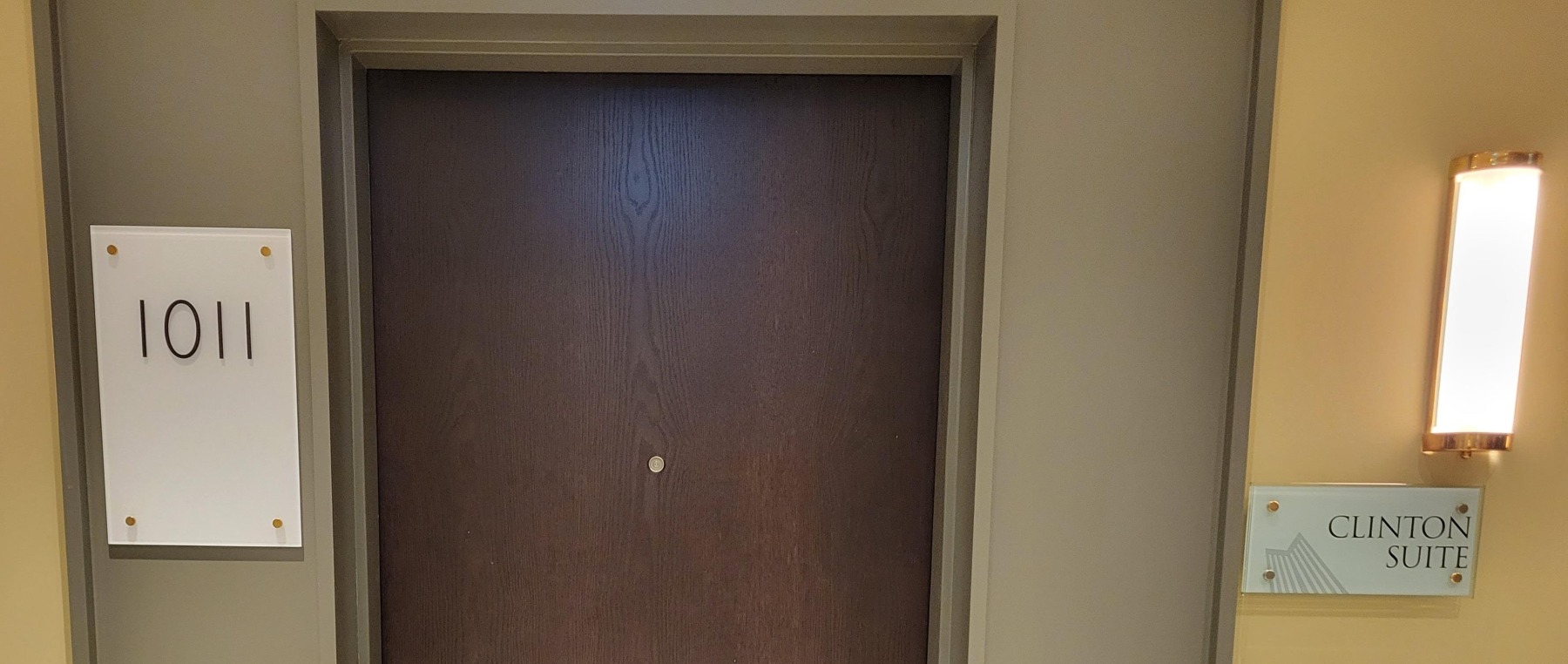
During a visit to Belfast, Northern Ireland several years ago, we by chance stayed in the same hotel where United States President Bill Clinton had stayed during a November 1995 visit. We later came across other references to his visit while wandering the beautiful city. These occurrences prompted me to discover why President Clinton had been visiting. Read along to discover more about this chance crossing of paths, thirty years later, and President Clinton’s “Remarks at the Christmas Tree Lighting at City Hall.”
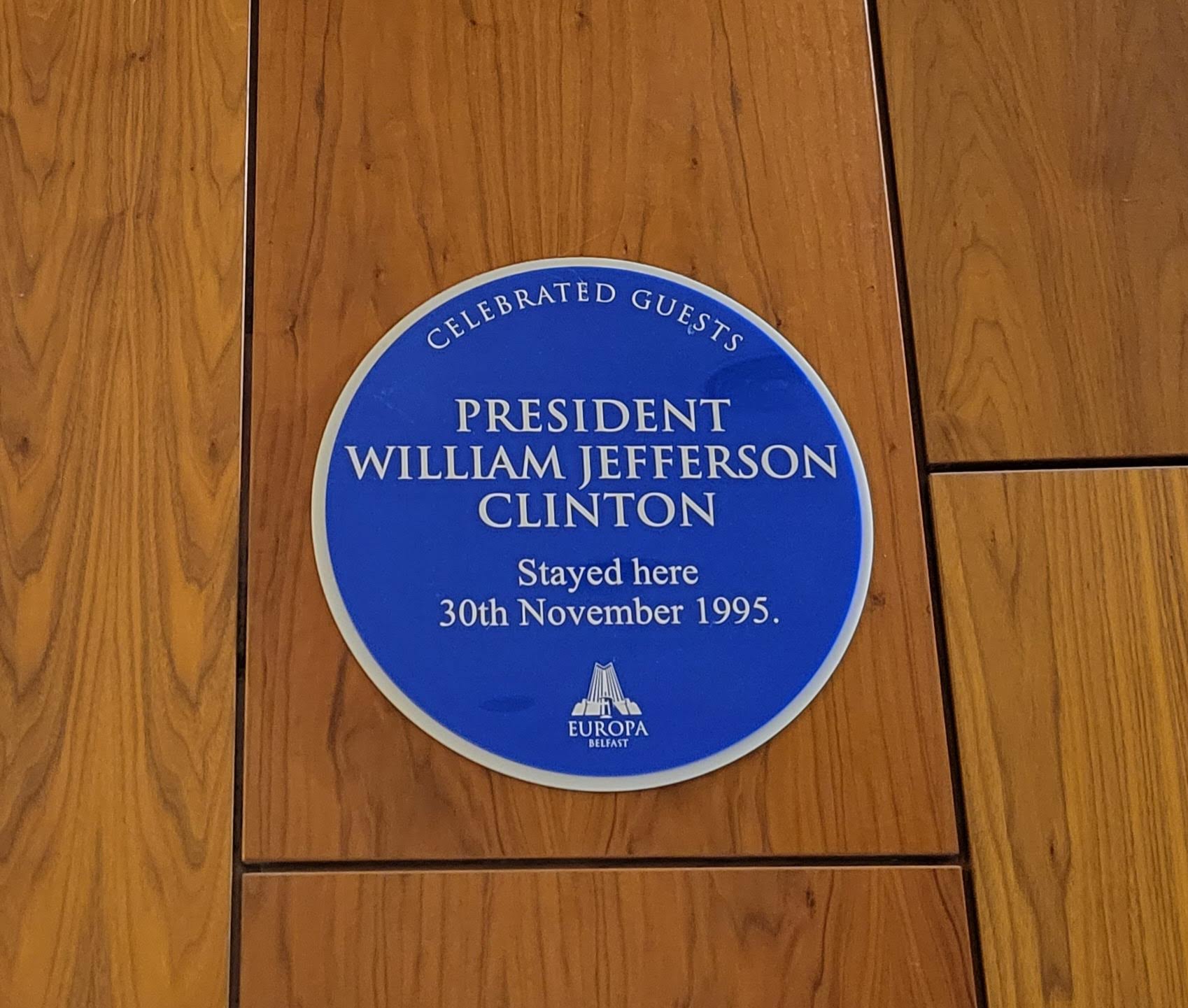
A blue marker at the Europa Hotel commemorating the visit of Bill Clinton to Belfast, Northern Ireland on November 30, 1995.The Clinton Suite at the Europa Hotel in Belfast, Northern Ireland
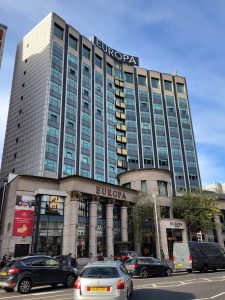
During our visit we had made reservations to stay at the Hotel Europa and couldn’t have been happier with our decision. The location was convenient and safe. The staff were wonderful to deal with, they were always courteous and helpful. The property itself was clean and inviting.
The Europa has been a Belfast destination for more than 50 years. With almost 300 rooms, including many suites, this 4-star property features an on-site bistro, bar, and piano lounge, making it the perfect destination to return to after a day of sightseeing. For a great price on reservations at the Europa Hotel, use THIS LINK.
A view of a room at the Hotel Europa in Belfast, Northern IrelandA different view of the room at the Europa Hotel in Belfast Northern Ireland
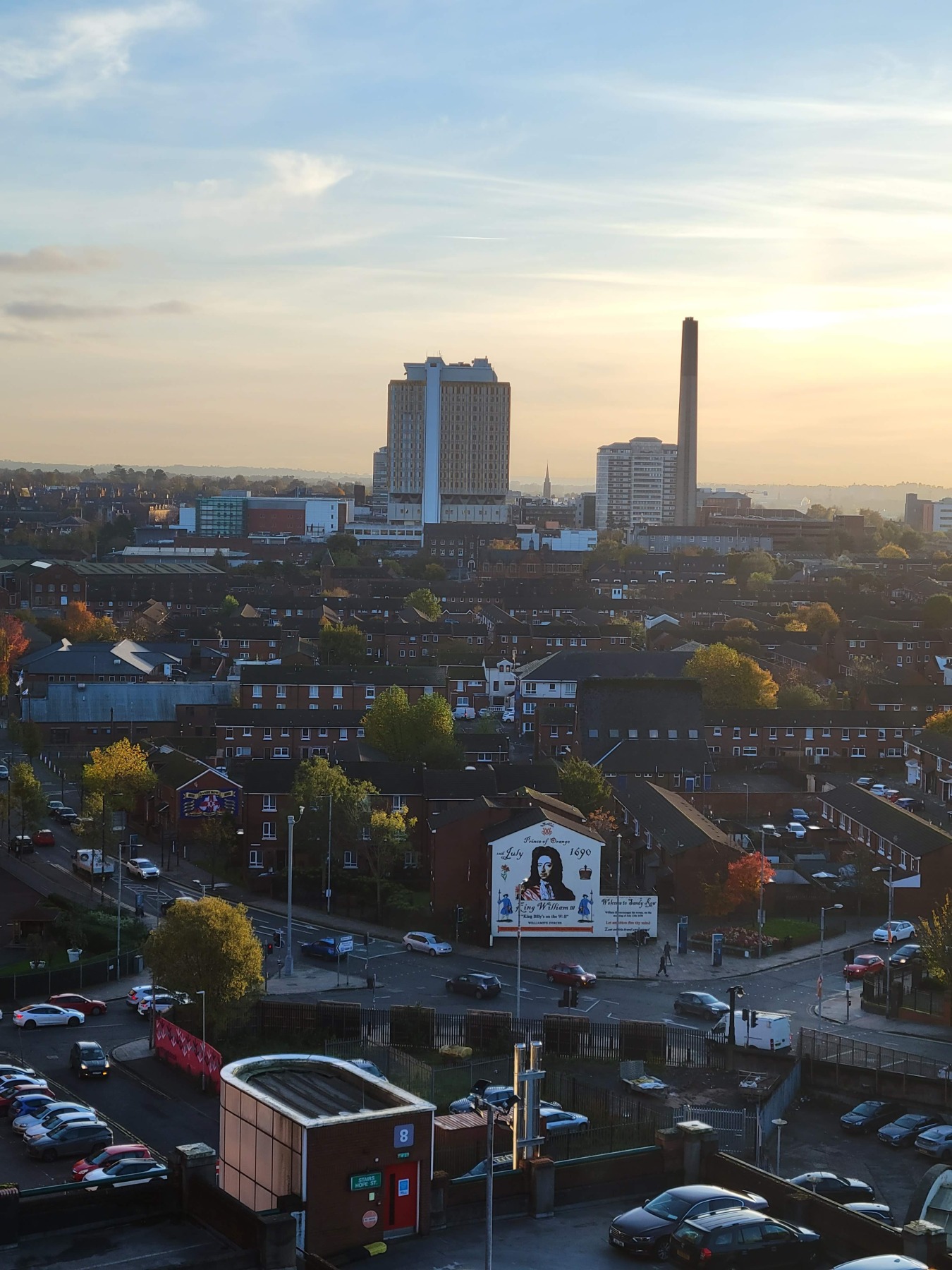
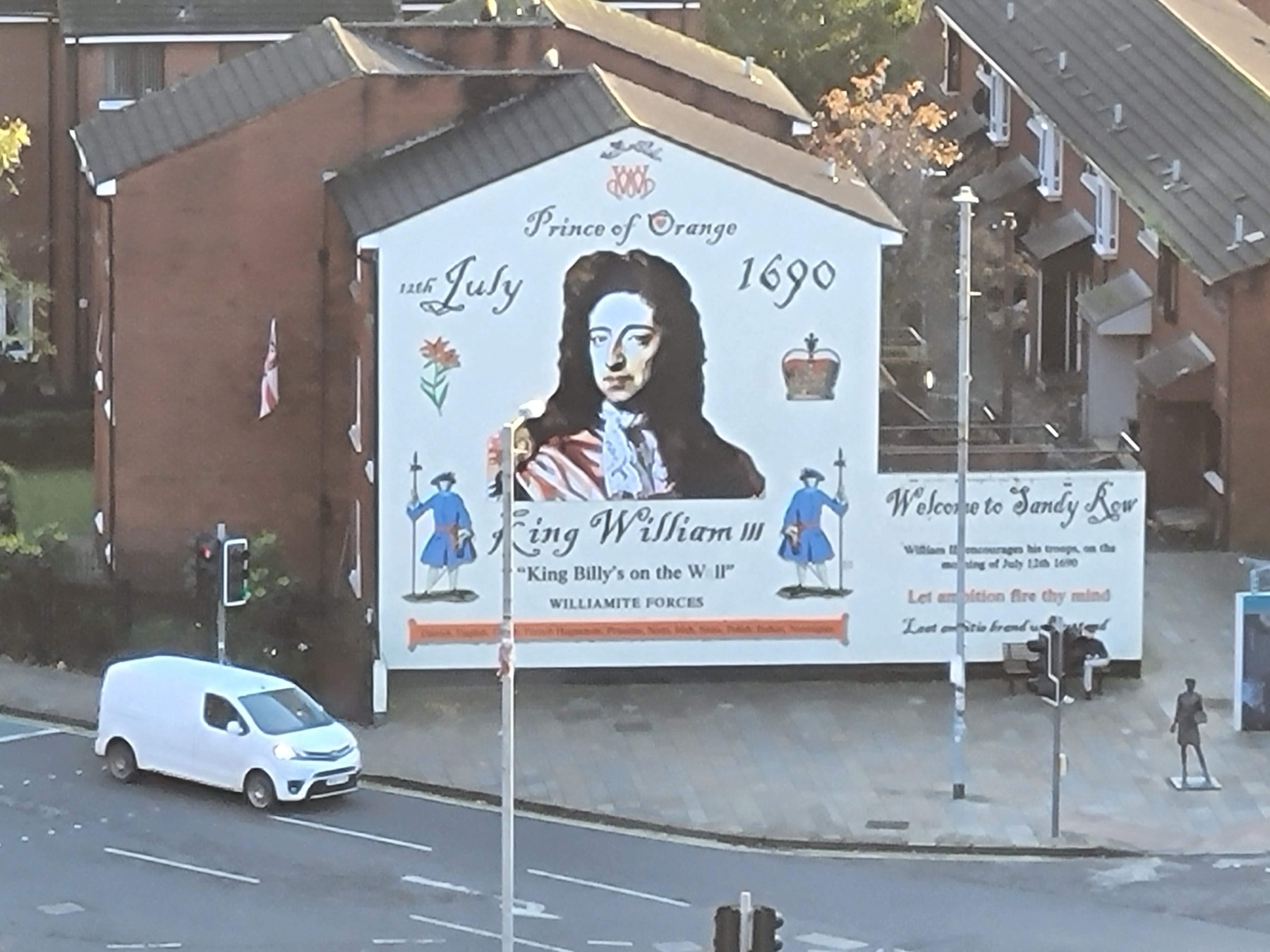
The amazing window view from the Europa Hotel in Belfast, Northern IrelandA zoomed in view of the King William III mural as seen from the Europa Hotel
The Clinton’s Schedule on Thursday, November 30, 1995
Visits by the president and his entourage are always full, time constrained, and stressful for the president, their handlers, and those working to make the visit a success. Bill Clinton’s visit to Belfast in November 1995 was no different as shown from the official itinerary.
President and Mrs. Clinton left their London accommodation by helicopter for Heathrow Airport at 7:30 a.m., departing at 8:05, and arriving at Belfast International Airport (Aldergrove Airport as shown on the itinerary) at 9:10 a.m. for a full day of events.
The president and Mrs. Clinton arrived at the Mackie International Plant at 9:55, giving a speech at around 10:45. You may learn more about his visit to Mackie International using THIS LINK. President Clinton departed at 11:40, arriving at the East Belfast Enterprise Park for a photo opportunity and brief meeting with tenants and managers from this business park and others. The president departs, arriving at City Airport at 1:15 p.m. for a flight aboard Marine One to the City of Derry Airport, arriving at 2:05 local time.
Pin this post for easy reference and to share with your followers.
Derry
President and first lady, Bill and Hillary Clinton arrive at Londonderry Guildhall at 2:35, participating in a presentation with remarks from the local mayor, John Kerr, John Hume, concluding with the president. The Clintons were then whisked away to a receiving line with members of the Tip O’Neil family and representatives or the American Ireland Fund, before at 4:20, participating in a reception for the inauguration of the Tip O’Neil Chair for Peace Studies at the University of Ulster Guildhall. After participating in press and staff photos, the first family depart for the Derry Airport, arriving at 5:25 for their return flight to Belfast, landing at 6:10 that evening.
Return to Belfast
The whirlwind day continued with a fast drive to Belfast City Hall, arriving at 6:30 before participating in the tree lighting ceremony that took place from 7:00 until 7:45. The Clinton’s then participated in a receiving line for members of the Belfast City Council before departing at 8:25 en route to Queens University where they were guests at a reception hosted by Sir Patrick and Lady Mayhew. Sir Patrick Mayhew and President Clinton both made remarks during the reception, before the president and first lady worked a reception line.
Before leaving Queens University, Sir Gordon Beveridge, Vice Chancellor, Queens University, invited President Clinton to sign a scroll commemorating the 150th anniversary of the university, which the president dutifully did.
With their long day complete, the president and first lady departed Queens University at 10:00, arriving at the Europa Hotel only minutes later. A nearly fifteen hour day, not including morning and evening preparations, meetings, and studying, was complete.
Source: “Schedule for the President for Thursday, November 30, 1995 Final,” Clinton Digital Library, accessed February 18, 2025, https://clinton.presidentiallibraries.us/items/show/57321.
Special Note: Today, Queens University is home to the William J. Clinton Leadership Institute. The William J Clinton Leadership Institute was founded in 2011 to support and develop the leadership skills of the Northern Ireland business community, as part of their commitment as a university to the pathway to peace.
Safely store your bags in Belfast before checking into, or after checking out of your hotel, usingRadical Storage, a worldwide leader in luggage storage, with more than 8,000 locations available. Click for full details, locations, and pricing.
Bill Clinton’s Remarks at the November 30, 1995 Christmas Tree Lighting
The Lord Mayor of Belfast, Eric Smyth, Mrs. Frances Smyth,
Image courtesy William J. Clinton Presidential Library & Museum
Ladies and gentlemen, I have run for election many times in my home state of Arkansas and of course throughout the United States when I sought the Presidency–and I have face some tough competition. But never have I confronted challengers with the name recognition, the media savvy, and the martial arts ability of the Mighty Morphin’ Power Rangers. To all of you whose support enabled me to join you tonight, I extend my heartfelt thanks.
I understand the city of Belfast has held a Christmas Tree Lighting ceremony for more than 20 years–but this year the occasion is especially joyous, because you are entering your second Christmas of peace.
Now people can do their holiday shopping without worrying about searches or bombs, visit their loved ones on the other side of the border without the burden of checkpoints or roadblocks, enjoy the sparkling lights of the city without fearing violence. Peace has brought real change to people’s lives.
Across the ocean, the American people are rejoicing along with you. We are joined to you by strong ties of community, commerce, and culture. Over the years, men and women of both traditions have flourished in America and helped America to flourish.
And today, the people of our lands re forging new and special bonds. Belfast’s sister city, Nashville, Tennessee, was proud to send this Christmas tree to friends across the Atlantic. I want to thank Vice President Gore, Mayor Bredeson of Nashville, and the U.S. Air Force for making it happen.
In this 50th anniversary year of the end of World War II, many Americans still remember the warmth the people of Northern Ireland showed the American Army forces that were stationed here under General Eisenhower.
The people of Belfast named General Eisenhower an Honorary Burgess of the city who viewed the honor bestowed on him “as a token of our common purpose to work together for a better world.” That mission endures today. We remain partners for security, partners for prosperity, and most important, partners for peace.
Two years ago, at this very spot, tens of thousands of you took part in a day for peace, as a response to some of the worst violence Northern Ireland had known in recent years.
The two morning newspapers, representing both traditions, sponsored a telephone poll for peace that generated almost 160,000 calls–the equivalent of 25 million calls in the United States. The response left no doubt that across Northern Ireland, the desire for peace was becoming a demand.
I am honored to announce today that those same two newspapers–The News Letter and The Irish News–have established the President’s Prize, an annual award to those at the grassroots level who have contributed most to peace and reconciliation.
The honorees will travel to the United State to exchange experiences on issues we share–such as community relations and conflict resolution. We all have much to learn from each other.
The President’s Prize will underscore that Northern Ireland’s two traditions have a common interest in peace.
As you know, I have received thousands of letters from school children from all over Northern Ireland, telling me what peace means to them.. The letters poured in from villages and cities, from Catholic communities and Protestant communities, from mixed schools, primary schools, and schools for children with special needs. All of he letters were wonderful–for their honesty, their simple wisdom, and their passion.
Many of the children showed tremendous pride in their homeland–in its beauty, and in its true nature. Eleven year old Keith from Carrickfergus wrote: “Please tell everyone in American that we are not always fighting here and that it is only a small number of people who make trouble.” Like many of the children, Keith did not identify himself as Protestant or Catholic, and did not distinguish between violent forces on either side.
So many children told me of loved ones they had lost–of lives disrupted, opportunities forsaken, and families forced to move. Yet, they showed remarkable courage and strength–and a commitment to overcome the past. As 14 year old Sharon of County Armagh wrote, “Both sides have been hurt, both sides must forgive.”
Despite extraordinary hardships so many of these children have faced, their letters were full of hope and humor and love.
To all of you who took the time to share your thoughts with me, thank you for brightening my holiday season with your words of faith and courage.
To all of you who asked me to do what I could to help the peace take root, I pledge America’s support. We will continue to stand with those who take risks for peace. We will work with you to give all of Northern’ Ireland’s children the chance to make the most of their God given potential.
And to 13 year old Ryan of Belfast, if you’re out there: No, an alien spacecraft did not crash in Roswell, New Mexico in 1947. And if the U.S. Air Force recovered alien bodies and didn’t tell anyone about it, it’s news to me.
Ladies and gentlemen, may the Christmas spirit of peace and goodwill flourish and grow in your land.
May the prophecy of Isaiah be realized here: “…ye shall go out with joy and be led forward with peace: The mountains and the hills shall break forth before you into singing, and all the trees of the field shall clap their hands.”
And may the lights on the tree that we celebrate tonight reflect the kindling of hope and faith in our hearts for a peaceful Northern Ireland.
Source: National Security Council and NSC Records Management System, “Remarks at Christmas Tree Lighting City Hall, Belfast, Northern Irelenad,” Clinton Digital Library, accessed February 18, 2025, https://clinton.presidentiallibraries.us/items/show/57453.
Commemorating the Visit
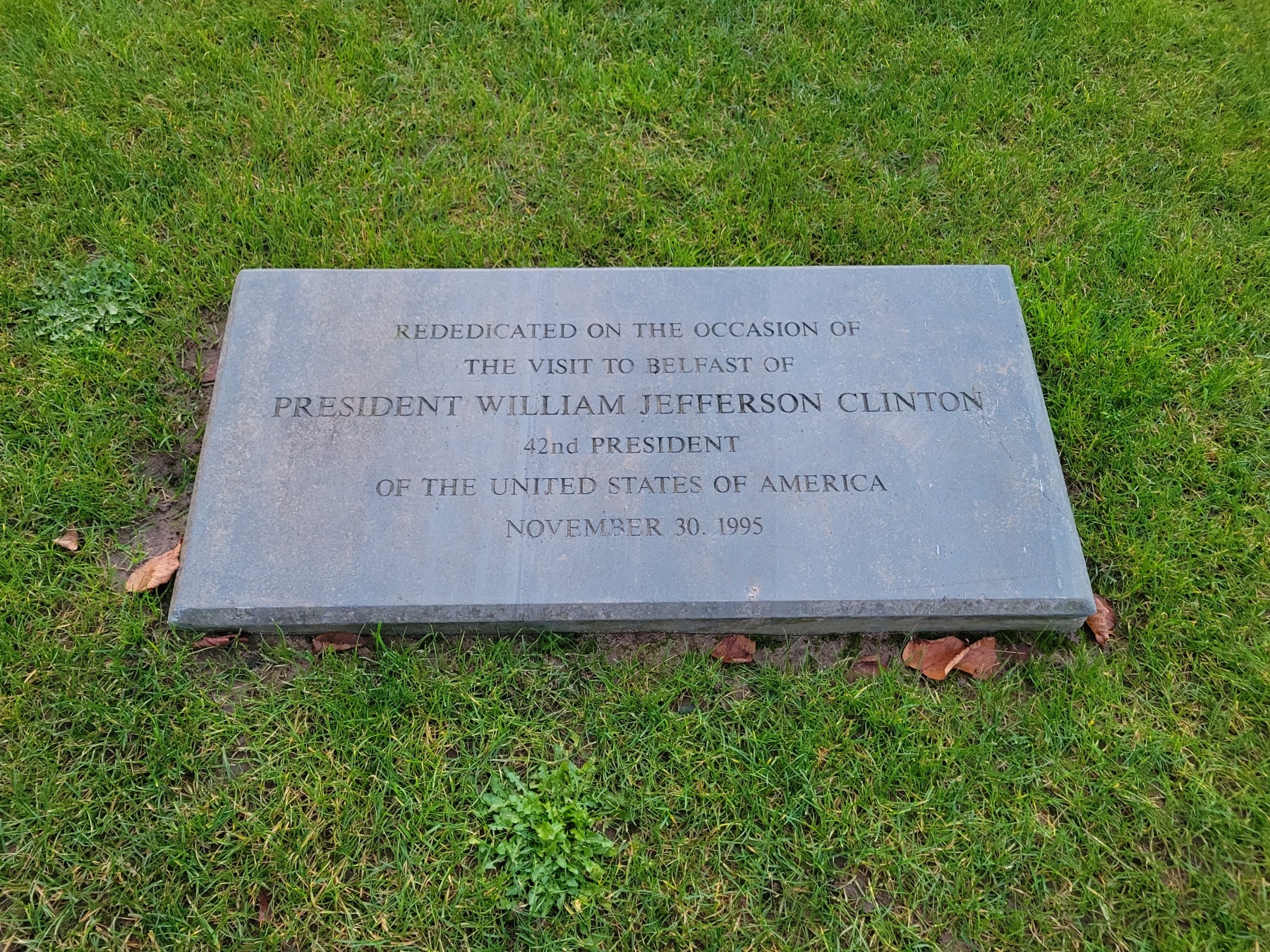
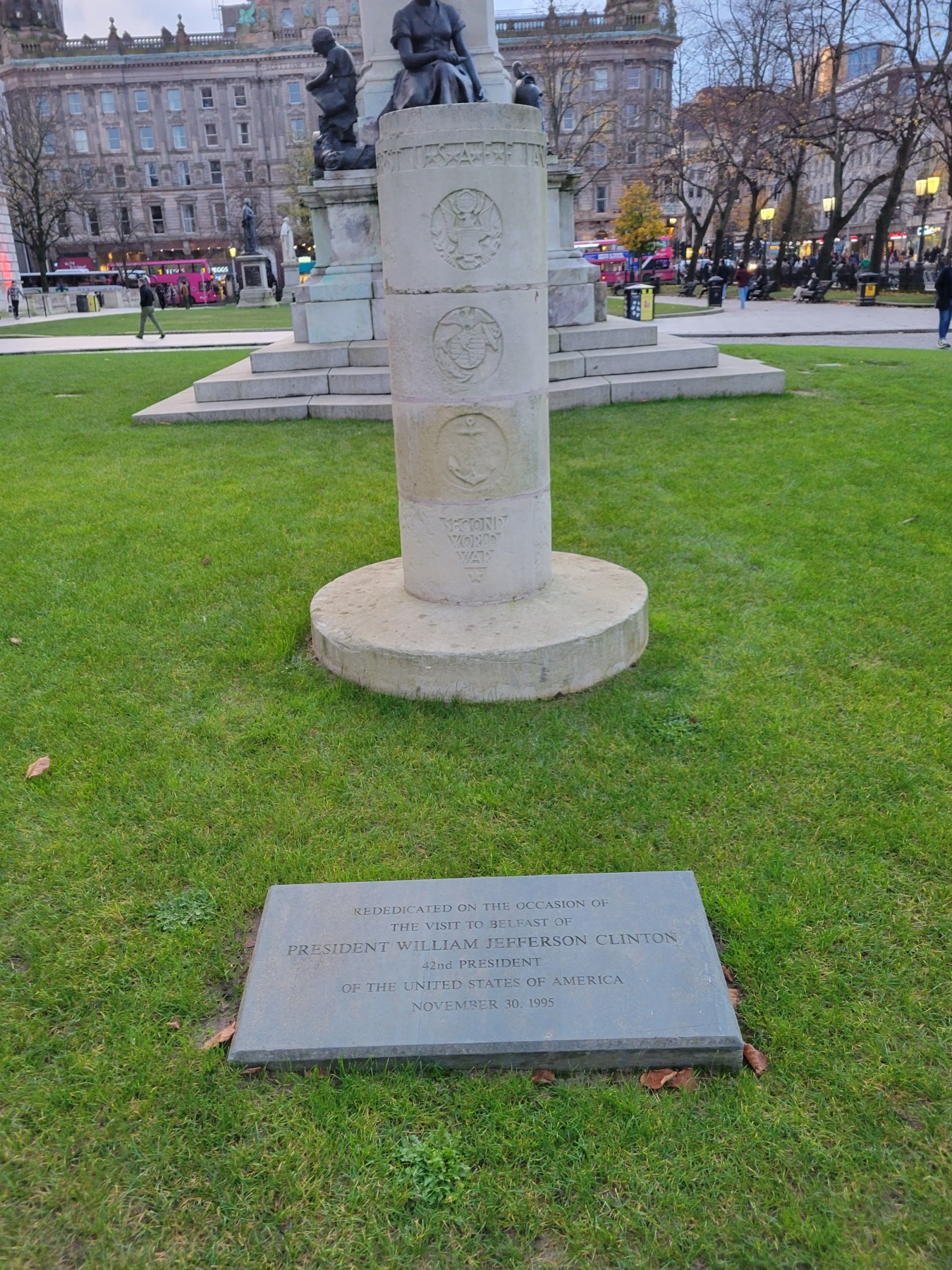
The city of Belfast is rightfully proud of this important presidential visit. Today, visitors can remember the visit with a historic marker placed at Belfast City Hall.
Historic marker commemorating the visit of President Bill Clinton to Belfast, Northern Ireland on November 30, 1995.A wider view of the location of the Clinton marker at Belfast City Hall.
Click the image above to support this site through Buy Me A Coffee. Your helps pay for website fees and maintenance, research fees for blog and book writing, photo usage and rights fees, and other associated costs. And maybe, it will go to buying a bag of coffee to help keep me focused on the research topic at hand.
This post may contain affiliate links. If you click these links and make a purchase, I may receive a small commission. This commission does not affect any price that you pay. Affiliate programs or sponsors providing products do not influence my views and opinions.
Citizen: My Life After the White House, written by Bill Clinton