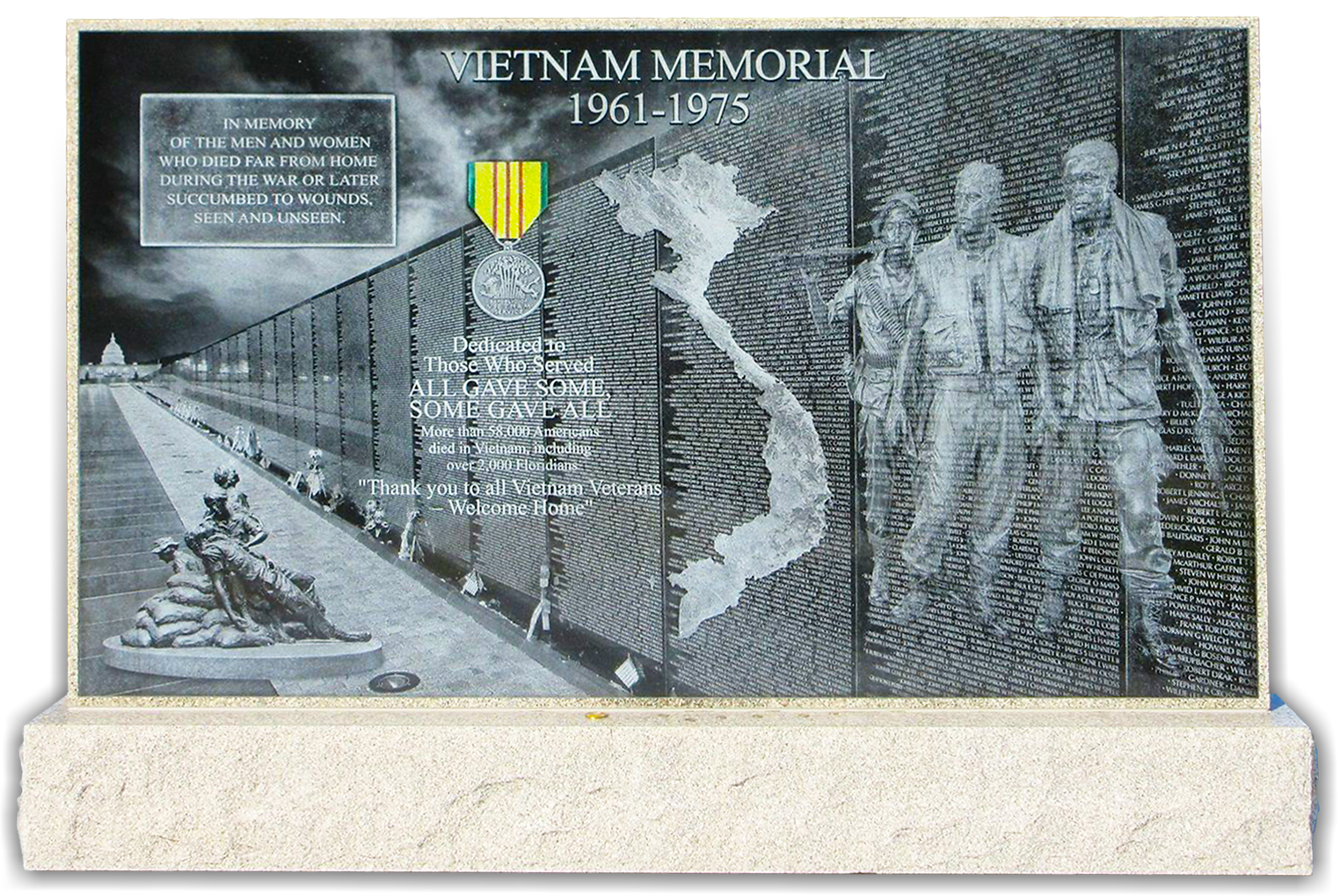
VOLUSIA COUNTY, FLORIDA – To honor local Vietnam veterans and preserve their legacy for generations to come, Volusia County will unveil a Vietnam Memorial Wall at 10 a.m. Friday, March 27, at Veterans Memorial Plaza, 125 W. Orange Ave., Daytona Beach.
The gray granite monument, which is 5 feet high and 8.5 feet wide, will stand on the north side of the plaza against a backdrop of the Halifax River. A black granite panel, etched with scenes from the Vietnam Memorial Wall and Vietnam Women’s Memorial in Washington, D.C., will document the war, those who served, those lost, and those who came home.
Inscribed on the panel are the words, “To All the Vietnam Veterans/Thank You and Welcome Home,” a call to residents to thank a Vietnam veteran, shake their hand, and welcome them home – honors many of them did not receive when they returned from the war.
Volusia County Veterans Services Director Scott Olson noted that the monument will also serve as an educational tool. It will help capture the duty, honor and sacrifice of Vietnam veterans and their families.
U.S. Army veteran Robert “Bob” Adkins, a sergeant during the Vietnam War, led the effort to bring the monument to Volusia County. As past president of Volusia Vietnam Veterans of America (VVA) Chapter 1048, Adkins spearheaded the chapter’s $35,000 donation.
“The Vietnam Veterans of America Chapter 1048 is proud to have partnered with Volusia County to make this monument a reality,” Adkins said. “This wall will mean a great deal to the veterans who served and to the community that supports them, and we hope it stands as a lasting reminder of the sacrifices made by so many.”
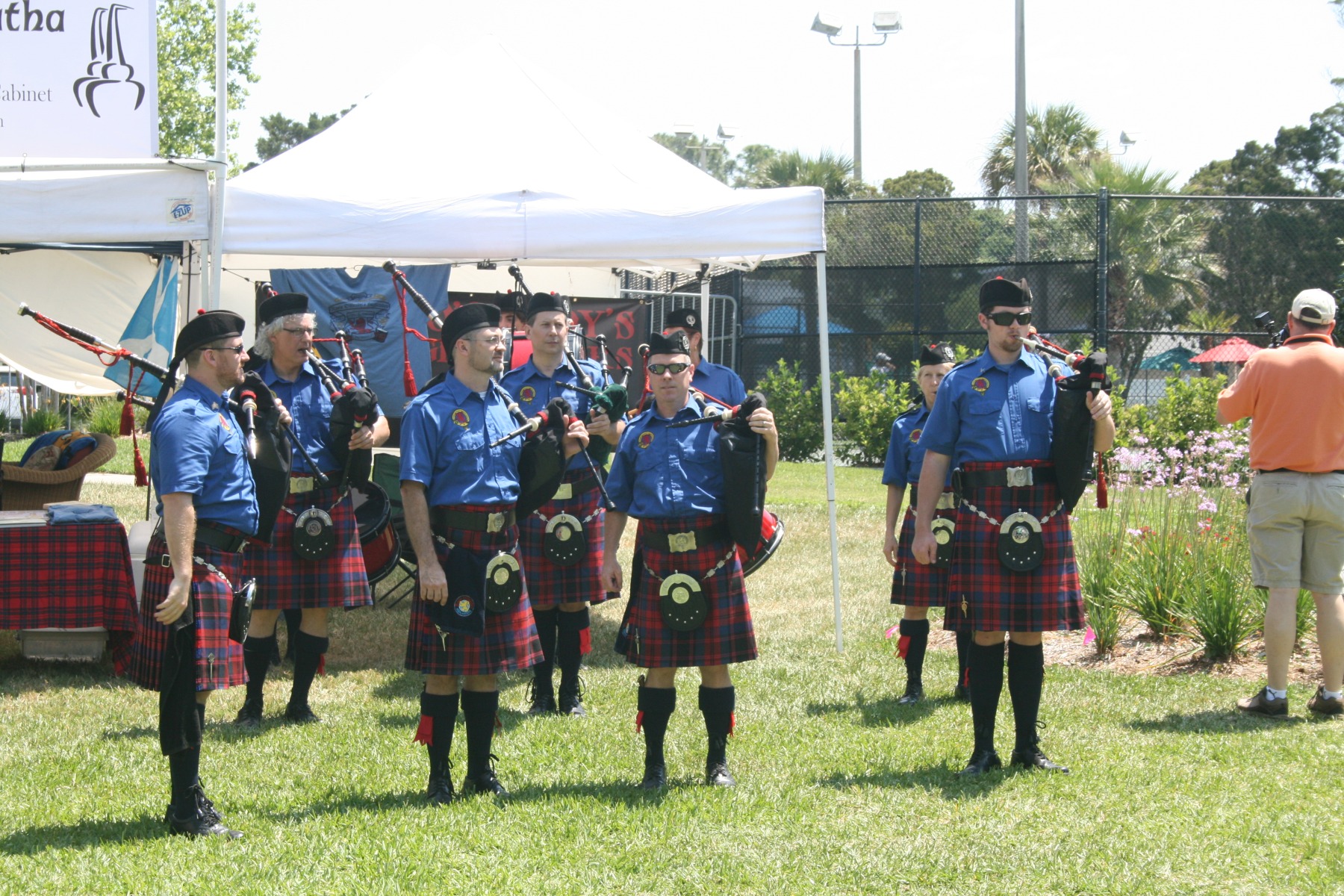
Speakers include retired Gen. James Hartsell, executive director of the Florida Department of Veterans Affairs; State Sen. Tom Wright; State Rep. Chase Tramont; Volusia County Council At-large Member Jake Johansson; and Bob Adkins. VVA Chapter 1048 will serve as the Honor Guard. Coastal Florida Police & Fire Pipes & Drums will provide traditional music to mark the solemnity of the occasion.
Read the story of Staff Sergeant William Lee Owen Brown, a DeLand born man who lost his life when a plane he was flying aboard came under fire while approaching the Khe Sanh Airfield in 1968.
Click the image above to support this site through Buy Me A Coffee. Your helps pay for website fees and maintenance, research fees for blog and book writing, photo usage and rights fees, and other associated costs. And maybe it will go to buying a bag of coffee to help keep me focused on the research topic at hand.
This post may contain affiliate links. If you click these links and make a purchase, I may receive a small commission. This commission does not affect any price that you pay. Affiliate programs or sponsors providing products do not influence my views and opinions.
Men’s, Women’s, or Children’s. Shirts, hats, golf attire, beach attire, and more. Shop their exclusive line of USA 250 gear and celebrate the country’s 250th birthday! Shop Flagshirtfor all your patriotic needs.
Now celebrating their 15th anniversary, the Ormond Beach Celtic Festival 2026 will be bigger and better than ever. This year, the festival occupies two beachside parks along the Halifax River and fills them with multiple music stages, a Highland Games, a Clan Village, and Celtic societies from throughout the region, as well as a host of other activities.
Be sure to look for the free parking, including spaces available at Ormond Beach City Hall, located at 22 S. Beach Street. There will be a free shuttle service to and from the festival.
What is there to do and enjoy
Rockefeller Gardens will be transformed into a Celtic Village, complete with plenty of music, food vendors, craftspeople, a Clan village where you can learn about Celtic heritage and maybe find distant relatives. Did I mention Guinness? Yes, you’ll be able to have a delicious cold one, poured properly.
If it’s the games you are seeking, stroll under the bridge to Fortunato Park. Here you will find more than 60 athletes, men and women, competing for points toward the North American Scottish Games Athletics organization. Four divisions will compete each day and there will be nine different games contested, including the open stone, Braemar, heavy and light hammer, heavy and light weight for distance, weight over bar, sheaf, and the famous Caber!
On Sunday, don’t miss the dog parade. Dogs can be entered in the parade by bringing a contribution of cash or dog food to the Festival to benefit the Halifax Humane Society. There will even be prizes for the best-dressed dog.
This is a great event, with fun for all ages, though you must be 21+ to drink.
Call Ormond Beach Main Street office at (386) 492-2938 for questions.
Click the image above to support this site through Buy Me A Coffee. Your help pays for website fees and maintenance, research fees for blog and book writing, photo usage and rights fees, and other associated costs. It might go to buying a bag of coffee, keeping me focused on the research topic at hand.
This post may contain affiliate links. If you click these links and make a purchase, I may receive a small commission. This commission does not affect any price that you pay. Affiliate programs or sponsors providing products do not influence my views and opinions.
Read below to learn about the 2026 Peabody Auditorium Foundation Scholarship, available to Volusia County high school seniors.
SCHOLARSHIP APPLICATION DEADLINE: MARCH 27, 2026
Dear Volusia County:
The PEABODY AUDITORIUM FOUNDATION SCHOLARSHIP PROGRAM is designed specifically to encourage the pursuit of higher education goals among Volusia County high school seniors pursuing a degree and career in the performing arts (dance, music and theater). It is intended that the award, in the amount of $1,000, will be used to support college and advanced training expenses.
The criteria to qualify requires that the applicant be a Volusia County School graduating senior, is planning to purse a degree and profession in the performing arts, has demonstrated academic potential with a minimum grade point average of 3.0, completes the Peabody Auditorium Foundation scholarship application, provides a biographical essay, and two letters of recommendation.
If you have a Volusia County School high school senior or know someone that may qualify for the performing arts scholarship award, please have the student visit their high school guidance counselor or school website for the Peabody Auditorium Foundation Scholarship application. COMPLETED SCHOLARSHIP APPLICATIONS MUST BE POSTMARKED NO LATER THAN MARCH 27, 2026.
Peabody Auditorium Foundation Scholarships will be announced and awarded at Volusia County School senior award ceremonies in May 2026.
The Peabody Auditorium Foundation phone number is 386-631-1974. They also have a contact page on their website that you can fill out.
Click the image above to support this site through Buy Me A Coffee. Your help pays for website fees and maintenance, research fees for blog and book writing, photo usage and rights fees, and other associated costs. It might go to buying a bag of coffee, keeping me focused on the research topic at hand.
This post may contain affiliate links. If you click these links and make a purchase, I may receive a small commission. This commission does not affect any price that you pay. Affiliate programs or sponsors providing products do not influence my views and opinions.
Take a walk on the wild side as Lyonia Environmental Center(LEC) presents the annual Wildlife Festival. The festival will feature Florida wildlife presentations, environmental displays, kids’ activities, and guided hikes and eco-buggy tours of Lyonia Preserve. An early-bird hike will kick off the day at 9 a.m.
Admission is free, and food will be available for purchase from food trucks, so make your plans to attend the Lyonia Wildlife & Scrub Jay Festival, February 21, 2026.
Click the image above to support this site through Buy Me A Coffee. Your help pays for website fees and maintenance, research fees for blog and book writing, photo usage and rights fees, and other associated costs. It might go to buying a bag of coffee, keeping me focused on the research topic at hand.
This post may contain affiliate links. If you click these links and make a purchase, I may receive a small commission. This commission does not affect any price that you pay. Affiliate programs or sponsors providing products do not influence my views and opinions.
Marine Science Center Dedicates New Artificial Reef Exhibit to Former Volusia County Lifeguard John Crisp
Press release and image courtesy County of Volusia
Originally Posted On: January 23, 2026
Marine Science Center Dedicates New Artificial Reef Exhibit to Former Volusia County Lifeguard John Crisp
The Marine Science Center dedicated its newest permanent exhibit, the John Crisp Artificial Reef Exhibit, during a ceremony held Wednesday, Jan. 21, honoring a longtime public servant whose leadership, commitment to safety and passion for ocean conservation left a lasting impact on Volusia County.
Crisp played a key role in shaping Volusia County Beach Safety into a highly respected, professional operation. As an assistant chief, he emphasized calm decision-making, teamwork and putting public safety first, values that continue to guide the agency today.
His service extended beyond protecting people to protecting the ocean itself, recognizing that healthy marine ecosystems support safer beaches and a stronger community. That commitment made the Marine Science Center a natural place to honor his legacy. Artificial reefs reflect the principles Crisp championed: strengthening marine life, preserving natural systems and investing in long-term solutions that benefit future generations. The exhibit ensures his name is connected to an educational resource that will continue to give back to the community.
Completion of the John Crisp Artificial Reef Exhibit was part of the Marine Science Center’s $4.2 million renovation project, which included expanded classrooms, a coral lab and enhanced living exhibits. Since reopening to the public, the upgraded facility has welcomed thousands of residents, school groups and visitors, strengthening education programs, expanding hands-on learning and improving animal care capabilities.
Marine Science Center Visitor Information
The Marine Science Center is open 10 a.m. to 4 p.m. Tuesday through Saturday and noon to 4 p.m. Sunday. The center is closed Mondays. For more information, visit marinesciencecenter.com or call 386-304-5545.
Click the image above to support this site through Buy Me A Coffee. Your helps pay for website fees and maintenance, research fees for blog and book writing, photo usage and rights fees, and other associated costs. And maybe, it will go to buying a bag of coffee to help keep me focused on the research topic at hand.
This post may contain affiliate links. If you click these links and make a purchase, I may receive a small commission. This commission does not affect any price that you pay. Affiliate programs or sponsors providing products do not influence my views and opinions.
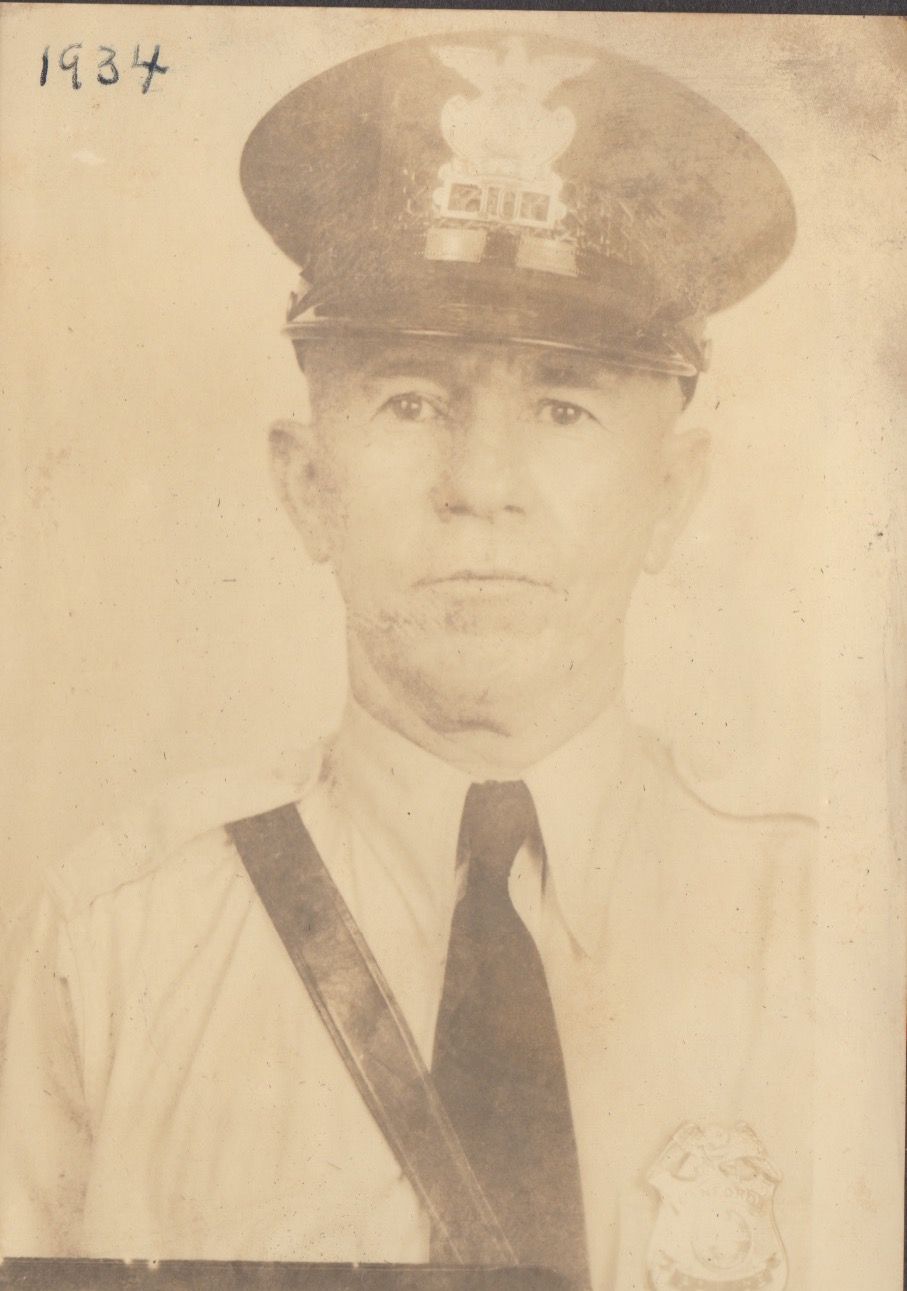
On the night of January 23, 1931, Daytona Beach, FL police officer Banny Praither Stricklin was shot and killed during a shootout with burglary suspect Joe “Nassau Red” Ward.
Banny Praither Stricklin
Banny Praither Stricklin was born in January 1896 to parents James Golden and Sophronia Belle (Brewer) Stricklin, of Wayne County, Tennessee. According to the 1900 United States Census report, father James was a student, at age 26, and Sophronia did not work outside the home. The young Stricklin family lived with James’s parents, Samuel H. and Sarah. By 1910, the younger Stricklin family were living on their own, James working as a surveyor in the Wayne County area. (U.S. Census Reports 1900, 1910)
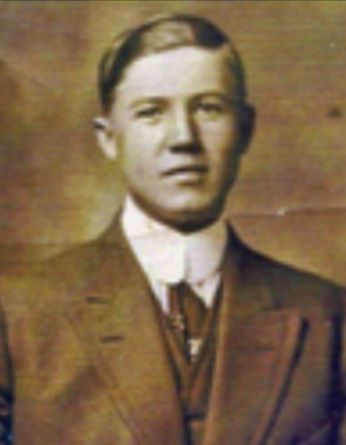
An undated image of a young Banny Praither Stricklin. Image courtesy Findagrave.
Soon, young Banny was to meet Mary Lois Busby and the two were married on October 4, 1914. Banny was only 18 with Lois being around 16/17. The Nashville Banner ran notice of the wedding stating the young couple were wed at the home of Judge and Mrs. E. E. McNely and that “the wedding was a surprise to the many friends of the young couple.” (Nashville Banner 10/10/14)
The young newlyweds quickly started a family with daughter Lera being born in 1916.
With World War I raging and the United States on the verge of full participation, Banny was required to register for the draft in 1917. The Stricklins were living in Collinwood, TN. Banny described himself on his registration card as being of medium build with brown eyes and black hair. He was self-employed, operating a grist mill. The young man requested an exemption from military service, having served two years in the Tennessee State Guard, in the 1st TN Regiment. Further, he was needed at home to care for his wife, daughter, and mother. I cannot see that Stricklin served during the Great War. (World War I Draft Registration Card)
By 1920, the still quite young family were living with Lois’s family in Lawrenceburg, TN. Little Lera and the family had welcomed a second daughter, Anita, to the family in 1919. Banny was employed as a construction worker, working with his father in law.
Some time during the late 1920s, the Stricklin family broke from their family ties and moved to Daytona Beach, FL. Here, they rented a home, hoping to start a new life. Banny owned Strickland Service Station, while Lois worked out of the home and was the primary caregiver to the children. Perhaps seeking to provide a stable living for his family, Banny accepted employment with the Daytona Beach Police Department in December 1930.
Named for the figures and landmarks that have helped make Milwaukee what it is today, our boots are a hand-crafted nod to our city’s wealth of industry and work ethic. They’re made for those who crave real craftsmanship. Those who work hard and are fearless when it comes to failure. For those who hold on to true grit, determination, and will be damned if their boots don’t follow suit. Click the link or image and learn more about Milwaukee Boot Company and to place an order.
Crimes That Evening
The early morning hours of January 23, 1931 were eventful ones for Daytona Beach Police Officers. The area south of what was then Halifax Boulevard, now International Speedway Boulevard, was the scene of several home intrusions. Ultimately, one police officer was shot, dying several hours later from his wounds.
M.C. Jones, of First Street, reported the loss of five dollars from his room. A.J. Burch, who lived on S. Beach Street reported chasing a “negro” intruder from his home around 1:30 a.m., firing off two shots in the process. Whether these minor crimes could have been pinned on the same individual who later killed Officer Banny P. Stricklin, is unknown.
According to reports, around 3:00 a.m., Howard Elting of S. Ridgewood Avenue, was awakened to find an intruder in his room who demanded money. Elting’s shouts awakened his wife and maid who were asleep upstairs in the home. When Elting told the intruder he had no cash, the man made off with a pair of pants and an overcoat.
Mrs. Elting screamed awakening the neighbors. Mr. Elting pushed the assailant out a door, though neither he nor his wife managed a good look at the intruder. The burglar left quickly into the night, carrying a flashlight and his pilfered clothing.
The Killing of Officer Stricklin
Officers were quickly on the scene. Sergeant Roy Tillis, Banny Stricklin, and “two negro patrolmen,” R.C. Clark (I believe this memorial to be for the correct person) and Clarence Roberts gave chase. They tracked the unknown robber to the neighborhood of South and First streets. Sergeant Tillis placed his men at “strategic points,” and ran in search of additional help.
The three officers patrolled their assigned territory, seeking to prevent a getaway. Clark and Roberts reported gunfire; two sharp discharges preceding a much heavier sounding shot. The officers heard Stricklin yell that he had been shot. Rushing to the intersection of South and First, the two officers found Stricklin lying in a pool of blood, where he soon lost consciousness.
Stricklin, gravely wounded, was rushed to Halifax district hospital. Surgeons Joseph H. Rutter and James Ralston Wells quickly found Officer Stricklin had been shot in the right shoulder, a major artery being severed, accounting for the considerable loss of blood. Patrolman Stricklin, on the force less than one year, passed at 10:10 a.m. from severe loss of blood. He is claimed to have said to a fellow officer, “He got me. I’m going to die. Oh, my poor wife and babies.” (Shooting details: Daytona Beach News Journal 1/23/1931)
The immediate investigation determined that Stricklin’s gun had two empty chambers, matching the sounds reported by Officers Clark and Roberts. Local residents however disagreed with the two officers sequence of events, stating the loud, heavier shot was first, followed what would be Stricklin’s two rounds. Residents aroused by the commotion claimed to have seen a seen the assailant, describing him as a “negro wearing a brown overcoat.” (DBNJ 1/23/1931)
The DeLand Sun News provided a racially charged description of the murder suspect stating “that the negro was a light brown or ginger bread color, tall, slim, and stoop shouldered. He was apparently from 35 to 38 years of age and weighed about 165 pounds. The negro is said to have worn a light cap, an overcoat which had been stolen and which was of a light brown or tan color. In this overcoat was a leather cigarette case, a whistle, and some keys. The coat had a New York label in it. ” (DeLand Sun News 1/23/1931)
At Gate Operators Direct, we are committed to providing high-quality, durable, and reliable gate automation solutions for residential, commercial, and industrial properties. As a trusted supplier in the industry, we offer a wide range of gate openers, accessories, and security solutions, ensuring homeowners and businesses have the best products to secure their properties with ease.
Immediate Reaction
As happens when a law enforcement officer is killed, action was swift in trying to name and apprehend the accused. A $100 reward was quickly put forward by the City of Daytona Beach. The city was littered with handbills and posters seeking information and residents were quick to respond. Unfortunately, the tips led nowhere quickly.
A jury of inquest into the shooting was held which proved inconclusive. Both officers Clark and Roberts were unable to identify the gunmen and could not state with certainty the man’s race. Howard Elting testified about the intruder at his residence but as with the officers, could not state conclusively if the man was White or Black.
Muddying the waters was the testimony of Dr. Joseph Rutter, who stated the wound suffered by Stricklin would have caused him to bleed to death almost immediately. Rutter stated the right hand firing Stricklin almost certainly would have had to have fired first, because the wound would have paralyzed his arm. The men of the jury discounted the possibility of Stricklin firing with his left hand due to the rapid discharge sounds reported.
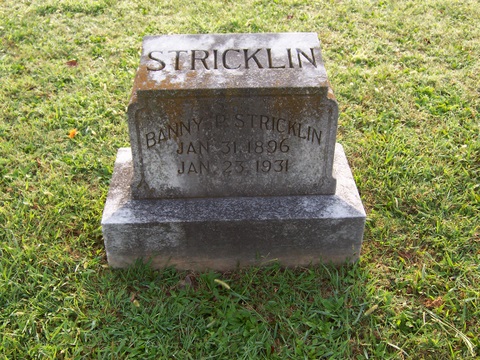
The headstone for Banny Praither Stricklin. Image courtesy Findagrave.
The body of Banny P. Stricklin was handled by the local funeral home, Baggett-Wetherby, and was loaded on a train, which departed for Waynesboro, TN, the day after the murder. The Stricklin family was onboard as well, with it being reported they would be leaving Daytona Beach to live with family in Tennessee. Young officer Praither was laid to rest in McGlamery Cemetery, in Collinwood, TN. (DBNJ 1/25/1931)
During the inquest, Officers Clark and Roberts testified they had seen the robbery suspect race into a wooded area prior to their fellow officer being mortally wounded. Roberts encouraged Clark to go with him into the dark area in an attempt to apprehend them. Clark testified that he was afraid to follow and refused. For his lack of action, Officer R. C. Clark was relieved of duty. In announcing the termination, Daytona Beach Police chief Charles J. Luke stated, “We cannot have men on the force who are afraid to face the music. It’s unpleasant, but that’s what we are for.” (DBNJ 1/26/1931)
In the wake of R.C. Clark being relieved of duty for failing to act, a new officer was needed and Chief Luke wasted little time in filling the opening. As reported in the News Journal, “Jessie Mitchell, negro, will carry out the police duties formerly executed by Patrolman R.C. Clark…” (DBNJ 1/29/1931)
GARVEE is a leading brand that specializes in equipment and tools, developed and managed by Garvee lnnovation lnc.GARVEE offers a wide array of commercial equipment to fulfill a variety of business needs, ranging from DIY tools to maintenance, repair, and operations (MRO) products across multiple applications. Our inventory spans business & industrial tools, agricultural supplies, furniture, plumbing solutions, gardening essentials, outdoor gear, home necessities, as well as automotive parts & repair tools, and robust commercial kitchen equipment. Click the link or image to discover the wide range of tools and equipment offered by GARVEE, all at great prices.
An Arrest
For more than two weeks, there was seemingly little to report and it certainly had to feel as if the trail had grown cold. Two days after Valentine’s Day, on February 16, 1931, news broke that “a negro” by the name of Joe Ward, using the nickname “Nassau Red,” approximately 35 years old, was being held in a Miami jail awaiting Constable George L. Haney to arrive and whisk him back to Volusia County where murder charges awaited him.
Police chief Charles Luke, using informant information from one of five known Ward compatriots, tracked the shooter to Miami where Nassau Red was located, already behind bars, suspected in the robbery of a Miami Beach home. Miami police willing gave up the murder suspect and he was immediately brought back to Daytona Beach, arriving at 3 a.m. in the morning of the 17th. (DBNJ 2/16/1931)
It didn’t take long for the accused to confess to being the shooter. By early afternoon on February 17, Ward had confessed and waived his preliminary hearing. He was to be transported to the county jail facility in DeLand and held for trial. It went unreported whether Ward had received legal counsel at this time. (DBNJ 2/17/1931)
Ward would not be alone in jail for long however. Only days later, Constable Haney made the long drive to Miami a second time, returning with Clyde Morrison, a 25-year old “negro,” who was held for being an accessory before the fact according to the warrant. Morrison appeared before justice Charles L. Beers for a first hearing on February 23 with Joe Ward testifying as a witness.
Ward testified that it was Morrison who acted as his driver and had supplied the weapon used in the shooting of officer Stricklin. Arresting officer Haney testified that Morrison admitted selling the weapon to James Gaskin and that he, Haney, had recovered the weapon from Gaskin.
The accused was represented by attorney Paul W. Harvey. Harvey attempted to provide Morrison with an alibi, placing Jannette Falson, Morrison’s “sweetheart” on the stand. She stated the accused as with her from 8:30p until 2:30a. Morrison’s mother testified that he arrived home at 3:00a.
As would have been expected, Morrison was ordered held for trial and placed in the county jail in DeLand. (DBNJ 2/22/31, 2/23/31)
In early April, Morrison, with the assistance of a new attorney, Elmer Jones, was granted a habeas corpus action with Judge Marion G. Rowe presiding. Bond for the accused was set at $5,000, but there appeared to be no immediate action with Morrison remaining in custody. (DBNJ 4/3/31)
Trial
Leroy “Roy” Tillis. Image courtesy Findagrave.
Court actions began in earnest during the second week of July. A grand jury was convened on July 9 with ten witnesses summoned to provide testimony. Called before the grand jury were police chief Charles J. Luke, officers Roy Tillis and J. M. Durden, constable George L. Haney, E. V. Dickman, Clyde Morrison, Lilly M. Lloyd, Nora Adams, James Gaskin, and the accused, Joe Ward.
The grand jury returned with a charge of first degree murder with a trial date set for July 20, 1931. Ward entered a plea of not guilty to the crime charged, which carried with it a death penalty. The court appointed Joseph A. Scarlettto serve as defense counsel. The same grand jury returned a no true bill against Ward conspirator Clyde Morrison. A no true bill meant that they were unable to determine if there was enough evidence against Morrison in order to prosecute at that time. It did not mean they believed him innocent. Morrison was held as a material witness on a $1,000 bail. (DBNJ 7/8/31, 7/13/31)
Court proceedings moved quickly. The same week as a the grand jury indictment, judge Daniel Simmons drew a venire (pool of jurors) of 18 regular and 36 special to potentially serve as jurors for the trial. These same jurors were also called for two additional first degree murder cases. State attorney Murray Sams, known as an aggressive prosecutor, stated that “We are ready for trial Monday…” (DBNJ 7/16/31, 7/19/31)
The trial of Joe Ward took place at the Volusia County Courthouse, in downtown DeLand, to much fanfare as would be expected in such a significant case. A jury was quickly selected in the morning. The defense excused four jurors using peremptory challenges; C.L. Stone, Eric Causey, Arthur B. Wilkinson, and Fulton F. Smith. Two jurors were excused for “conscientious scruples;” F.J. Nordman and John “Pat” Sheedy.
The final empaneled jury included G.R. Brownlee, E.H. Washburn, G.W. Horn, J.G. Cade, J.M. Hughes, Herbert C. Russell, R.O. Kirchoff, Harry Eastman, G.B. Thomas, N.H. Harper, George W. Tanner, and D.L. Waters.
Murray Sams called the first witness, Dr. Joseph H. Rutter, who dramatically testified how officer Stricklin had bled to death from a bullet severed artery. Police Chief Charles J. Luke then identified the bullet which had been introduced as evidence to the jury.
A further parade of witnesses were called by Sams, describing the events of the evening, including robbery and the shooting. Sergeant Roy Tillis described the search for a robbery suspect, leading them to a wooded area. Tillis recounted gathering officers Clarence Roberts and Jessie Clark (earlier reported as R.C. Clark), along with Stricklin and posting them at the woods while he attempted to find additional officers. After hearing of the shooting, Tillis testified, “With officer James McHale, I rushed to the scene. We found Stricklin weltering in blood and unable to walk. I left several officers on the scene in ambush and rushed Stricklin to the hospital where he died a few hours afterwards.”
Next on the stand was officer Clarence Roberts. Roberts stated, “Clark and I were quite a little distance from Stricklin. Suddenly we heard three rapid shots and a call for help from the officer. I rushed to his aid and Clark followed later. I sent him [Clark] to telephone headquarters. Stricklin gave a description of the negro who shot him and told which way he went. Soon the other officers arrived.”
Clyde Morrison, Ward’s accomplice, was called and proved a key witness for the prosecution. Morrison testified that on the day after the shooting, Ward visited him and left the murder weapon in his [Morrison’s] possession. Morrison testified he later agreed to drive Ward to Cocoa for ownership of the gun and ten gallons of gas. Morrison claimed he agreed to this arrangement out of fear.
From here, the ownership of the weapon becomes a bit muddled as Morrison claims he sold the weapon to James Gasque, a Black man from Daytona Beach. Gasque took the stand and stated he turned the weapon over to Constable Haney, who himself took the stand to identify the weapon.
Defense attorney Scarlett attempted to downplay the testimony of Morrison by showing he had been in jail on charges related to this crime. Judge Simmons however reminded jurors that this was done at court order due to his status as a witness.
While on the stand Constable George Haney brought forth perhaps the most stunning testimony and evidence of the trial. Haney brought forth the signed confession from Ward, stating he had seen a copy of this. The typewritten confession in question was given in the presence of attorney Louis Ossinsky and stenographer Lily (Nellie according to the DeLand Sun News) M. Lloyd. Lloyd testified that while Ossinsky was questioning Ward, Ward stated he wished to confess. Attempts by defense counsel to put Ward on the stand to refute the testimony from Ms. Lloyd proved unsuccessful. The confession was read into evidence by attorney Murray Sams.
Witnesses who closed out the day’s testimony included William O’Shea who identified Ward as having purchase twelve bullets from him the day prior to the murder, and W.C. Jones, a man whose home had been robbed the night of the murder.
With his role of witnesses complete, state attorney Murray Sams rested his case at 3 o’clock.
Defense attorney Joseph A. Scarlett faced the unenviable, and near impossible, task of defending a man accused of killing a law enforcement officer when a signed confession was allowed into evidence. Faced with few options, Scarlett put the accused on the stand to attempt to defend himself. Ward claimed he was coerced into making a confession and that he testified against Clyde Morrison out of fear of the police. Ward testified that chief Luke told him he would never reach the county jail if he didn’t sign the confession. “I confessed what he told me to confess. I wasn’t scared of Chief Luke, but of what they might do to me.”
As would have been expected, Sams easily dealt with Ward, with Luke, Ossinsky, and Lloyd all denying Ward’s claims, while enticing him to admit he was a sailor who made frequent trips to and from Bimini and the Bahamas, returning to the Florida with loads of illegal whiskey as prohibition was still the law of the land. (DBNJ 7/20/31, 7/21/31; DSN 7/21/31)
To learn more about Prohibition in Florida, I invite you to read Florida Prohibition: Corruption, Defiance, & Tragedy, written by Randy Jaye. You may also order this excellent title directly from the publisher, Arcadia Publishing. If you order any books directly from Arcadia, use my discount code REDD24 and save 15%.
Whether you want to watch your favorite streaming services or play online games with no lagging, at the highest visual quality, the Valerion StreamMaster Plus 2 Laser Projector is for you. This system integrates seamlessly with your Smart Home system. CLICK HERE, or the image, to learn all the details and to place your order.
Verdict
The jury needed only 19 minutes to find Joe “Nassau Red” Ward guilty of first degree murder, a charge which carried the death penalty. His attorney, Joseph A. Scarlett began making plans for his appeal. (DBNJ 7/21/31; DSN 7/21/31)
The following morning, Scarlett filed his motion for appeal with circuit court clerk Samuel D. Jordan, citing multiple reasons for requesting the verdict be set aside and a new trial called. As reported Scarlett’s reasons were: the verdict was contrary to law; the verdict is contrary to evidence; the verdict is contrary to law and evidence; the verdict is contrary to the charge of the court; no evidence was admitted upon which to hinge a premeditated design; the jury was influenced by something other than testimony. Judge Simmons made no immediate ruling on the request. (DBNJ 7/22/31)
On the morning of July 23, judge Simmons ruled in favor of Scarlett’s request with the reasoning that “the verdict is not in keeping with the evidence and would not be sustained by the supreme court.” Having gained this victory, Ward’s attorney, Joseph A. Scarlett entered a guilty plea to second degree murder. While spared the death penalty, Ward was sentenced to life in prison. The following week he was transported to Florida State Prison in Raiford. (DBNJ 7/23/31; 7/28/31)
The Killer
Little is currently known about Joe “Nassau Red” Ward. As he confessed to in the trial, he worked as a sailor, importing illegal liquor into the United States during the prohibition years. Through his movements after the crime, he can be traced to the Miami area. Whether that was a permanent home or just out of convenience is still unknown.
Unfortunately, with a common name like Joe Ward and little else to go on, tracking his life is exceptionally difficult. Newspaper accounts show that in November 1938, he requested a pardon, which was denied.
One helpful bit of information was that he served time at the Florida State Prison Farm & Hospital in Union County, FL. Through that small lead, I was able to find Ward in the 1940 US Census. Through the Census record, we learn that Ward was born in approximately 1896, which made him 34 or 35 years old at the time of his crime. Unfortunately, the report lists his birthplace as Florida, providing no further clues to locating earlier records. Ward was uneducated, having completed only the third grade.
Ward’s time in prison is currently a mystery. A records request for Ward’s prisoner file came back with no record found. That was certainly frustrating but I suppose not unexpected in a nearly 100 year old case.
Ward is not listed in the 1950 US Census for the Florida State Prison. Through Ancestry I was able to locate the Florida State Prison Register, 1875-1959 and luckily did find a record for Joe Ward. Here we find that Ward was granted parole on August 26, 1947. Unfortunately, as often happens, the local press had apparently lost interest in the story and no mention has been found covering this event.
So the big question becomes, what happened to Joe Ward after his release in August 1947. Where did he go? Did he keep clean or return to a life of crime? When did he die and where is he buried? For now, these questions shall remain unanswered.
Memorials
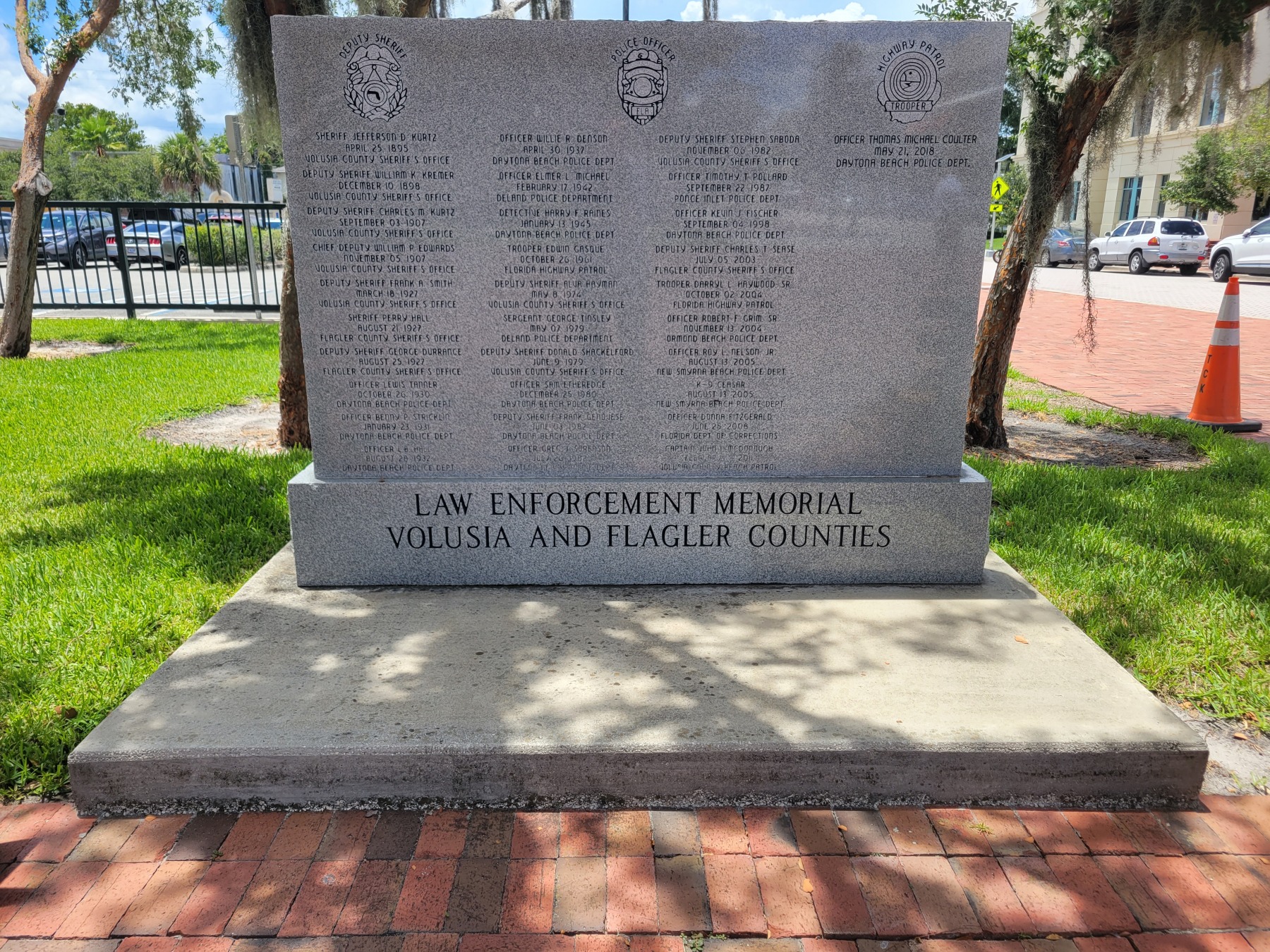
For those in the Volusia County area, there are two memorials which can be visited that pay tribute in part to Banny Praither Stricklin.
Volusia and Flalger Counties Law Enforcement Memorial located outside the Historic Volusia County Courthouse in DeLand
Readers are encouraged to view my post dedicated to the Volusia Flagler Law Enforcement memoriallocated in DeLand, FL. This post will provide you with information and links to other posts about local officers who gave their lives in the line of duty.
Daytona Beach Police Department “Fallen Heroes” memorial
In a peculiar twist of fate, the Stricklin family had suffered tragedy before the killing of Banny in 1931. Stricklin’s father, James G. Stricklin, commonly known as J. G., was a local land agent and trader in Collinwood, TN, who according to the Knoxville Sentinel, “had many enemies in the community, mainly on account of recent activities in connection with some revenue officers.” The Nashville Banner reported that Stricklin “had incurred the enmity of a number of people in the county.” The reason for the apparent dislike is not recorded in any detail. (Knoxville Sentinel 3/1/17, Nashville Banner 2/28/17)
On the evening of February 27, 1917, the elder Stricklin was visiting a friend, J. H. Cole, in Waynesboro. Leaving at the end of the night, Stricklin walked along College Street, unaware danger was lurking near a blacksmith’s shop. Parked on the street near the shop was a log wagon, left overnight for repairs to be made in the coming days.
From behind the wagon, a hidden gunman opened fire at around 10:30 p.m., striking the defenseless Stricklin with nine pieces of buckshot below and to the left of the heart. Local residents, including Katherine Cole, the daughter of Stricklin’s host that evening, raced to the scene and brought the dying man back to the Cole home. The wounded Stricklin would not live long, dying within an hour. Before passing, newspaper reports claim that Stricklin is said to have named who he believed the shooter to have been. That name does not appear to have been released through the press.
A coroner’s jury was quickly impaneled to determine the facts of the murder and who was behind the seemingly unprovoked attack on the otherwise peaceful neighborhood. Working throughout the day after the murder, and despite the possible assailant’s name, the jury returned a verdict that the deceased had met his death at the hands of unknown parties. In a newspaper report more than two week after the murder, it was stated that no arrest had been made.
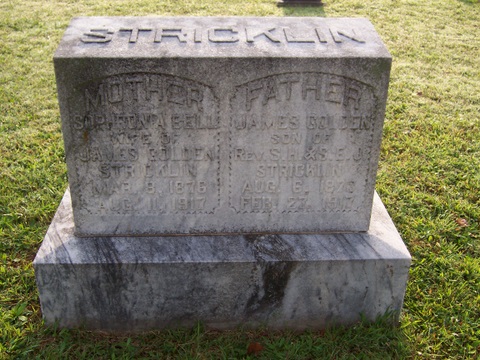
Headstone for James & Sophronia Stricklin. Image courtesy Findagrave
The Nashville Banner reported that in addition to his wife, James “is also survived by a son, aged about 21, Denny[sic] Stricklin.” (Nashville Banner 2/28/17)
James Stricklin was laid to rest in McGlamery Cemetery, in Collinwood, TN. On online memorial may be found HERE. According to Findagrave, Banny’s mother, Sophronia, also passed away later in 1917, but I have been unable to determine the circumstances.
Sources
Daytona Beach News Journal
DeLand Sun News
Findagrave
Florida State Prison Register, 1875-1959 (Records available on Ancestry)
Knoxville Sentinel
Nashville Banner
Tennessee Marriage Records 1780-2022 (Records available on Ancestry)
United States Census 1900, 1910, 1920, 1930, 1940
World War I Draft Registration Card (Records available on Ancestry)
Click the image above to support this site through Buy Me A Coffee. Your helps pay for website fees and maintenance, research fees for blog and book writing, photo usage and rights fees, and other associated costs. And maybe, it will go to buying a bag of coffee to help keep me focused on the research topic at hand.
This post may contain affiliate links. If you click these links and make a purchase, I may receive a small commission. This commission does not affect any price that you pay. Affiliate programs or sponsors providing products do not influence my views and opinions.
Never stop learning. Stream over 18,000 lectures in topics such as history, religion, travel, literature, foreign languages, and more. Click the link below or the image to get started. Welcome to New Home of the Great Courses – Save 20% Off!
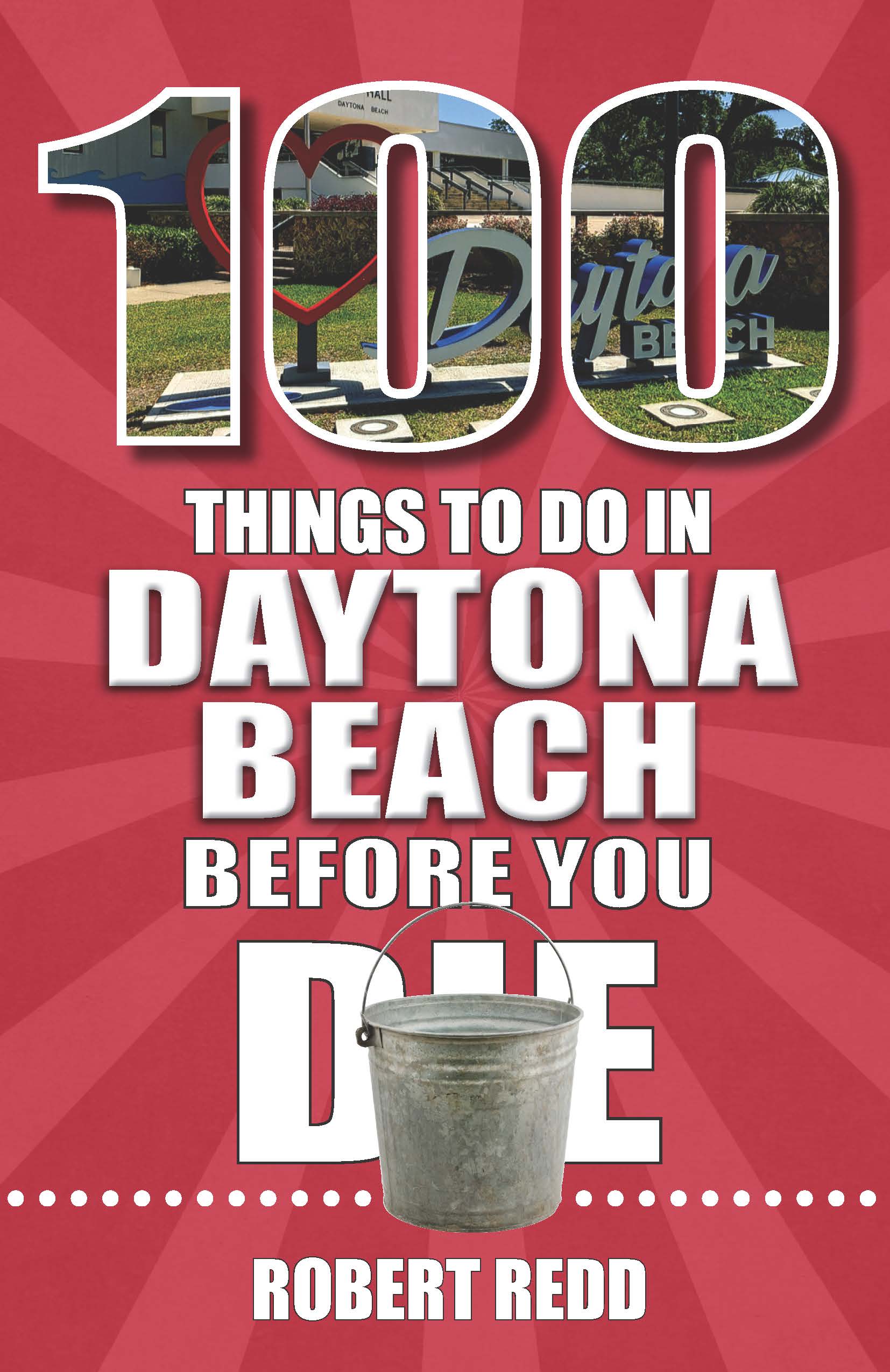
Join me at DeBary Hall for a discussion of my latest book 100 Things to Do in Daytona Beach Before You Die. I will be participating as part of their very popular Lemonade Lecture series.
We’ll discuss some of the lesser as well as well known “must visit” locations in and around Daytona Beach but will also focus on sites closer to DeBary, Orange City, and Enterprise; making this a truly local event. Bring your own ideas to share with the group.
Admission is free.
Signed books will be available for purchase at the event.
The book is being published by Reedy Press, out of St. Louis, and will be available through the publisher. You will also be able to purchase direct from me or at your favorite bookstore. The big websites will have copies for sale also.
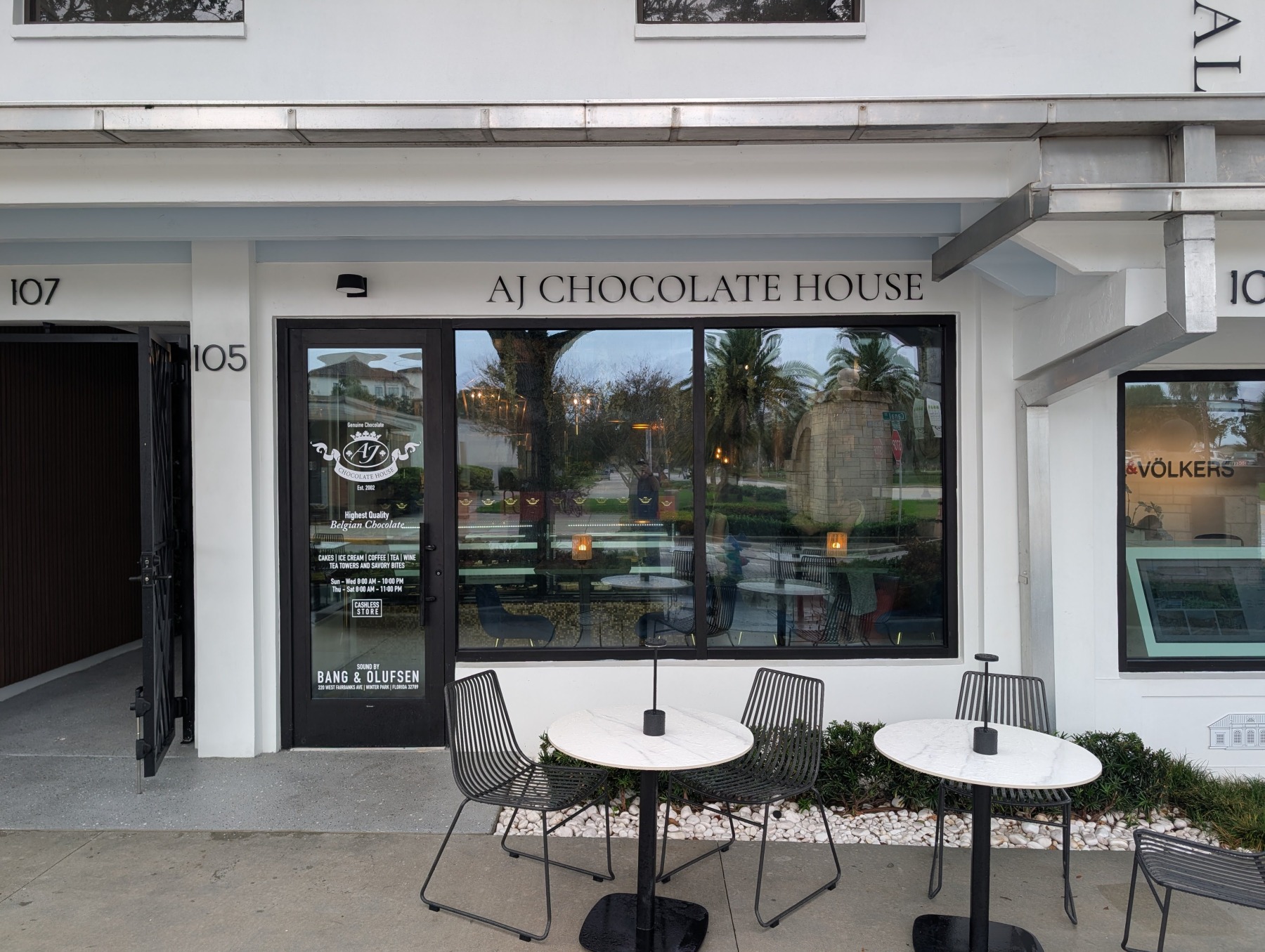
If you have a sweet tooth, or maybe just like to splurge on a piece or two of fine European chocolate from time to time, you have to make the trip to Canal Street in New Smyrna Beach, FL and visit AJ Chocolate House.
105 Canal Street (near the river on the north side of Canal Street)
New Smyrna Beach, FL 32168
321-468-8439
Parking is available on Canal Street or in the lot behind, off Riverside Drive
Use the Google Mapbelow to help find the restaurant
Company Background
While AJ Chocolate House is new to New Smyrna Beach, the concept is hardly a new one. AJ Chocolate House has been around since 2002, tracing its origins to the family home in Vilnius, Lithuania. After a visit to Belgium, Algimantas “AJ” Jablonskas, was inspired to open a fine chocolates shop. The brand expanded throughout Europe, eventually operating 25 locations. Son and daughter-in-law, Edwin and Katherine, opened the brand’s first U.S. shop in Winter Park in 2023. New Smyrna Beach is their second American location.
First, the interior is beautiful. There are tables set up in the front picture window, along the wall, and larger seating spaces in the rear of the building. For those who prefer to sit outside, there are several tables available if the weather cooperates.
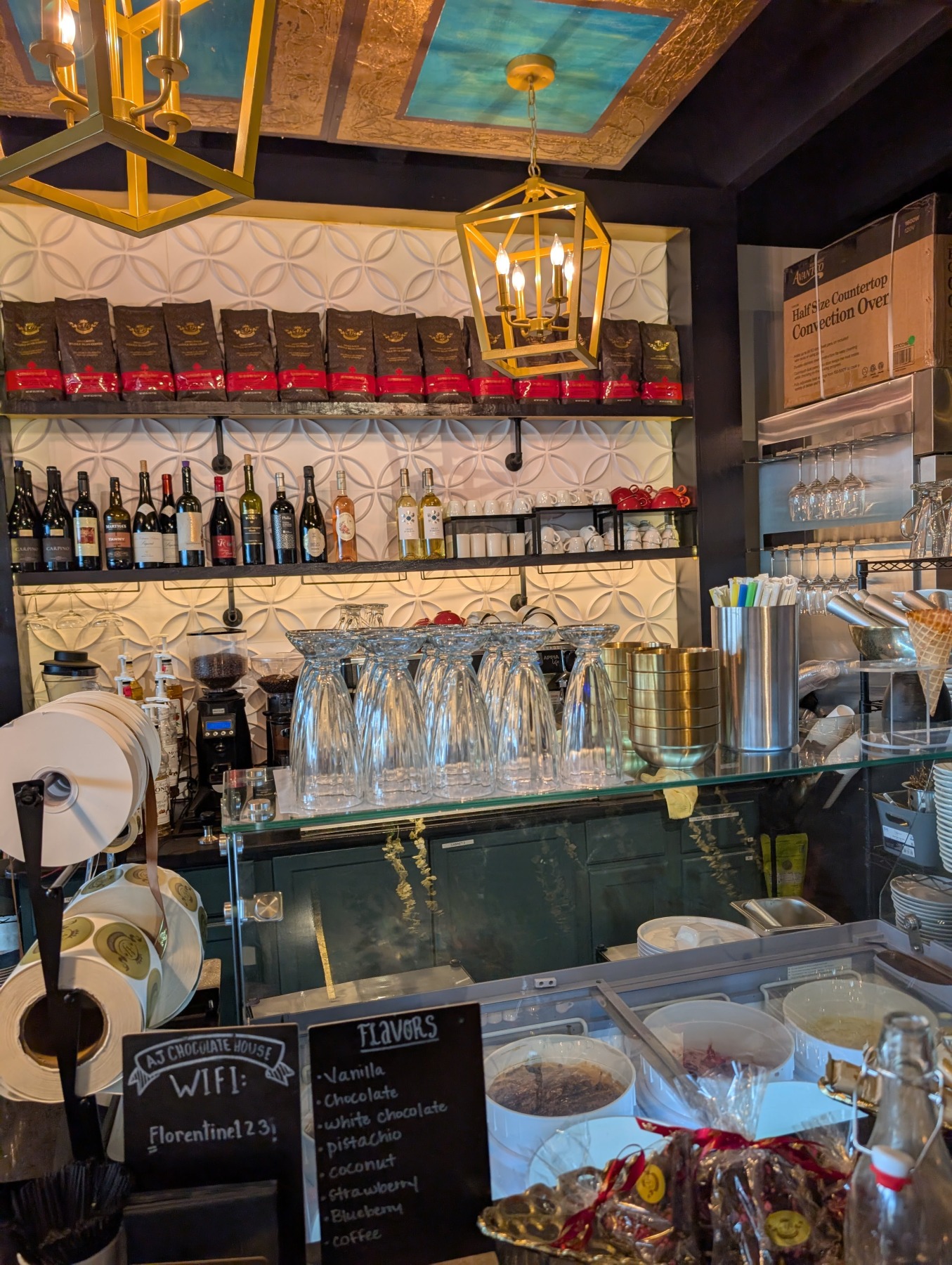
The second easily noticeable aspect is that the place is spotless. Staff was keeping the tables bussed and the floors were clean. Best of all, the coffee bar looked immaculate. Yes, it was being used. The staff however was right on things and everything shined. Finally, staff were wearing disposable gloves, making sure your food and drinks are the freshest they can be.
Next was how friendly the staff were. They were friendly, dressed neatly, and ready to assist. They were able to answer questions about product and exuded a level of confidence in their answers. Drinks were made to order and arrived at our table quickly. It seems that management has done some good vetting of applicants and provided the training needed. Let’s hope that continues.
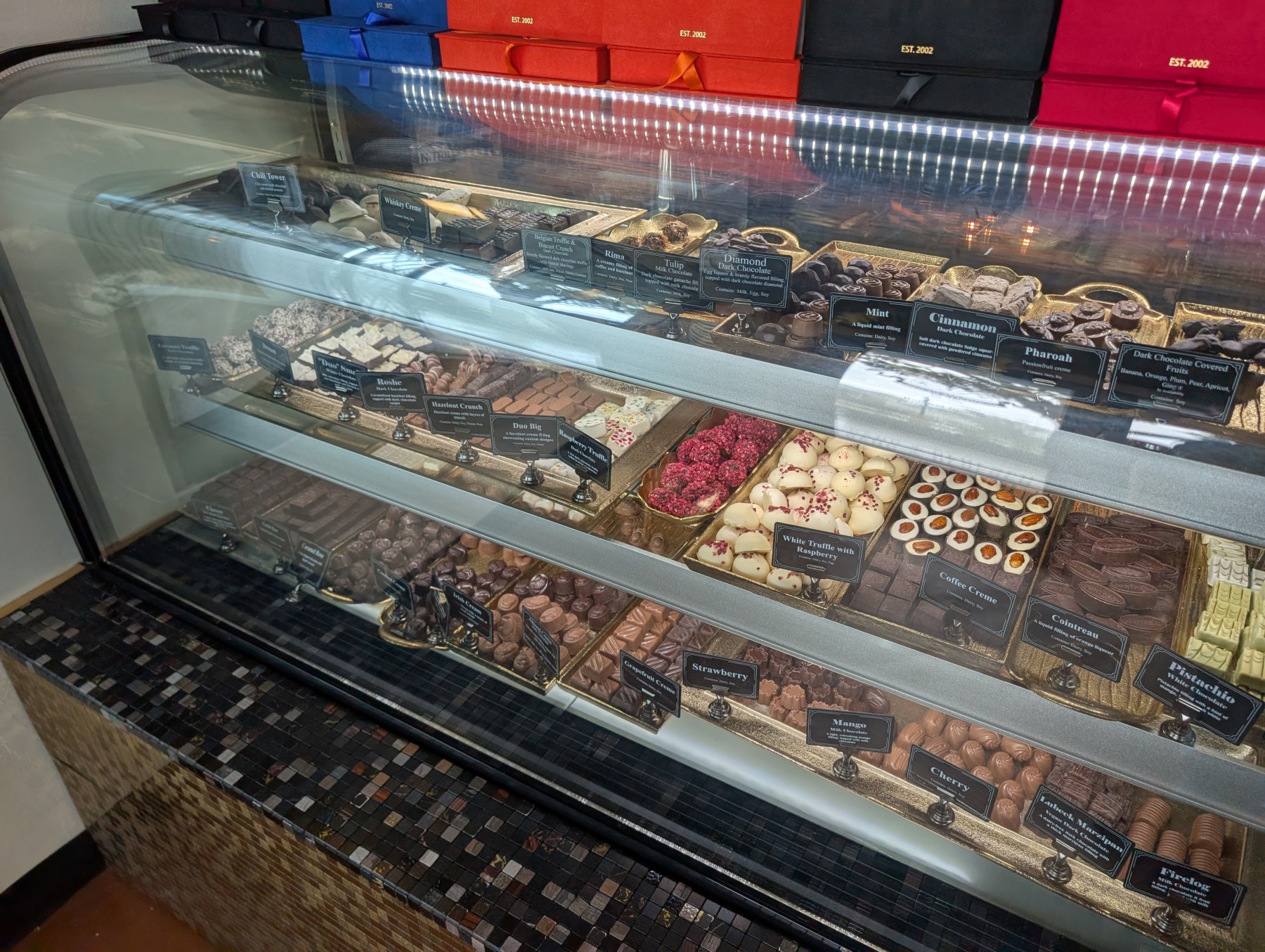
Finally, and most importantly, the display cases are packed with chocolates seldom seen in the States. AJ Chocolate House advertises “over 150 different amazing chocolate delicacies made in Europe.” I don’t know if there were 150 different available when we visited, but there were more than enough to satisfy any chocolate lover.
Click to enlarge any of the images below.
Our Order
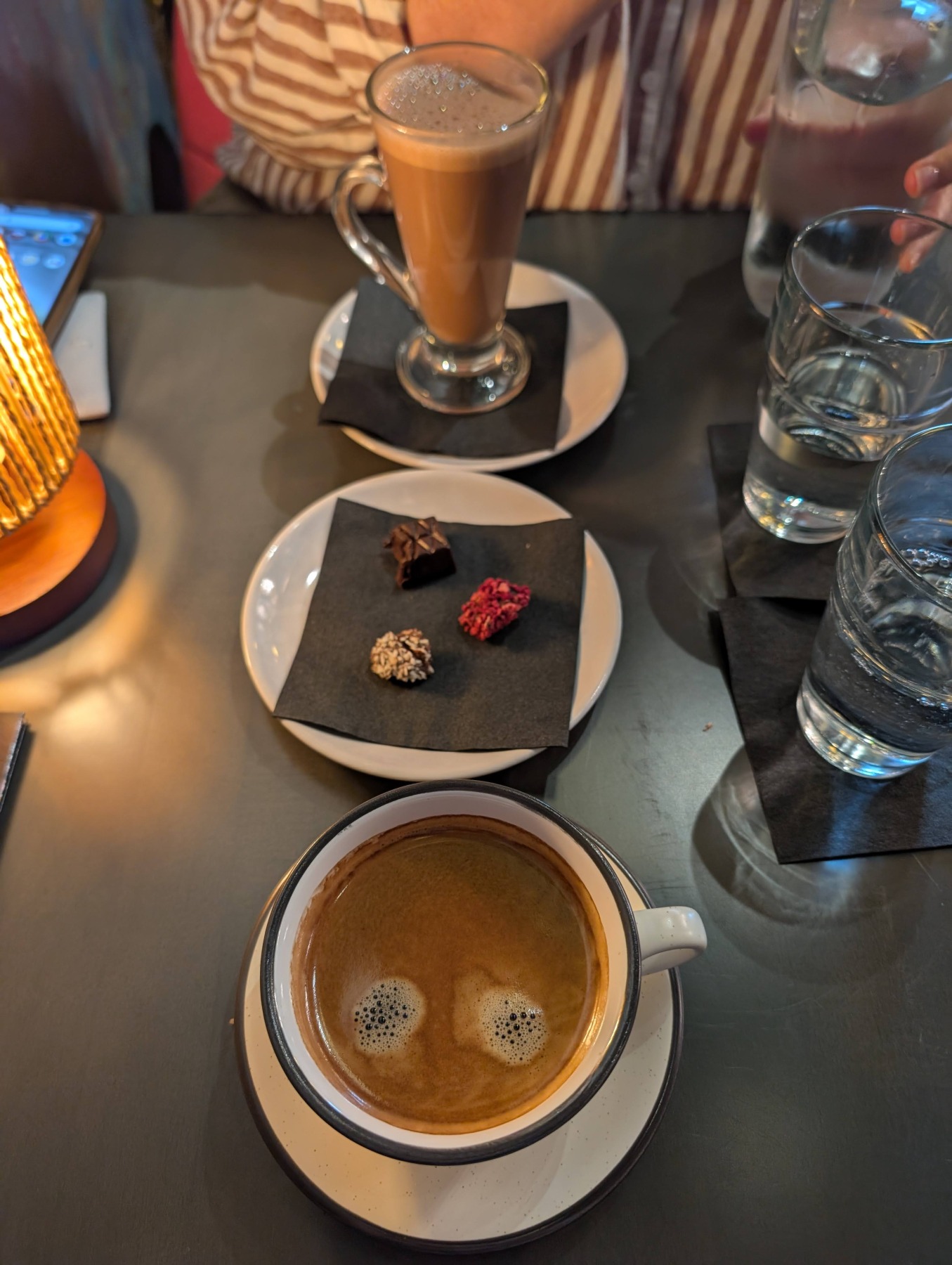
We kept our order very simple as first time visitors, saving a lot to return for. Our candies consisted of raspberry truffles and coconut truffles. They were delicious. For drinks we had a hot chocolate and an Americano. These were brought to our table quickly with a carafe of cold water, which is a nice European touch. Everything exceeded expectations and we will be returning soon to try a wider variety.
There were so many options it was difficult to select and not order one of everything. Whether you like chocolate covered fruit (think mango, cherry, and more, or prefer nuts such as pistachio or hazelnut, there is something for you. Do you like your chocolates a bit more exotic? Give the chili tower or cinnamon a try.
Now let me tell you about the cake case. That chocolate majesty is calling my name. Chocolate cake with thick layers of chocolate ganache. What’s not to love there? Looking for cheesecake, well they have it. Give the caramel cake some consideration. Chocolate cake with a citrus infused caramel will no doubt satisfy.
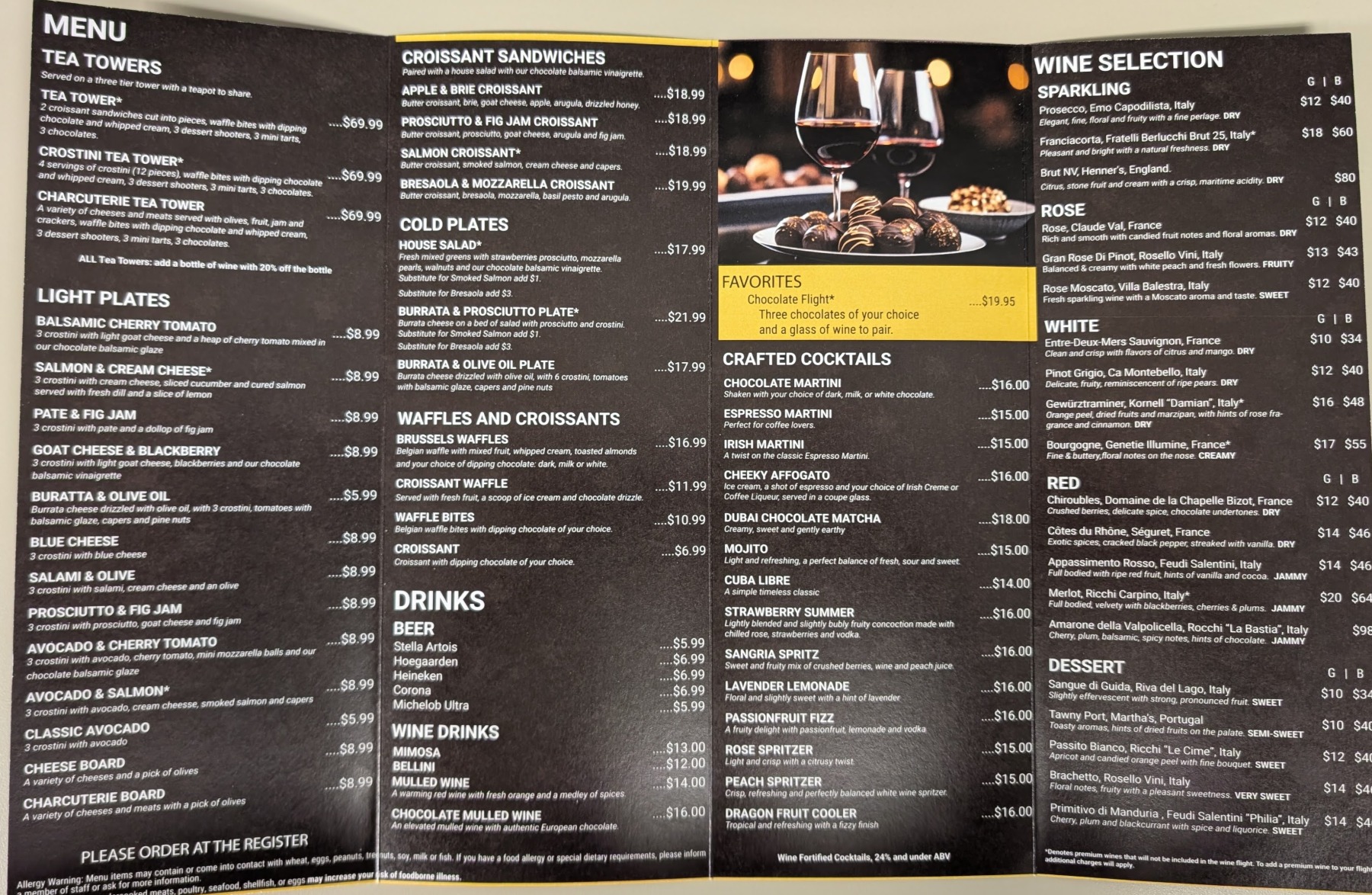
If you are seeking out something a bit more substantial, be sure to review the “light plates” and croissant sandwich offerings. For me personally, it’s a bit heavy on the goat cheese offerings, but I know a lot of folks like that.
There is a limited beer menu, wines, and a small cocktails menu. I think most anyone looking for a drink can find something they will enjoy.
A review of the menu shows that AJ Chocolate House is a perfect meet up spot for couples or maybe a first date. Are you meeting up with a friend you haven’t seen in awhile. This would be an excellent location to catch up on life. Maybe enjoy one of the “towers” and a coffee with friends.
Prices
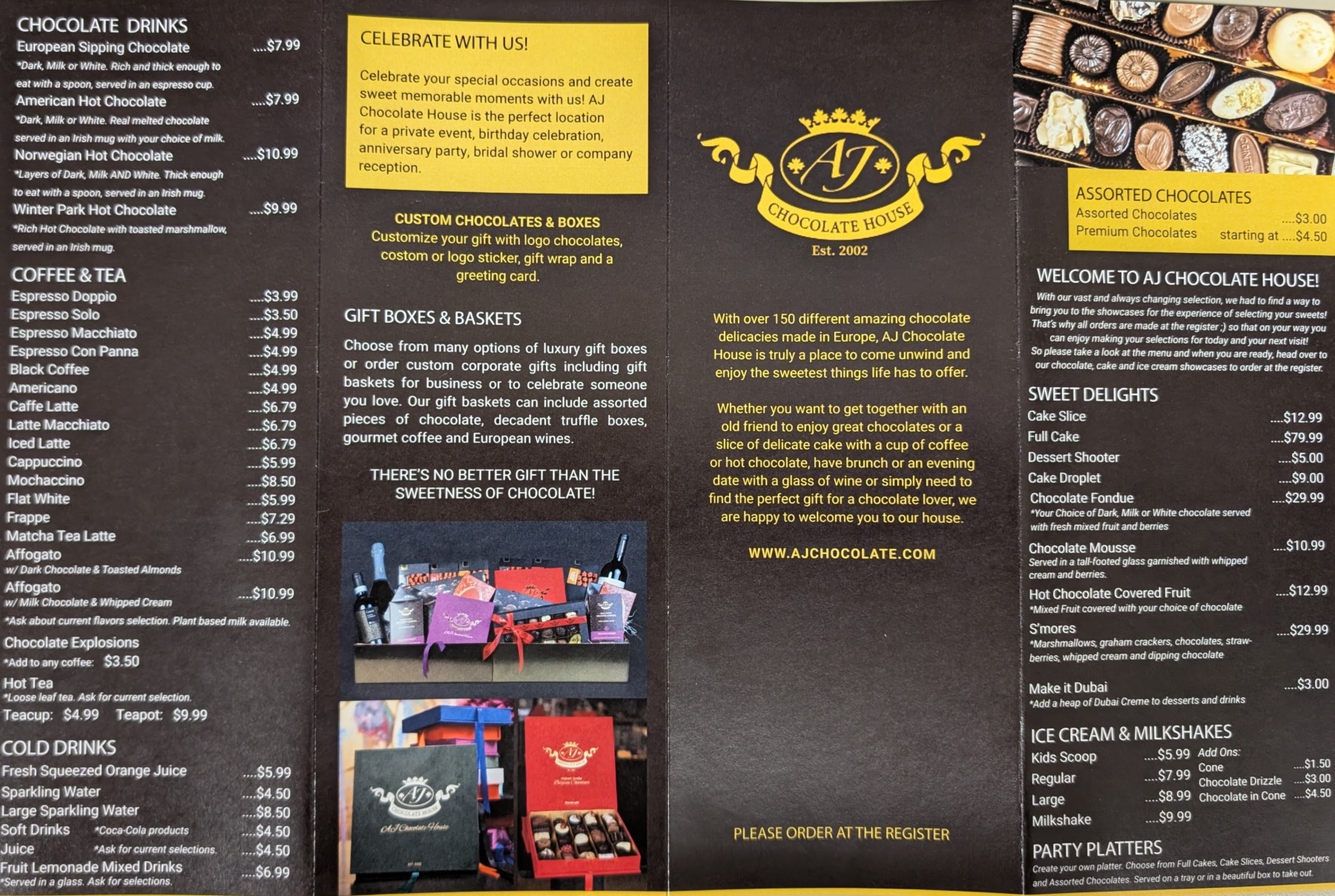
As for price, look, you don’t go into somewhere like this looking for bargain pricing. It’s not cheap. Chocolates start at $3 and can go higher. A cake slice is going to set you back $12.99, though there are some smaller, less expensive options. When you see the cake though, you’ll understand the price. Trust me. The various ice cream options, which sound and look amazing, are all under $10. The “light plate” options are less than $10, which is a great price. The croissant sandwiches are around $20, which is certainly not out of line compared to other meal options.
I found the drink prices to be all reasonable. If you’re looking for a plain coffee, most options are $5 or less with lattes, cappuccinos, etc. all being less than $10. If you drink specialty coffee, you know these are good prices. Are you a tea drinker? A pot of hot tea is only $10. Ask about their selections. Hot chocolates, which are all handmade with real chocolates, are $10 and under. Cocktails looked to all be under $20 while wine by the glass was generally under $15 with bottles around $40 and up.
Menu images are below. Please click to make them larger.
Final Thoughts
I left AJ Chocolate House highly impressed. The service was great and the food/drinks even better. I probably wouldn’t go there for a meal. It’s just not my preferred type of food. However, for desserts or coffee? Sign me up.
Current hours posted on their Facebook page are
Sunday through Wednesday 8am until 9pm
Thursday through Saturday 8am until 11pm
These are long hours and I am not sure New Smyrna Beach is able to support such. During the many Canal Street events, this place should be hopping. For most evenings however, Canal Street is rolled up much earlier than the posted hours. Perhaps they will prove me wrong, but I suggest checking hours before heading there after dark.
Highly recommended!
Click the image above to support this site through Buy Me A Coffee. Your help pays for website fees and maintenance, research fees for blog and book writing, photo usage and rights fees, and other associated costs. It might go to buying a bag of coffee, keeping me focused on the research topic at hand.
Click the image above to save this pin to your favorite Pinterest board to share with your friends and so you never lose it.
This post may contain affiliate links. If you click these links and make a purchase, I may receive a small commission. This commission does not affect any price that you pay. Affiliate programs or sponsors providing products do not influence my views and opinions.
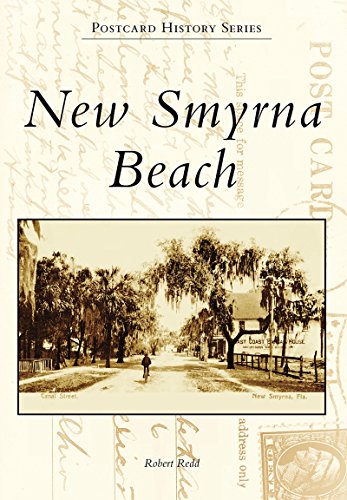
New Smyrna Beach Postcard History published by Arcadia Publishing. Order directly from the publisher and use my discount code REDD24 to save 15% on your entire order, not just my titles. Orders over $50 receive free shipping.
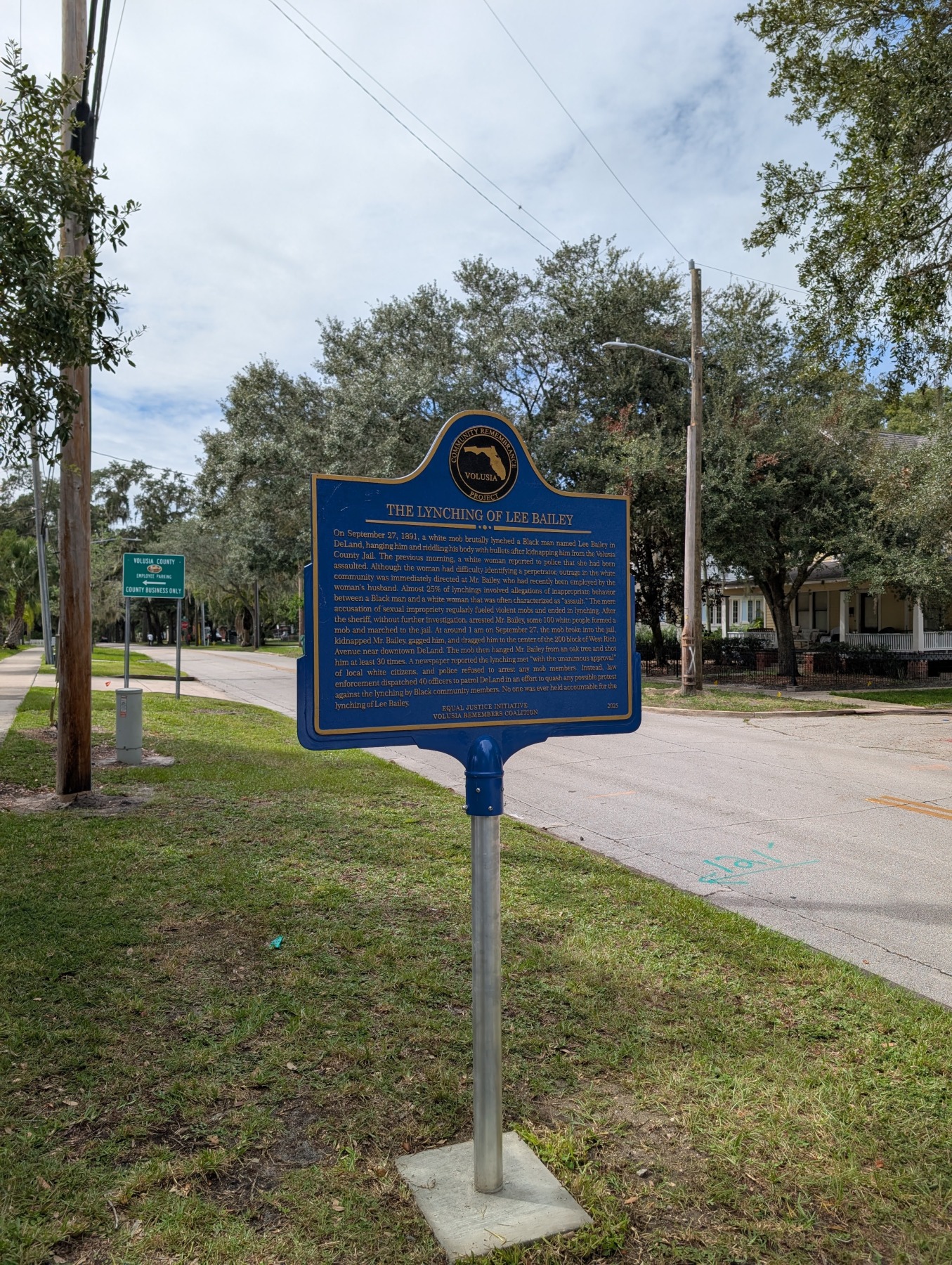
In 1891, Lee Bailey was the victim of a lynching in DeLand, FL. His story is now remembered with a historic marker in DeLand, Florida. The marker is located in the 200 block of west Rich Avenue, near the county owned parking lot. An easy way to find this marker, is to find Tom’s Auto Repair. The marker is across the street.
Bailey is one of five identified lynchings in Volusia County. More than 350 lynchings occurred in Florida between the end of the Civil War and 1950.
The marker was placed with the approval of the City of DeLand by the Volusia Remembers Coalition and the Equal Justice Initiative. A public unveiling of the marker was held on Saturday, September 27. The goal of the marker and Volusia Remembers Coalition is to honor, educate, and reconcile.
Buy it by the bag or subscribe and get delicious Intelligentsia Coffee delivered right to your door regularly. You choose: whole bean, ground, single origin, blends, espresso, light, medium, or dark roast. All freshly roasted and shipped straight to you. Click the image above to place your first order and you’ll be drinking Intelligentsia Coffee in no time.
The Marker Side One
The Lynching of Lee Bailey
On September 27, 1891, a White mob brutally lynched a Black man named Lee Bailey, in DeLand, hanging him and riddling his body with bullets after kidnapping him from the Volusia County Jail. The previous morning, a White woman reported to police that she had been assaulted. Although the woman had difficulty identifying a perpetrator, outrage in the White community was immediately directed at Mr. Bailey, who had recently been employed by the woman’s husband. Almost 25% of lynchings involved allegations of inappropriate behavior between a Black man and a White woman that was often characterized as “assault.” The mere accusation of sexual impropriety regularly fueled violent mobs and ended in lynching. After the sheriff, without further investigation, arrested Mr. Bailey, some 100 White people formed a mob and marched to the jail. At around 1 a.m. on September 27, the mob broke into the jail, kidnapped Mr. Bailey, gagged him, and dragged him to the center of the 200 block of West Rich Avenue near downtown DeLand. The mob then hanged Mr. Bailey from an oak tree and then shot him at least 30 times. A newspaper reported the lynching “met with the unanimous approval” of local White citizens and police refused to arrest any mob members. Instead, law enforcement dispatched 40 officers to patrol DeLand in an effort to quash any possible protest against the lynching by Black community members. No one was ever held accountable for the lynching of Lee Bailey.
2025
Equal Justice Initiative Volusia Remembers Coalition
The Marker Side Two
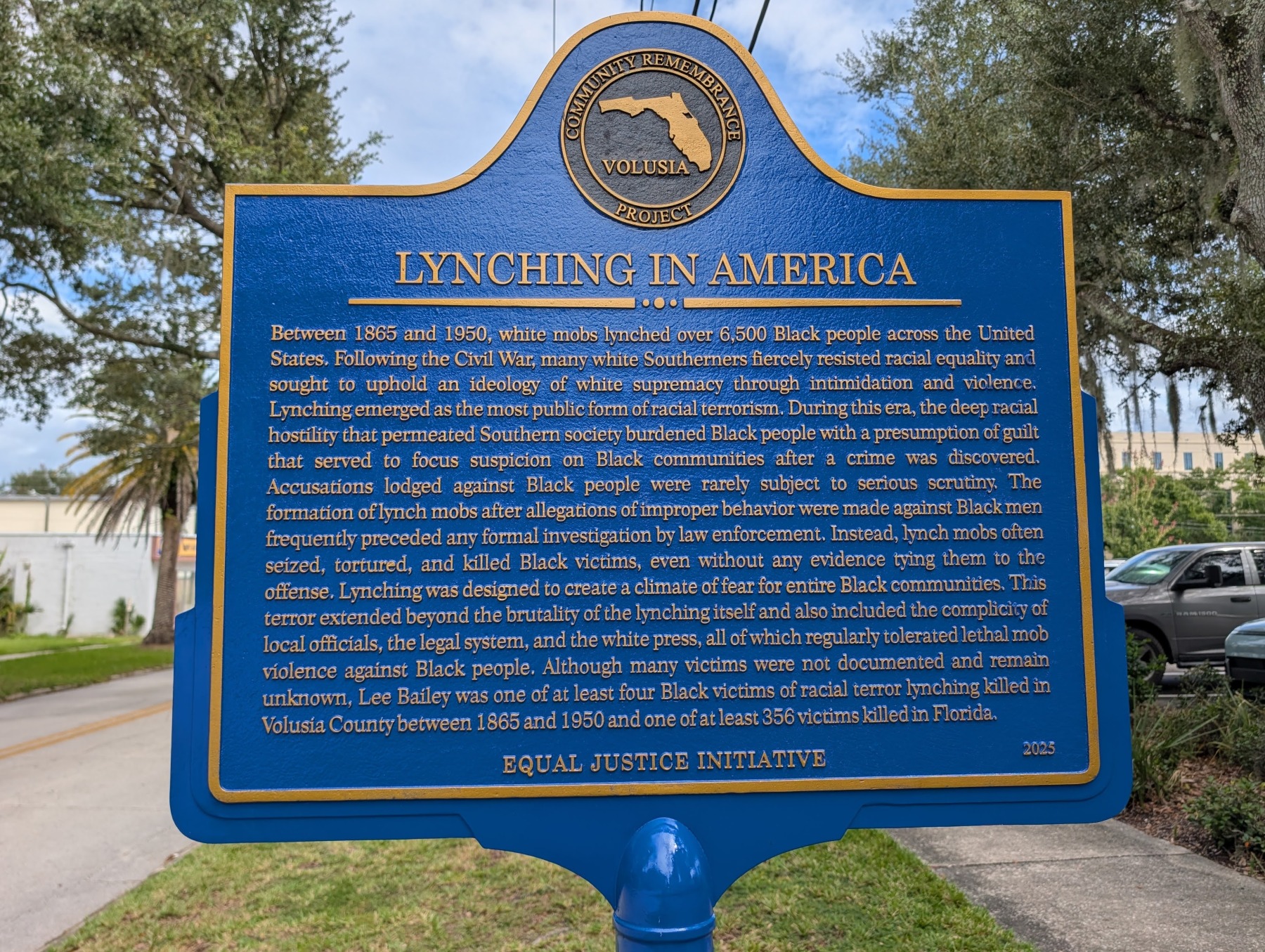
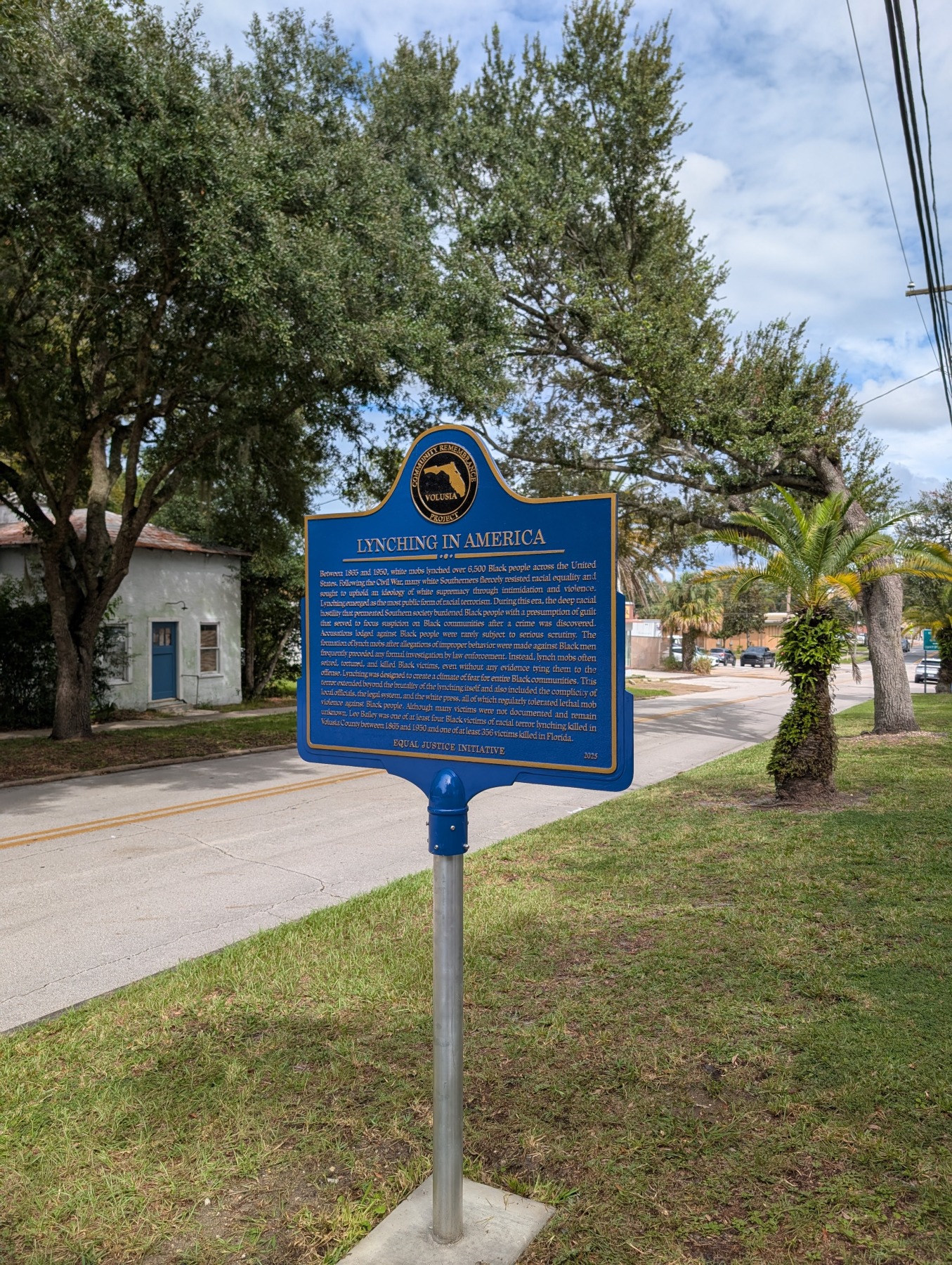
Lynching in America
Between 1865 and 1950, White mobs lynched over 6,500 Black people across the United States. Following the Civil War, many White Southerners fiercely resisted racial equality and sought to uphold an ideology of White supremacy through intimidation and violence. Lynching emerged as the most public form of racial terrorism. During this era, the deep racial hostility that permeated Southern society burdened Black people with a presumption of guilt that served to focus suspicion on Black communities after a crime was discovered. Accusations against Black people were rarely subject to serious scrutiny. The formation of lynch mobs after allegations of improper behavior were made against Black men frequently preceded any formal investigation by law enforcement. Instead, lynch mobs often seized, tortured, and killed Black victims, even without any evidence tying them to the offense. Lynching was designed to create a climate of fear for entire Black communities. This terror extended beyond the brutality of the lynching itself and also included the complicity of local officials, the legal system, and the White press, all of which regularly tolerated lethal mob violence against Black people. Although many victims were not documented and remain unknown, Lee Bailey was one of at least four Black victims of racial terror lynching killed in Volusia County between 1865 and 1950 and one of at least 356 victims killed in Florida.
2025
Equal Justice Initiative
Brief Analysis
As often occurs, I have a couple of minor quips with this Marker. The first being a grammatical correction I have made in my text. We either capitalize or use lower case for skin color. This choice should be used consistently. I capitalize, so I have done that throughout my transcription of the marker text. My second comment is that I find the text a bit long on both sides of the marker. Both sides seemed to lose a little bit of focus.
NOW, that being said, this is a vitally important marker. Lynchings were (and still are to read about them) terrible events that never should have occurred in a civilized society. We need to not forget these monstrous events happened. The Volusia Remembers Coalition and Equal Justice Initiative deserve credit for researching this story and bringing it to the attention of the world.
Volusia County has been known to have a poor record of race relations. To learn more, I invite you to read my blog post about Roy L. Cook.
Click the image above to support this site through Buy Me A Coffee. Your help pays for website fees and maintenance, research fees for blog and book writing, photo usage and rights fees, and other associated costs. It might go to buying a bag of coffee, keeping me focused on the research topic at hand.
This post may contain affiliate links. If you click these links and make a purchase, I may receive a small commission. This commission does not affect any price that you pay. Affiliate programs or sponsors providing products do not influence my views and opinions.
Since its founding, lynching has permeated American social, political, and cultural life, and no other book documents American lynching with historical texts offering firsthand accounts of lynchings, explanations, excuses, and criticism. CLICK HERE or the image to learn more and purchase your own copy.